District in Tilburg
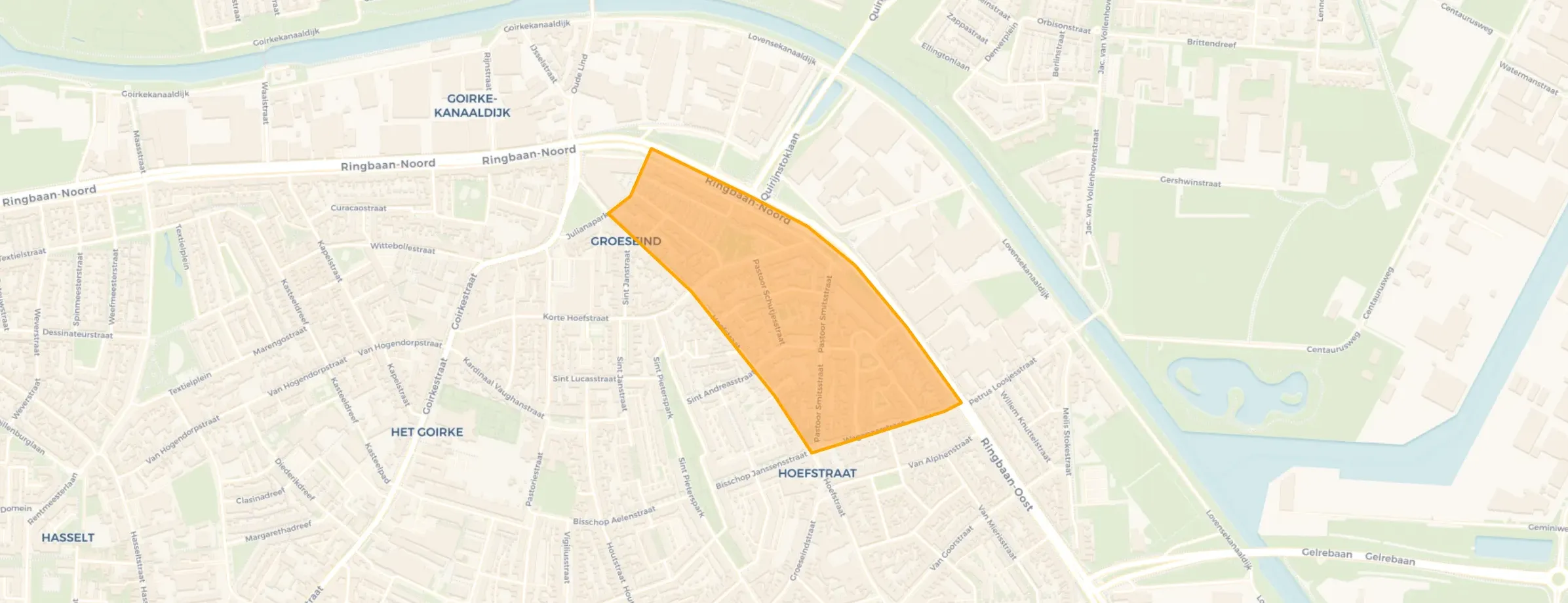
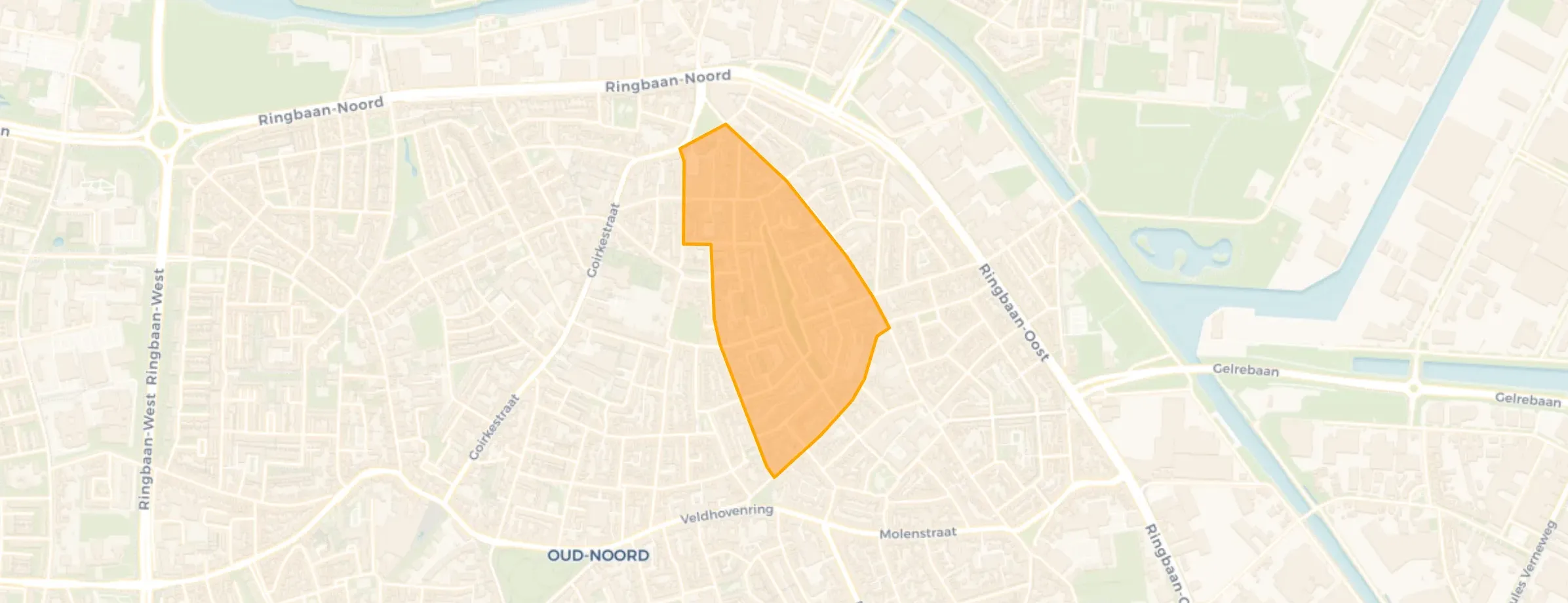
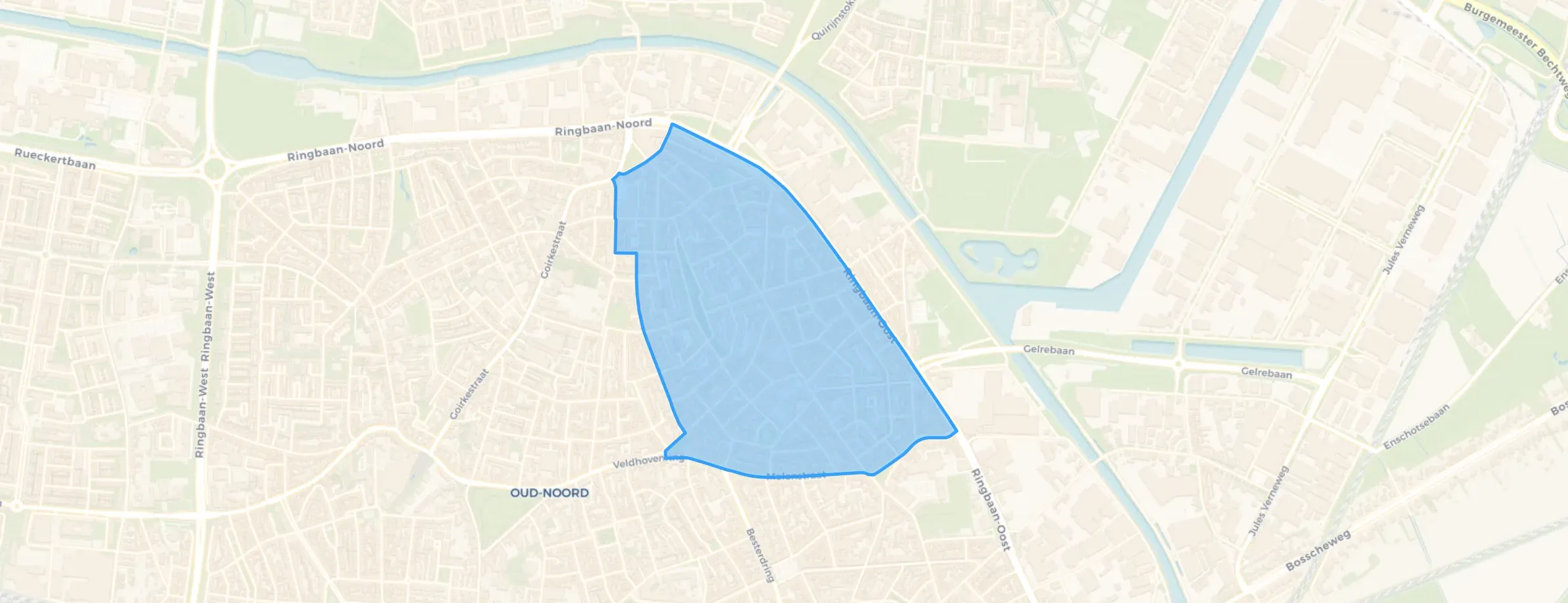
Groeseind-Hoefstraat is located in the province of Noord-Brabant, in the municipality of Tilburg The district has a total area of 64 hectares, of which 64 hectares are land and 0 hectares are water. The district is coded as WK085525. The postcode area is 5014ES-5046XB.
Groeseind-Hoefstraat has 7.160 residents. Of these, 51,2% are men and 48,8% are women. Most residents are 25 to 45 years (36,2%). The other age groups are 21,6% for '45 to 65 years', 15,6% for '15 to 25 years', 13,5% for '65 years or older' and 13,1% for '0 to 15 years'. Of the residents, 62,2% is unmarried, 26,0% is married, 7,8% is divorced and 4,1% is widowed. 4.675 residents originate from the Netherlands, 1.115 come from Europe and 1.375 come from countries outside Europe.
There are 3.855 households in Groeseind-Hoefstraat. 51,8% of these are single-person households, 24,4% households without children and 23,9% households with children. The average household size is 1,8 persons.
In Groeseind-Hoefstraat there are 5.800 income recipients. The average income per income recipient is €31.900, which is €3.900 (11%) lower than the national average of €35.800. Per resident, the average income is €27.100, which is €2.100 (7%) lower than the national average of €29.200. Most residents of Groeseind-Hoefstraat are educated to an intermediate level. 38,6% have an intermediate education (HAVO, VWO or MBO 2-4), 37,0% have a university or higher professional education (HBO/WO) and 24,3% have a lower education (VMBO or MBO 1).
Of the 7.160 residents, around 69% are in paid employment, which amounts to 4.940 people. This is 4% higher than the national average of 65%. The majority of workers are in salaried employment (89%), while 11% are self-employed. In Groeseind-Hoefstraat, 19% of residents receive a benefit. The largest group is those receiving a state pension (AOW). 850 people receive this benefit.
In Groeseind-Hoefstraat there are 3.383 homes with an average assessed value (WOZ) of €271.000. Of these, around 96% are occupied and 4% unoccupied. In Groeseind-Hoefstraat there are roughly as many rental as owner-occupied homes. This amounts to 48% rental homes and 52% owner-occupied homes. Of the homes, 52% privately owned, 26% owned by housing associations and 22% owned by other landlords. The most common construction periods in Groeseind-Hoefstraat are 1925-1950 (25%) and 2010-2020 (18%).
There are currently no homes for sale in Groeseind-Hoefstraat. The most recently listed home is Kardinaal van Enckevoirtstraat 15 by Kin Makelaars. No homes were sold in Groeseind-Hoefstraat over the past year.
There are currently no homes for rent in Groeseind-Hoefstraat. The most recent home is Veldhovenring 37-08, offered by vb&t Verhuurmakelaars. No homes were let in Groeseind-Hoefstraat over the past year.
No recent rental data available for Groeseind-Hoefstraat.
In Groeseind-Hoefstraat there are 3.348 addresses with a registered energy label. The most common labels are A (34%), F (17%) and C (13%). On average, an address in Groeseind-Hoefstraat uses 2.480 kWh of electricity per year. This is 12% below the national average of 2.810 kWh. With an annual consumption of 940 m³ per address, natural gas consumption is 27% below the national average of 1.280 m³.
.
Auto-translated to English by AIMy neighbourhood is a place where people help and respect each other, where we sometimes go for coffee at each other's homes and help one another. We look after each other and if something is wrong, we always try to help.
Auto-translated to English by AIA nice, quiet neighbourhood where you can live well, but the traffic safety is poor. Traffic regularly drives in the wrong direction and often drives too fast. The measures in place are insufficient to ensure safety for children playing. Furthermore, weeds are not removed enough (this is also the responsibility of residents), but the municipality could do more about this.
Auto-translated to English by AII've been living in my neighbourhood for a year now, it's always cosy and we have a weekly market. Unfortunately, I occasionally have trouble with the vagrants hanging around here doing drugs.
Auto-translated to English by AI
The housing stock is predominantly pre-war — 52% of the homes date from before 1945. In addition, the most common type is terraced houses (51%).
Over the past year a home for sale in Groeseind-Hoefstraat was listed for an average of €340,118 (€3,976 per m²). Last quarter prices fell by 6%.
A rental home in Groeseind-Hoefstraat cost an average of €1,128 per month (€13 per m²).
Residents give Groeseind-Hoefstraat a 7.6 out of 10 based on 4 reviews. Housing stands out with a 8.3; cleanliness lags behind with a 6.0.
Wijk Groeseind-Hoefstraat has 7,160 residents. The largest age group is 25 to 45 years (36%). Notably, 52% of the households are single-person households.
A considerable share of the supply in Groeseind-Hoefstraat is less efficient: 31% has an E, F or G label. The average natural gas consumption per household is 940 m³ per year.
From Groeseind-Hoefstraat you can on average reach a supermarket at 0.5 km, a GP at 0.4 km, a railway station at 2.4 km, a primary school at 0.4 km (as the crow flies, source: CBS).
Right now you will find 53 homes for sale and 22 homes for rent in Groeseind-Hoefstraat.

Buurtje.nl uses cookies to make the site work and to improve it. In doing so, we process data such as your IP address and the pages you visit.
We use this data for three purposes: running the website (functional), measuring visits so we can improve Buurtje.nl (analytics), and — if you allow it — tailoring ads to your interests (marketing).
How we handle your data is described in our privacy policy. You can change your preferences at any time via 'Cookie preferences' at the bottom of every page.
Choose per category which cookies we may place. Read more in our privacy policy.