District in Aalsmeer
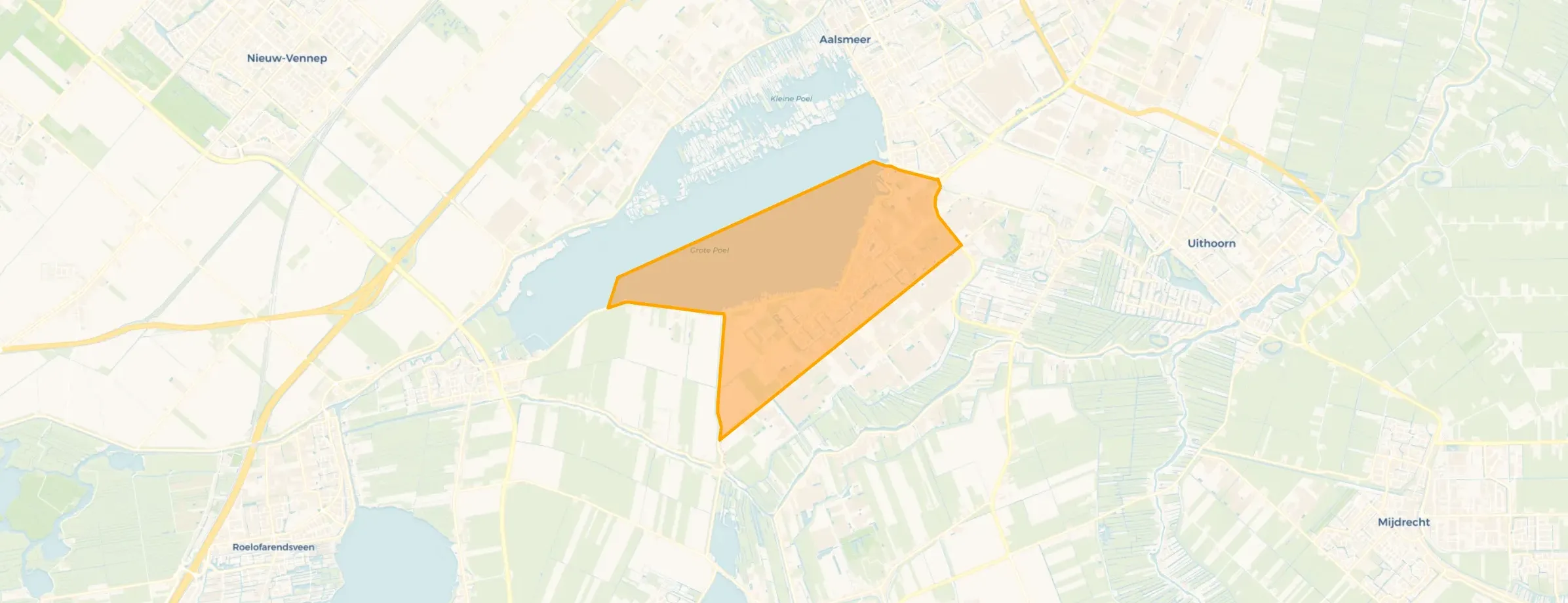
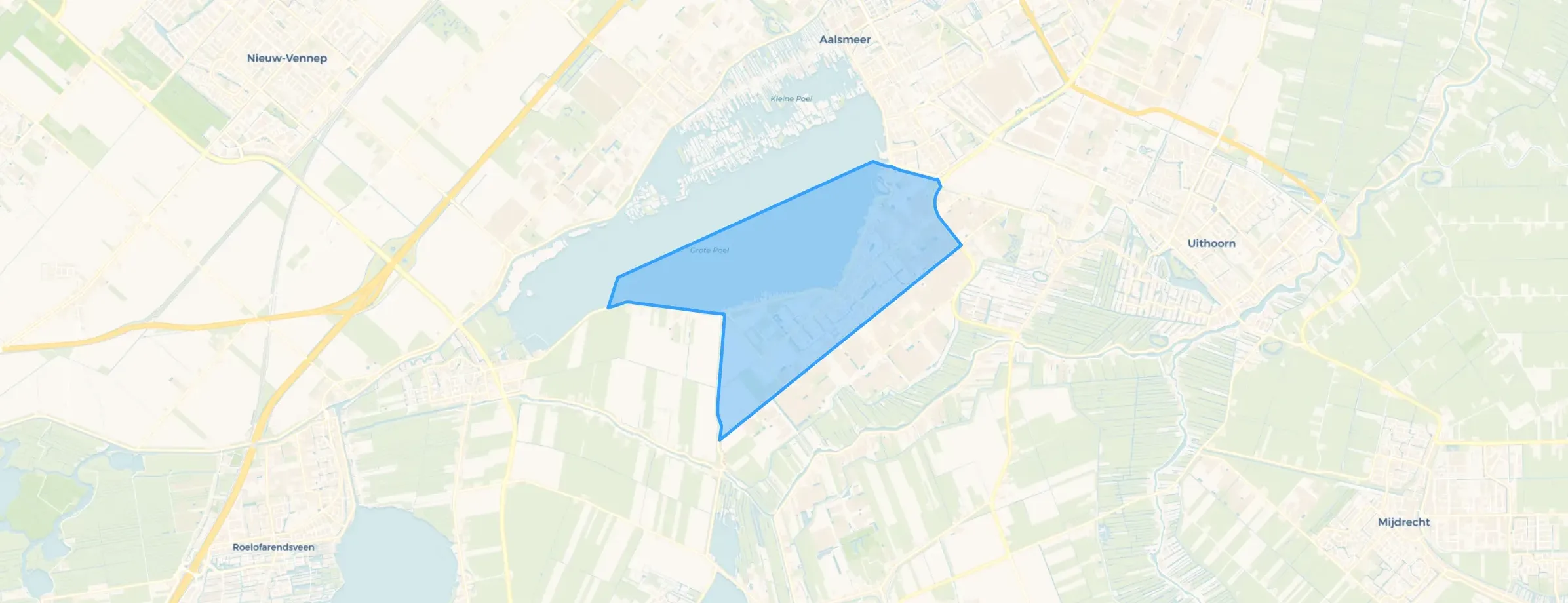
Kudelstraat en Kalslagen is located in the province of Noord-Holland, in the municipality of Aalsmeer The district has a total area of 826 hectares, of which 435 hectares are land and 392 hectares are water. The district is coded as WK035801. The postcode area is 1433AA-1433WP.
Kudelstraat en Kalslagen has 9.255 residents. Of these, 50,5% are men and 49,6% are women. Most residents are 45 to 65 years (28,5%). The other age groups are 23,7% for '25 to 45 years', 18,3% for '65 years or older', 17,5% for '0 to 15 years' and 12,1% for '15 to 25 years'. Of the residents, 48,0% is unmarried, 42,2% is married, 6,3% is divorced and 3,6% is widowed. 7.140 residents originate from the Netherlands, 765 come from Europe and 1.350 come from countries outside Europe.
There are 3.825 households in Kudelstraat en Kalslagen. 27,7% of these are single-person households, 29,8% households without children and 42,5% households with children. The average household size is 2,4 persons.
In Kudelstraat en Kalslagen there are 7.500 income recipients. The average income per income recipient is €40.600, which is €4.800 (13%) higher than the national average of €35.800. Per resident, the average income is €32.900, which is €3.700 (13%) higher than the national average of €29.200. Most residents of Kudelstraat en Kalslagen are educated to an intermediate level. 43,3% have an intermediate education (HAVO, VWO or MBO 2-4), 30,8% have a university or higher professional education (HBO/WO) and 25,9% have a lower education (VMBO or MBO 1).
Of the 9.255 residents, around 71% are in paid employment, which amounts to 6.571 people. This is 6% higher than the national average of 65%. The majority of workers are in salaried employment (86%), while 14% are self-employed. In Kudelstraat en Kalslagen, 22% of residents receive a benefit. The largest group is those receiving a state pension (AOW). 1.490 people receive this benefit.
In Kudelstraat en Kalslagen there are 3.818 homes with an average assessed value (WOZ) of €453.000. Of these, around 97% are occupied and 3% unoccupied. Most homes are owner-occupied. This amounts to 34% rental homes and 66% owner-occupied homes. Of the homes, 66% privately owned, 27% owned by housing associations and 7% owned by other landlords. The most common construction periods in Kudelstraat en Kalslagen are 1980-1990 (28%) and 2000-2010 (27%).
There are currently no homes for sale in Kudelstraat en Kalslagen. The most recently listed home is Fonteinkruidhof 36 by www.vva.amsterdam. No homes were sold in Kudelstraat en Kalslagen over the past year.
There are currently no homes for rent in Kudelstraat en Kalslagen. The most recent home is van Swietenstraat 5, offered by PCW Housing op Funda. No homes were let in Kudelstraat en Kalslagen over the past year.
No recent rental data available for Kudelstraat en Kalslagen.
In Kudelstraat en Kalslagen there are 3.929 addresses with a registered energy label. The most common labels are A (39%), C (34%) and B (19%). On average, an address in Kudelstraat en Kalslagen uses 2.850 kWh of electricity per year. This is 1% above the national average of 2.810 kWh. With an annual consumption of 960 m³ per address, natural gas consumption is 25% below the national average of 1.280 m³.
Since the completion of the neighbourhood in 2004, there has been a clear decline and impoverishment. Liveability is structurally under pressure. Assessment: The neighbourhood scores insufficient on the following aspects: Safety, Community spirit, Hygiene, Education / upbringing climate, Green spaces, Facilities, Accessibility. Explanation per aspect: Safety: Parking and driving on pavements and footpaths. Unsafe situations for pedestrians and playing children. Nuisance from hanging groups and fatbike groups, especially in the evenings. Insufficient visible enforcement. Community: High turnover in apartments, little connection to the neighbourhood. Hardly any social cohesion or mutual accountability culture. Little involvement in the living environment. Hygiene: Structural dog poop on grass fields; the clean-up duty is not observed. Lots of litter, including sweet and crisp wrappers, also in private gardens. Insufficient cleaning and maintenance by the municipality. Education / upbringing climate: Children play outside without supervision. Norms and values regarding waste, respect for others' property and public space are visibly lacking. Negative role model for younger children. Green: Poorly maintained green spaces. Grass fields polluted and therefore not usable for recreation. Unattractive and unkempt street scene. Facilities: Insufficient parking facilities, partly due to company vans. No clear facilities to combat nuisance (such as extra bins or supervised play areas). Accessibility: Pavements and footpaths often blocked by parked vehicles. Poor accessibility for the elderly, prams and people with disabilities. What could be improved: Active and visible enforcement of parking, dog poop and nuisance. Tackling long-term parked company vans. Improvement of municipal maintenance of green and public space. Placement of extra bins and targeted cleaning actions. Structural deployment of neighbourhood police and enforcement officers, especially in the evenings. Measures to strengthen social cohesion and encourage residents to take more responsibility. Clear communication about norms, rules and consequences.
Auto-translated to English by AINice house Lots of green Shopping centre nearby Public transport accessibility could be better Not safe due to nuisance from youths, who learn their behaviour from their parents. Disrespectful, selfish. No sense of community. Hygiene: shit everywhere on the grass field is not cleaned up, youths just throw packaging into gardens.
Auto-translated to English by AIThe neighbourhood started off quite well. New houses, new residents. However, after a number of residents moved away and were replaced by the next residents, it has deteriorated a lot. Besides a huge increase in nuisance from night flights from Schiphol, the mutual social behaviour has dropped to zero. It is a neighbourhood with many children who find the antisocial behaviour of their parents so normal that they don't know any better and copy their parents' behaviour. In recent years, there has been a lot of nuisance and vandalism by whole groups of terrorising children. These children are getting older and are now starting to show different behaviour or moving away. Addressing people and talking about it is not accepted. And bullying is a daily occurrence, especially if you keep your distance from these people. Because you already know that talking and addressing them backfires. Because if you don't join in or show the same antisocial behaviour, you are treated like a pariah. In Kudelstaart there is supervision by a neighbourhood police officer, and after the shooting you see more police and enforcement. However, if you contact the neighbourhood officer or ask the police for help, you can forget about it. We have plenty of beautiful nature and greenery in and around the neighbourhood. Education could be better. There is childcare, primary school education (the level is not great) and there is a VMBO (which also has a not-so-good reputation). However, for children who go to havo or vwo, you have to look further. Accessibility by public transport is very poor. There is a bus station in Aalsmeer that the bus from Kudelstaart goes to. However, the bus does not connect at all with the other buses. It would be nice if at least one bus every quarter or half hour went directly to the nearest train station (e.g. Hoofddorp) without having to transfer. Maybe the tram from Uithoorn could be extended to Kudelstaart. Facilities are sufficient but could also be better.
Auto-translated to English by AIReasonably neat neighbourhood. Unfortunately, there is nuisance from screaming neighbours, drunk neighbours, antisocial behaviour towards neighbours who distance themselves from it. So if you don't belong or don't want to belong, you'd better brace yourself. Little empathy and understanding. A lot of nuisance from vandalism of cars and personal belongings. In addition, there are regularly groups of young people who terrorise the neighbourhood by "ring and run", and if you don't respond, they then bang on the windows. Furthermore, windows are smeared with eggs and yoghurt. The neighbourhood police officer is very hard to find, the police do nothing, confronting the neighbours backfires.
Auto-translated to English by AII personally never really felt unsafe in the neighbourhood. I think it's a nice neighbourhood to live in with hardly any problems. A small, pleasant village, but public transport is a bit lacking. There is only one bus that runs every half hour, and the direct connection to Amsterdam-Zuid will be discontinued in the summer of 2024. Other than that, it's an extremely quiet living environment.
Auto-translated to English by AI
The housing stock is relatively young — 72% dates from after 1990. In addition, the most common type is terraced houses (43%).
Over the past year a home for sale in Kudelstraat en Kalslagen was listed for an average of €632,951 (€5,034 per m²). Last quarter prices rose by 16%.
Residents give Kudelstraat en Kalslagen a 4.8 out of 10 based on 5 reviews. The strongest score is for housing (6.8), the weakest for community (2.8).
Wijk Kudelstraat en Kalslagen has 9,255 residents. Many families: 42% of the households have children.
The housing supply in Kudelstraat en Kalslagen is remarkably efficient: 81% has an A, A+ or B label. The average natural gas consumption per household is 960 m³ per year.
From Kudelstraat en Kalslagen you can on average reach a supermarket at 0.9 km, a GP at 0.8 km, a railway station at 10.1 km, a primary school at 0.7 km (as the crow flies, source: CBS).
Right now you will find 42 homes for sale and 1 homes for rent in Kudelstraat en Kalslagen.

Buurtje.nl uses cookies to make the site work and to improve it. In doing so, we process data such as your IP address and the pages you visit.
We use this data for three purposes: running the website (functional), measuring visits so we can improve Buurtje.nl (analytics), and — if you allow it — tailoring ads to your interests (marketing).
How we handle your data is described in our privacy policy. You can change your preferences at any time via 'Cookie preferences' at the bottom of every page.
Choose per category which cookies we may place. Read more in our privacy policy.