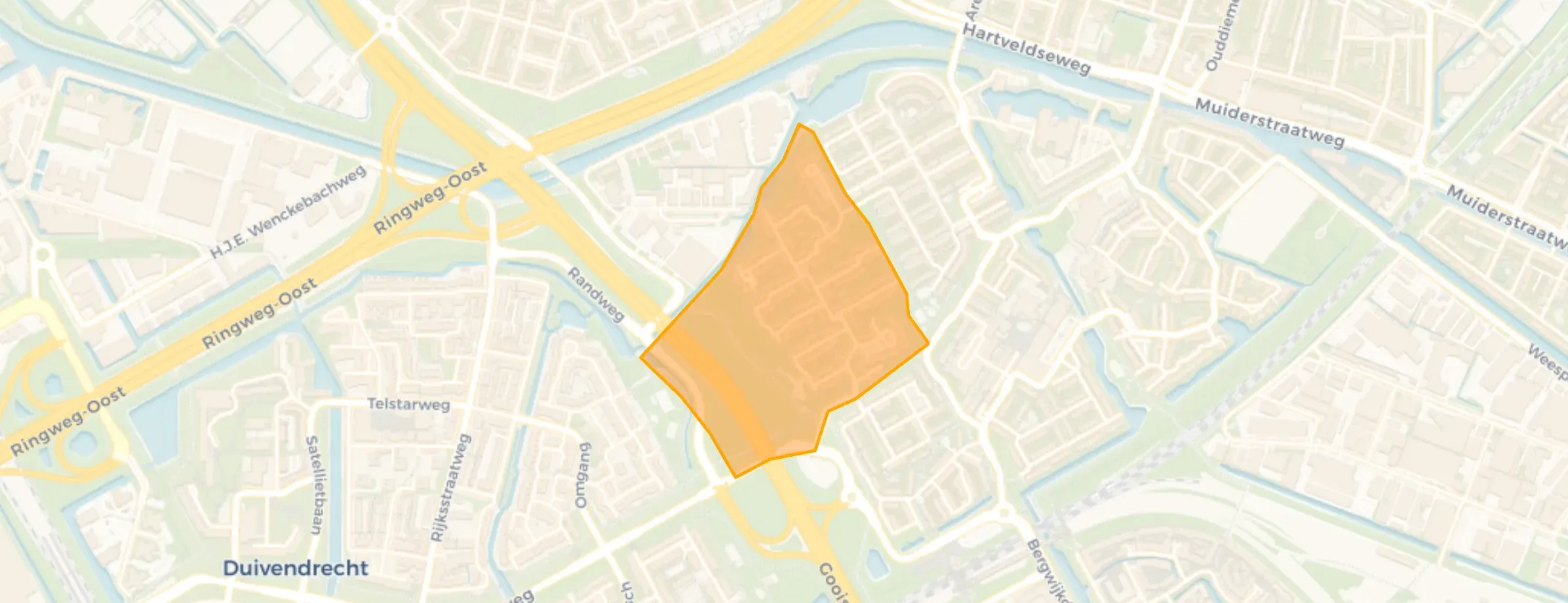
Neighbourhood in Diemen
Akkerland is located in the province of Noord-Holland, in the municipality of Diemen, in the district Diemen Zuid The neighbourhood has a total area of 18 hectares, of which 18 hectares are land and 0 hectares are water. The neighbourhood is coded as BU03840301. The postcode area is 1112HA-1112JV.
Two residents rate the neighbourhood as very good with a score of 8.3. They describe it as 'More homes' and 'Diemen'. Based on a limited number of reviews, no clear trends are visible yet in this neighbourhood.
Akkerland has 1.165 residents. Of these, 49,4% are men and 51,1% are women. Most residents are 45 to 65 years (26,2%). The other age groups are 25,8% for '25 to 45 years', 18,5% for '65 years or older', 15,9% for '0 to 15 years' and 14,2% for '15 to 25 years'. Of the residents, 51,5% is unmarried, 38,6% is married, 6,4% is divorced and 4,3% is widowed. 660 residents originate from the Netherlands, 180 come from Europe and 335 come from countries outside Europe.
There are 525 households in Akkerland. 35,2% of these are single-person households, 26,7% households without children and 38,1% households with children. The average household size is 2,2 persons.
In Akkerland there are 1.000 income recipients. The average income per income recipient is €39.600, which is €3.800 (11%) higher than the national average of €35.800. Per resident, the average income is €32.000, which is €2.800 (10%) higher than the national average of €29.200. Most residents of Akkerland are highly educated. 46,2% have a university or higher professional education (HBO/WO), 36,3% have an intermediate education (HAVO, VWO or MBO 2-4) and 17,6% have a lower education (VMBO or MBO 1).
Of the 1.165 residents, around 69% are in paid employment, which amounts to 804 people. This is 4% higher than the national average of 65%. The majority of workers are in salaried employment (82%), while 18% are self-employed. In Akkerland, 20% of residents receive a benefit. The largest group is those receiving a state pension (AOW). 190 people receive this benefit.
In Akkerland there are 486 homes with an average assessed value (WOZ) of €476.000. Of these, around 99% are occupied and 1% unoccupied. Most homes are owner-occupied. This amounts to 33% rental homes and 67% owner-occupied homes. Of the homes, 67% privately owned and 33% owned by other landlords. The most common construction periods in Akkerland are 1970-1980 (98%) and 1980-1990 (1%).
There are currently no homes for sale in Akkerland. The most recently listed home is Roggekamp 83 by Van der Helm Makelaardij. No homes were sold in Akkerland over the past year.
There are currently no homes for rent in Akkerland. The most recent home is Tarwekamp 178, offered by NEWCURB Makelaars op Pararius. No homes were let in Akkerland over the past year.
No recent rental data available for Akkerland.
In Akkerland there are 486 addresses with a registered energy label. The most common labels are C (64%), B (29%) and D (6%). On average, an address in Akkerland uses 2.410 kWh of electricity per year. This is 14% below the national average of 2.810 kWh. With an annual consumption of 1.060 m³ per address, natural gas consumption is 17% below the national average of 1.280 m³.
1. What could be improved in the municipality of Diemen regarding housing? More social housing: Diemen, like many other municipalities, faces a growing demand for affordable homes. Promoting the construction of social rental housing could be a solution to the increasing housing shortage. Better distribution of housing types: The municipality could develop more diverse housing types, from affordable apartments to family homes, so that there is a suitable home for every target group. Acceleration of construction projects: The construction of homes in Diemen could be accelerated by simplifying permit procedures and addressing delays in ongoing projects. Sustainable and future-proof building: Integrating sustainability into new housing projects can help the municipality meet future environmental standards while improving liveability. 2. What could be improved in the municipal approach to housing in Diemen? More resident involvement: The urban development process could benefit from more input from Diemen residents. Actively involve residents in the planning of new homes and facilities to ensure that development plans meet their needs. Accessibility and connectivity: The municipality could invest in better infrastructure and public transport to ensure that new housing locations are easily accessible to everyone, including those without a car. Housing allocation: There could be more transparency and fairness in the allocation of homes, so that people with urgent housing needs get priority.
Auto-translated to English by AIWell, it's very quiet here, and the street is very safe. You can also easily reach the shopping centre for your daily necessities. It can sometimes get very boring, as people in the neighbourhood don't have much contact with each other.
Auto-translated to English by AIThe housing stock is mainly post-war — 93% was built between 1945 and 1990. In addition, the most common type is terraced houses (51%).
Over the past year a home for sale in Akkerland was listed for an average of €526,271 (€5,308 per m²).
A rental home in Akkerland cost an average of €2,067 per month (€21 per m²).
Buurt Akkerland has 1,165 residents. Many families: 38% of the households have children.
The housing supply in Akkerland is remarkably efficient: 55% has an A, A+ or B label. The average natural gas consumption per household is 1,060 m³ per year.
From Akkerland you can on average reach a supermarket at 1.1 km, a GP at 1.0 km, a railway station at 0.9 km, a primary school at 1.0 km (as the crow flies, source: CBS).