Neighbourhood in Veenendaal
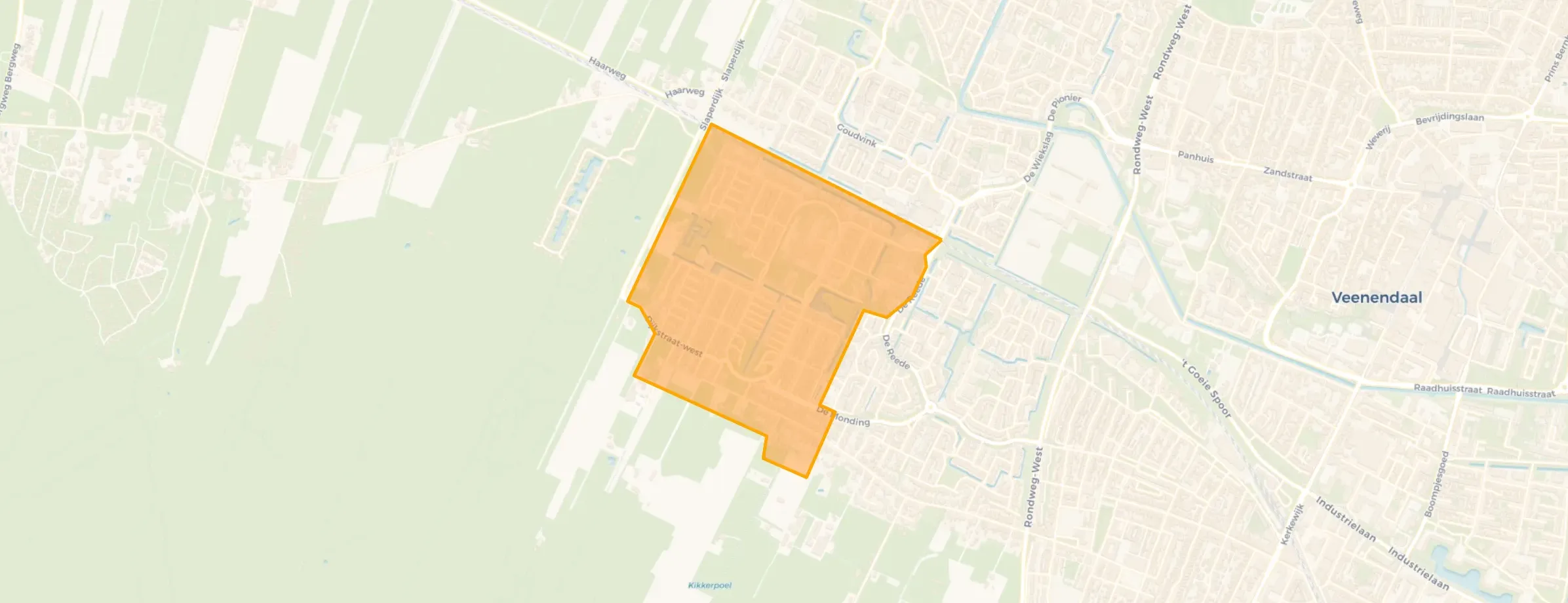
Dichtersbuurt is located in the province of Utrecht, in the municipality of Veenendaal, in the district West The neighbourhood has a total area of 62 hectares, of which 62 hectares are land and 0 hectares are water. The neighbourhood is coded as BU03450554. The postcode area is 3904DC-3906XN.
Four residents rate the neighbourhood as very good with a score of 8.3. They describe it as 'good', 'A quiet neighbourhood with many amenities' and 'very nice neighbourhood, with looking out for each other'. Residents experience big differences in this neighbourhood: accessibility, education, safety receive high ratings, while greenery and amenities are mentioned as weak points.
Dichtersbuurt has 2.615 residents. Of these, 49,1% are men and 51,1% are women. Most residents are 45 to 65 years (29,6%). The other age groups are 29,1% for '65 years or older', 17,4% for '25 to 45 years', 12,8% for '0 to 15 years' and 11,1% for '15 to 25 years'. Of the residents, 36,5% is unmarried, 51,1% is married, 6,5% is divorced and 5,7% is widowed. 2.265 residents originate from the Netherlands, 120 come from Europe and 230 come from countries outside Europe.
There are 1.160 households in Dichtersbuurt. 29,7% of these are single-person households, 39,2% households without children and 31,0% households with children. The average household size is 2,2 persons. The national average is 2,1 persons.
In Dichtersbuurt there are 2.200 income recipients. The average income per income recipient is €38.200, which is €4.000 (9%) lower than the national average of €42.200. Per resident, the average income is €34.800, which is €100 (0%) lower than the national average of €34.900. Most residents of Dichtersbuurt are educated to an intermediate level. 41,2% have an intermediate education (HAVO, VWO or MBO 2-4), 35,1% have a university or higher professional education (HBO/WO) and 23,7% have a lower education (VMBO or MBO 1).
Of the 2.615 residents, around 71% are in paid employment, which amounts to 1.857 people. This is 1% lower than the national average of 72%. The majority of workers are in salaried employment (87%), while 13% are self-employed. In Dichtersbuurt, 33% of residents receive a benefit. The largest group is those receiving a state pension (AOW). 690 people receive this benefit.
In Dichtersbuurt there are 1.184 homes with an average assessed value (WOZ) of €445.000. Of these, around 98% are occupied and 2% unoccupied. Most homes are owner-occupied. This amounts to 31% rental homes and 69% owner-occupied homes. Of the homes, 69% privately owned, 30% owned by housing associations and 1% owned by other landlords. The most common construction periods in Dichtersbuurt are 1990-2000 (90%) and 2020 and later (4%).
There are currently 8 homes for sale in Dichtersbuurt. The most recently listed home is Brederodelaan 5 by Burgland Makelaars op Funda. Over the past year, 69 homes were sold in Dichtersbuurt. On average, a home was sold within 26 days.
The average asking price for a home for sale in Dichtersbuurt over the past year was €610.907. This is 37% higher than the average assessed value (WOZ) of €445.000. The average asking price per m² of plot is €3.658.
There are currently no homes for rent in Dichtersbuurt. The most recent home is Vondellaan 110, offered by Ginkel Bemmelen NVM Makelaars. Over the past year, 4 homes were let in Dichtersbuurt. On average, a listing was let within 23 days.
No recent rental data available for Dichtersbuurt.
In Dichtersbuurt there are 762 addresses with a registered energy label. The most common labels are A (48%), B (27%) and C (14%). On average, an address in Dichtersbuurt uses 2.410 kWh of electricity per year. This is 5% below the national average of 2.550 kWh. With an annual consumption of 760 m³ per address, natural gas consumption is 5% below the national average of 800 m³.
I don't feel like filling this in
Auto-translated to English by AIFantastic!!!
Auto-translated to English by AIWe have lived here from the start. Our children grew up here. Everyone went to the Baken, so there was a lot of contact. Plenty of play areas and a large garden. Still many neighbours from the beginning with nice contact. The street is wide, with lots of greenery. We don't look at each other's plates, haha. We'll be staying for a while yet!
Auto-translated to English by AII've been living here for a while and it's a nice quiet neighbourhood. The biggest problem is the fact that there's little to do in the area and unfortunately there's not much nature.
Auto-translated to English by AIThe housing stock is relatively young — 90% dates from after 1990.
Over the past year a home for sale in Dichtersbuurt was listed for an average of €610,907 (€4,473 per m²). Last quarter prices rose by 45%.
Residents give Dichtersbuurt a 8.3 out of 10 based on 4 reviews. Accessibility stands out with a 10.0; amenities lags behind with a 6.8.
Buurt Dichtersbuurt has 2,615 residents. The largest age group is 45 to 65 years (30%).
The housing supply in Dichtersbuurt is remarkably efficient: 74% has an A, A+ or B label. The average natural gas consumption per household is 760 m³ per year.
From Dichtersbuurt you can on average reach a supermarket at 1.0 km, a GP at 0.6 km, a railway station at 1.3 km, a primary school at 0.8 km (as the crow flies, source: CBS).