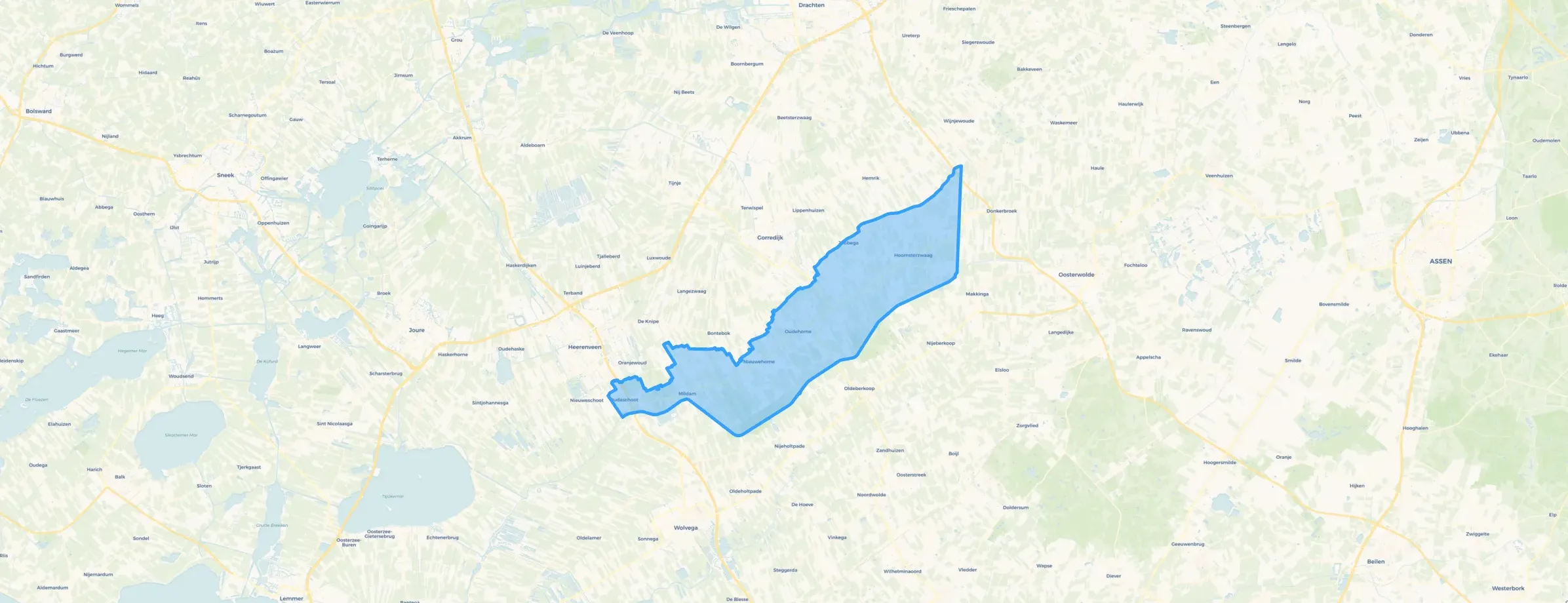
Neighbourhood in Heerenveen
Jubbega is located The neighbourhood has a total area of 7.012 hectares, of which 6.954 hectares are land and 58 hectares are water. The neighbourhood is coded as WK007404. The postcode area is 8411CH-8455JX.
Jubbega has 9.120 residents. Of these, 50,2% are men and 49,9% are women. Most residents are 45 to 65 years (31,3%). The other age groups are 23,8% for '65 years or older', 20,0% for '25 to 45 years', 14,2% for '0 to 15 years' and 10,7% for '15 to 25 years'. Of the residents, 43,7% is unmarried, 43,0% is married, 7,8% is divorced and 5,6% is widowed. 8.540 residents originate from the Netherlands, 265 come from Europe and 315 come from countries outside Europe.
There are 3.980 households in Jubbega. 30,0% of these are single-person households, 35,4% households without children and 34,5% households with children. The average household size is 2,3 persons.
In Jubbega there are 7.500 income recipients. The average income per income recipient is €32.900, which is €2.900 (8%) lower than the national average of €35.800. Per resident, the average income is €27.200, which is €2.000 (7%) lower than the national average of €29.200. Most residents of Jubbega are educated to an intermediate level. 49,2% have an intermediate education (HAVO, VWO or MBO 2-4), 29,7% have a lower education (VMBO or MBO 1) and 21,1% have a university or higher professional education (HBO/WO).
Of the 9.120 residents, around 65% are in paid employment, which amounts to 5.928 people. This is 0% lower than the national average of 65%. The majority of workers are in salaried employment (81%), while 19% are self-employed. In Jubbega, 27% of residents receive a benefit. The largest group is those receiving a state pension (AOW). 1.880 people receive this benefit.
In Jubbega there are 3.927 homes with an average assessed value (WOZ) of €353.000. Of these, around 96% are occupied and 4% unoccupied. Most homes are owner-occupied. This amounts to 28% rental homes and 72% owner-occupied homes. Of the homes, 71% privately owned, 24% owned by housing associations and 5% owned by other landlords. The most common construction periods in Jubbega are 1950-1970 (29%) and 1970-1980 (15%).
There are currently no homes for sale in Jubbega. No homes were sold in Jubbega over the past year.
There are currently no homes for rent in Jubbega. No homes were let in Jubbega over the past year.
No recent rental data available for Jubbega.
In Jubbega there are 4.020 addresses with a registered energy label. The most common labels are C (23%), G (20%) and B (16%). On average, an address in Jubbega uses 3.040 kWh of electricity per year. This is 8% above the national average of 2.810 kWh. Natural gas consumption, at 1.340 m³ per year, is 5% above the national average of 1.280 m³.

The most common type is detached houses (58%).
Over the past year a home for sale in Jubbega was listed for an average of €594,285 (€2,842 per m²).
Residents give Jubbega a 8.0 out of 10 based on 3 reviews. The strongest score is for accessibility (9.0), the weakest for community (7.0).
Wijk Jubbega has 9,120 residents. The largest age group is 45 to 65 years (31%). Many families: 35% of the households have children.
A considerable share of the supply in Jubbega is less efficient: 31% has an E, F or G label. The average natural gas consumption per household is 1,340 m³ per year.
From Jubbega you can on average reach a supermarket at 2.1 km, a GP at 2.0 km, a railway station at 12.5 km, a primary school at 1.2 km (as the crow flies, source: CBS).

Buurtje.nl uses cookies to make the site work and to improve it. In doing so, we process data such as your IP address and the pages you visit.
We use this data for three purposes: running the website (functional), measuring visits so we can improve Buurtje.nl (analytics), and — if you allow it — tailoring ads to your interests (marketing).
How we handle your data is described in our privacy policy. You can change your preferences at any time via 'Cookie preferences' at the bottom of every page.
Choose per category which cookies we may place. Read more in our privacy policy.