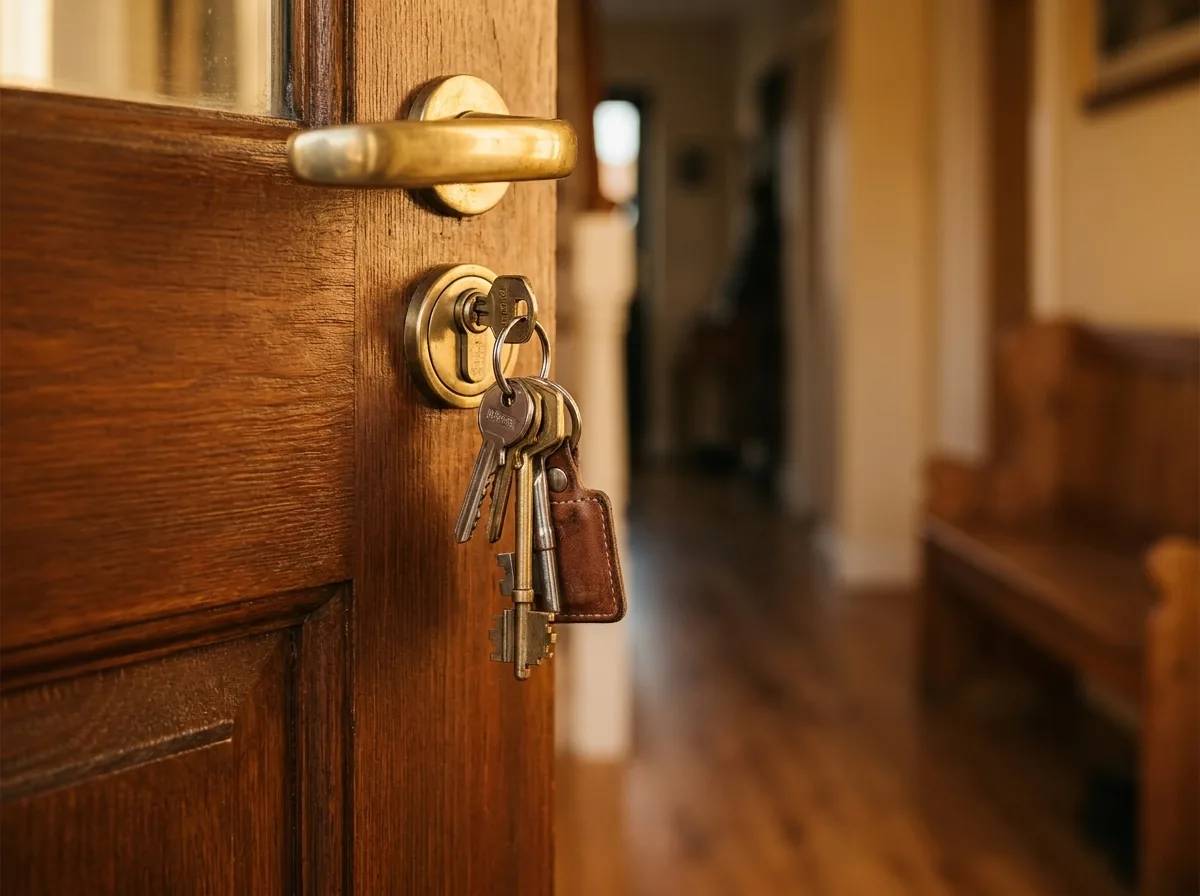
The key handover is the moment when you receive the keys to your new home. This usually happens immediately after the deed of transfer has been signed at the notary's office, or at a pre-agreed time. Just before that, you walk through the property with the seller (the final inspection) and note down the meter readings. Meanwhile, the notary arranges the property transfer and the entire money flow. Below, we walk through what happens on that day step by step.
What exactly is the key handover?
The key handover is the official moment when the property changes ownership and you receive the keys. Legally, you become the owner as soon as the deed of transfer has been signed at the notary's office and it has been registered with the Land Registry (Kadaster). In practice, the signing and the key handover often take place on the same day, sometimes even within an hour.
There are two common variants. In the first, you sign the deed at the notary's in the morning and then immediately pick up the keys from the seller or the estate agent. In the second, you agree on a fixed time, for example in the afternoon, when you meet at the property. Which variant it will be is agreed in advance with the seller.
The final inspection: walking through the property together
Just before the key handover, you carry out a final inspection with the seller, also known as the completion inspection. You then walk calmly through the entire house to check that everything is as agreed in the purchase agreement. Take your time for this: after the transfer, you are in principle responsible for what you find.
During the final inspection, pay attention to the following points:
- Chattels: are the agreed items left behind (think of the kitchen, floors, curtains or blinds) and are unwanted items removed?
- Leftover mess: is the property delivered broom-clean, or is there still half an attic full of junk?
- Visible damage: have any new damages occurred since your last viewing, for example due to the seller's move?
- All keys and codes: do you receive all house keys, keys to the shed, the mailbox, any safe, and codes for the alarm or smart doorbell?
- Operation of installations: do the central heating boiler, taps and electrics work properly?
Feel free to take photos during this round. This prevents later discussion about what was or was not present.
Recording meter readings: don't forget
A small task that many people underestimate: record the meter readings for gas, electricity (often two meters: high and low) and water together with the seller. Write them down, take a photo and have both parties sign the overview for approval.
With these readings, you take out an energy contract and the seller is deregistered, so that you only pay for your own consumption from the day of transfer. Do you already have a supplier? Then pass on the readings quickly, so that you don't get an unnecessary advance payment or correction afterwards.
The role of the notary: ownership and money flow
The notary is the linchpin of the entire transfer. He or she draws up the deed of transfer (the official deed by which ownership passes to you) and, if you have a mortgage, also the mortgage deed. At the appointment, the notary checks everyone's identity, reads out the core of the deed and has everyone sign.
In addition, the notary arranges the complete money flow. Your bank transfers the mortgage amount to the notary's client account, you deposit any own contribution, and from this the notary pays the seller, repays the seller's old mortgage and settles the costs. Only when everything is correct does he register the deed with the Land Registry and you become the official owner.
For notary costs for a home of around 400,000 euros with a mortgage, you can expect about 1,800 euros. In practice, the total varies from about 700 to 1,900 euros, depending on the notary's office and whether you compare. If you buy without a mortgage, the mortgage deed is not needed and you often end up around 1,000 to 1,200 euros (only the deed of transfer plus Land Registry costs).
Are you between 18 and 34, are you going to live there yourself and does the home cost a maximum of 555,000 euros? Then you can sign a declaration at the notary for the starter's exemption and pay 0% transfer tax once. If you do not fall under that but are going to live there yourself, the rate of 2% applies.
What if something is wrong at the transfer?
Suppose: during the final inspection you discover that agreed items are missing, that there is new damage, or that the property is full of junk. The best time to resolve this is before you sign. A commonly used solution is a withholding via the notary: the notary keeps an agreed amount of the purchase price separate in his account until the problem is resolved.
This gives you leverage: if the seller resolves it, he gets the money after all; if not, you can (partially) use it to arrange it yourself. Always agree the amount and conditions clearly and have the notary record them. Never agree to a vague promise without anything in writing.
Practical tips for the day itself
- Bring your ID to the notary, otherwise the deed cannot be passed.
- Plan the final inspection with plenty of time: do not do it five minutes before signing, but preferably an hour beforehand, so that you can still adjust.
- Check the settlement statement that you receive from the notary a few days in advance. Is the amount to be transferred correct? Are the correct costs listed?
- Have the old locks replaced shortly after the transfer. You never know how many spare keys have been handed out over time.
- Notify your new address to the municipality, your insurer and the Tax and Customs Administration.
What a home approximately costs
Before you get to the key handover, of course, you first have to buy. Note: these are asking prices, not transaction prices. In our own current housing supply, the median asking price nationally is 470,000 euros. The median is the middle price and gives a fairer picture than the average of about 539,000 euros, which is pulled up by expensive outliers. Per city, the medians vary, from Groningen at 325,000 euros and Rotterdam at 410,000 euros to Utrecht at 510,000 euros and Amsterdam at 595,000 euros.
This article is general information, not financial or tax advice; for your situation, the notary and your mortgage advisor are the appropriate people. Would you like to look around for your next home yourself? The full range can be found on Buurtje.nl and in the Buurtje.nl app.
Source: own current housing supply on Buurtje.nl, median asking prices (June 2026). Asking prices are not transaction prices. Tax amounts based on the rules for 2026.