Introduction
In the Netherlands, where rainfall and effective water management are crucial, wadis are gaining popularity as a sustainable solution for rainwater management. But what exactly is a wadi, how does it function, and what benefits does it offer?
What is a Wadi?
A
wadi is a sunken green strip or ditch that captures, purifies, and infiltrates rainwater into the soil. The term is an abbreviation of "Water Afvoer Drainage en Infiltratie" (Water Drainage and Infiltration) and is derived from the Arabic word for a dry river valley. In urban areas, a wadi helps prevent waterlogging by not draining rainwater directly into the sewer system but allowing it to seep into the ground in a controlled manner. (
Wikipedia)
How does a Wadi work?
A wadi is designed to capture rainwater from impervious surfaces such as streets and roofs. The water flows to lower-lying green zones, where it is temporarily stored. Subsequently, the water infiltrates through the soil, with the top layer acting as a filter that removes pollutants before it reaches the groundwater. (
Klimaatadaptatie Nederland)
[caption id="attachment_160613" align="alignnone" width="613"]
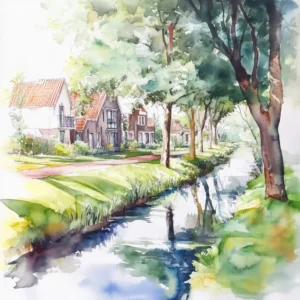
Illustration of an infiltration ditch in a residential area[/caption]
Benefits of a Wadi
These natural retention zones offer various advantages for water management and the environment:
- Prevention of Waterlogging: By capturing rainwater and allowing it to infiltrate in a controlled manner, wadis reduce the burden on the sewer system and decrease the risk of flooding. (Klimaatadaptatie Nederland)
- Groundwater Recharge: The infiltrated water helps maintain groundwater levels, which is essential during dry periods. (Stad & Groen)
- Improved Water Quality: During infiltration, pollutants are filtered from the rainwater, resulting in cleaner groundwater. (Klimaatadaptatie Nederland)
- Enhanced Biodiversity: Wadis can be planted with diverse flora, providing a habitat for insects and birds, thus promoting biodiversity. (Groen Blauwe Netwerken)
- Climate Adaptation: In light of climate change, wadis help cities adapt to more extreme weather conditions by mitigating both waterlogging and drought. (NL Adaptief)
Applications of Wadis in the Netherlands
Since the 1990s, wadis have been introduced on a large scale in the Netherlands. Today, almost all municipalities have constructed one or more wadis. They are used in various environments, from residential areas to business parks, contributing to sustainable water management and an improved living environment. (
Klimaatadaptatie Nederland)
Conclusion
A wadi is more than a simple ditch; it is a smart, sustainable solution for urban water management. By capturing, purifying, and infiltrating rainwater, wadis offer a natural way to reduce waterlogging, promote biodiversity, and make cities climate-resilient.
Does your neighbourhood have a Wadi? Or do you need a Wadi? Discuss it on
Buurtje.nl.