District in Amersfoort
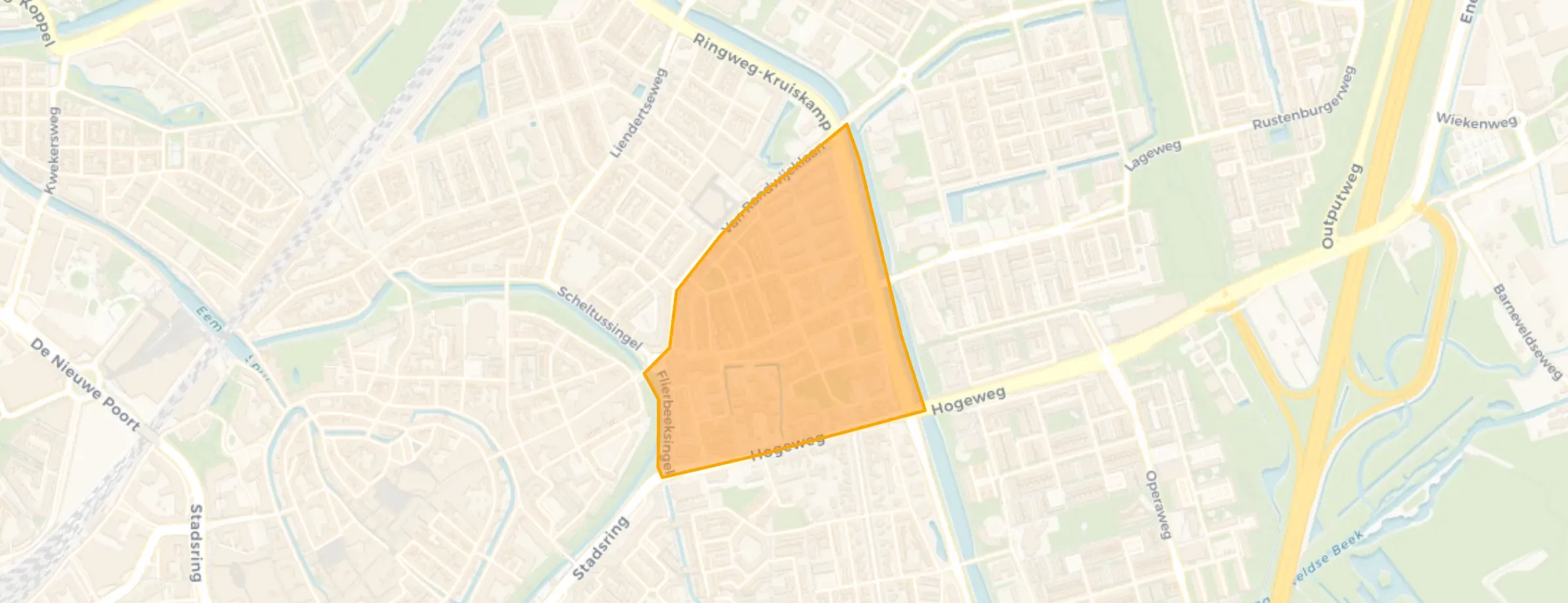
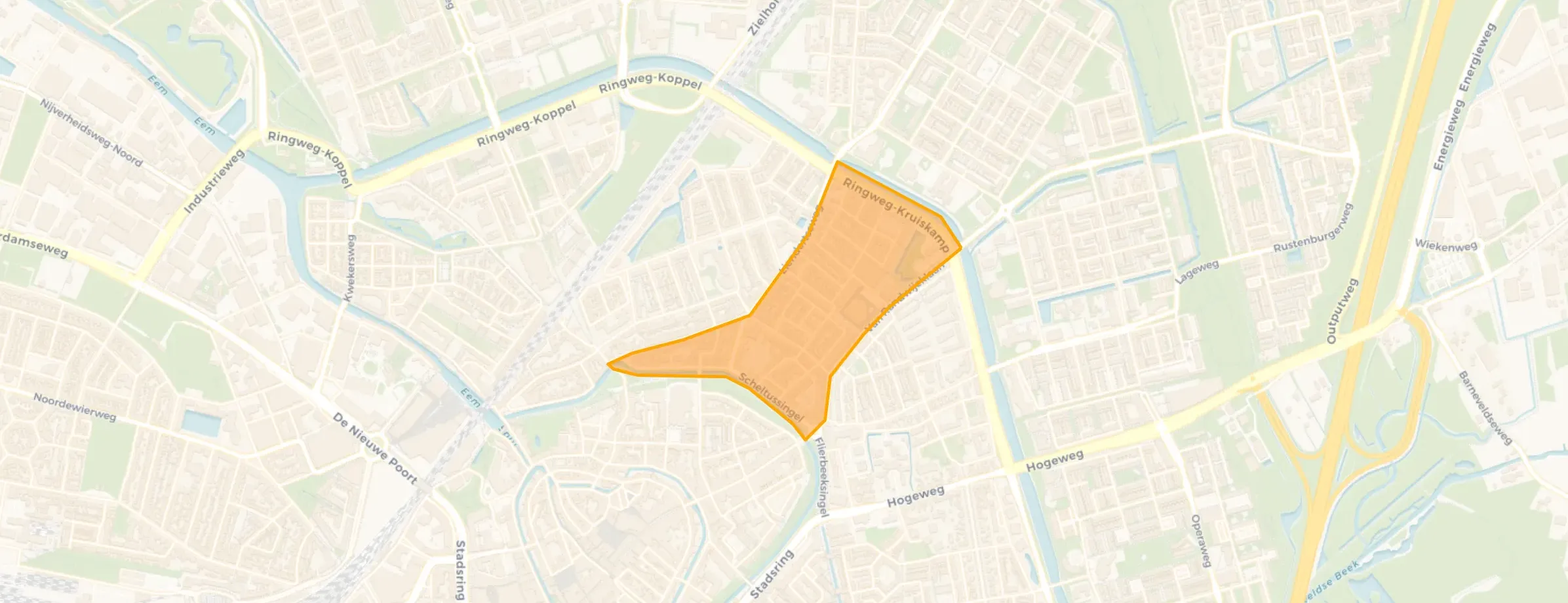
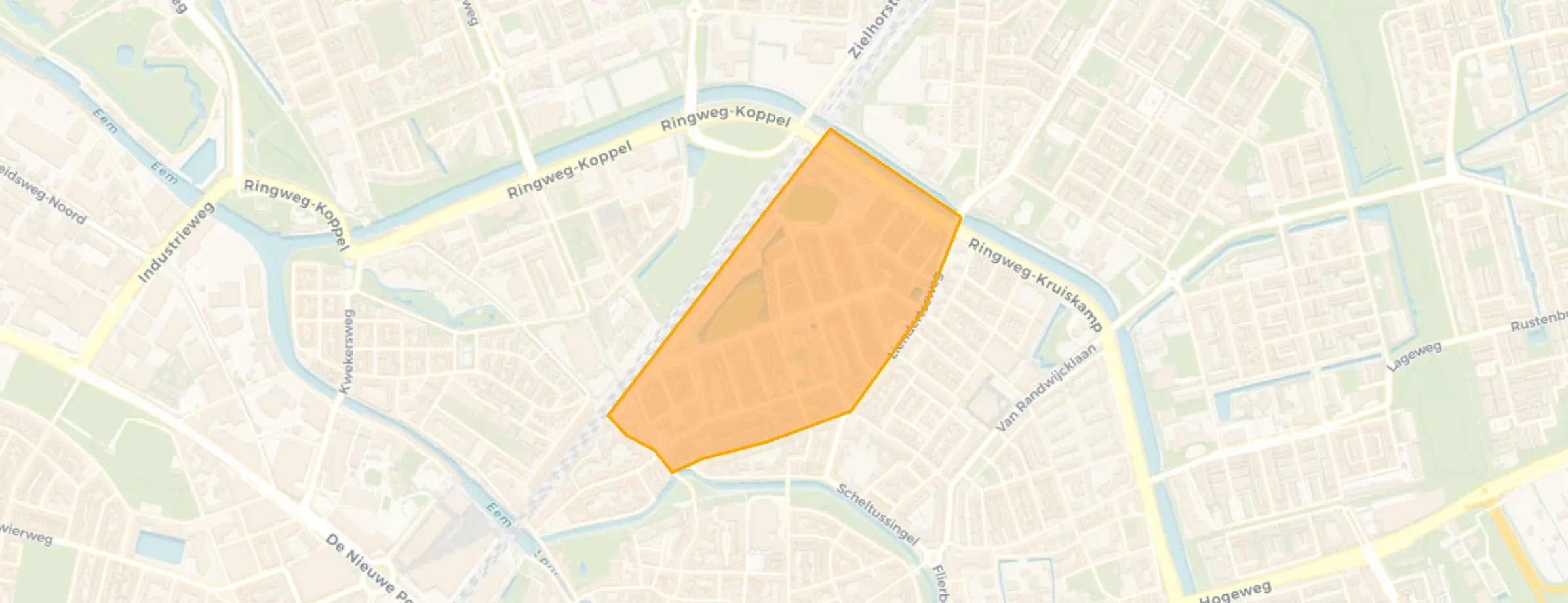
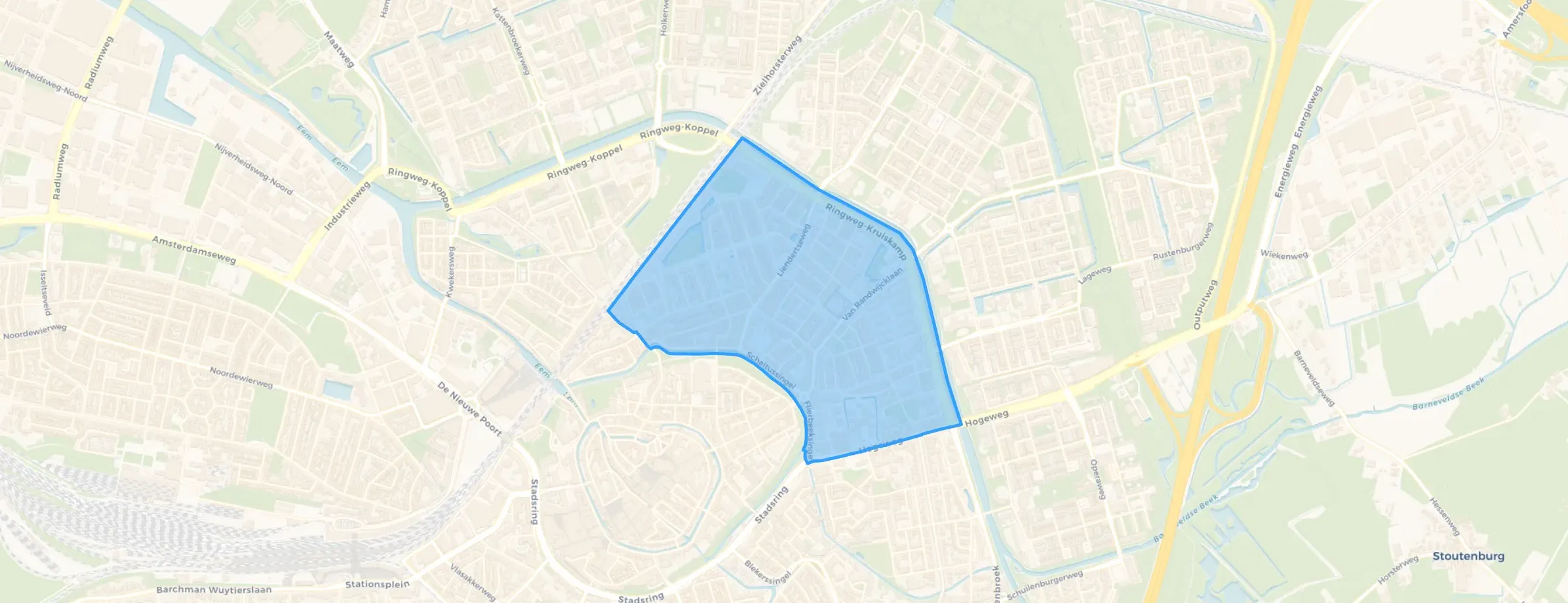
Kruiskamp is located in the province of Utrecht, in the municipality of Amersfoort The district has a total area of 80 hectares, of which 77 hectares are land and 2 hectares are water. The district is coded as WK030707. The postcode area is 3813TC-3814XW.
Kruiskamp has 6.020 residents. Of these, 49,1% are men and 50,8% are women. Most residents are 25 to 45 years (31,2%). The other age groups are 24,3% for '45 to 65 years', 16,4% for '0 to 15 years', 15,9% for '65 years or older' and 12,4% for '15 to 25 years'. Of the residents, 54,5% is unmarried, 32,7% is married, 8,4% is divorced and 4,4% is widowed. 3.350 residents originate from the Netherlands, 360 come from Europe and 2.310 come from countries outside Europe.
There are 2.855 households in Kruiskamp. 44,5% of these are single-person households, 24,2% households without children and 31,3% households with children. The average household size is 2,1 persons.
In Kruiskamp there are 4.900 income recipients. The average income per income recipient is €33.800, which is €2.000 (6%) lower than the national average of €35.800. Per resident, the average income is €27.200, which is €2.000 (7%) lower than the national average of €29.200. Most residents of Kruiskamp are highly educated. 36,1% have a university or higher professional education (HBO/WO), 35,4% have an intermediate education (HAVO, VWO or MBO 2-4) and 28,5% have a lower education (VMBO or MBO 1).
Of the 6.020 residents, around 63% are in paid employment, which amounts to 3.793 people. This is 2% lower than the national average of 65%. The majority of workers are in salaried employment (86%), while 14% are self-employed. In Kruiskamp, 26% of residents receive a benefit. The largest group is those receiving a state pension (AOW). 830 people receive this benefit.
In Kruiskamp there are 2.840 homes with an average assessed value (WOZ) of €339.000. Of these, around 96% are occupied and 4% unoccupied. Most homes are rental properties. This amounts to 58% rental homes and 42% owner-occupied homes. Of the homes, 42% privately owned, 47% owned by housing associations and 11% owned by other landlords. The most common construction periods in Kruiskamp are 1950-1970 (36%) and 2000-2010 (15%).
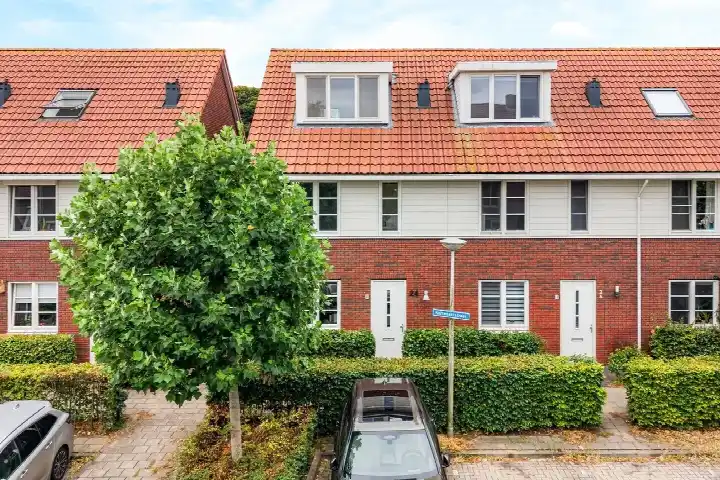
There are currently no homes for sale in Kruiskamp. The most recently listed home is Columbusweg 83 by Snel ERA Makelaars. No homes were sold in Kruiskamp over the past year.
There are currently no homes for rent in Kruiskamp. The most recent home is Ringweg-Kruiskamp 72P, offered by Govaert Makelaardij Verhuur & Beheer. No homes were let in Kruiskamp over the past year.
No recent rental data available for Kruiskamp.
In Kruiskamp there are 3.044 addresses with a registered energy label. The most common labels are A (32%), C (19%) and E (11%). On average, an address in Kruiskamp uses 2.040 kWh of electricity per year. This is 27% below the national average of 2.810 kWh. With an annual consumption of 840 m³ per address, natural gas consumption is 34% below the national average of 1.280 m³.
Nice location, city within walking distance, the neighbourhood itself is easily accessible by bike, public transport and car. Many social people from various groups live here and they all get along well. I like that different cultures, religions (church and mosque) and ages live together. Neptunusplein shopping centre is a nice shopping centre with a wide range, but it's always busy and getting there by car and parking can be difficult due to the crowds. Kruiskamp has a somewhat negative image but that really seems to be improving. Especially in the part where I live, a lot has been built and the old, dilapidated houses have been demolished. The Alliantie has now built Parkweelde there, where I also live. Nice houses, a very diverse group of people living there. Never any nuisance. What could be better is more greenery in the neighbourhood. There is some, but especially after building and demolishing, greenery seems to have disappeared. They have created a nice little park, but it still needs to grow. Unfortunately, there is almost no open view anywhere in the whole neighbourhood, so you often look at houses and it feels a bit cramped and enclosed. Furthermore, cars drive very fast and also against the direction. There is often rubbish next to the bins. I do see that ROVA, for example, handles that very well. Those employees are also coincidentally super friendly and sometimes offer to take rubbish away themselves (during jobs there was sometimes temporary rubbish/construction waste in the gardens). I also see that gardeners take good care of the hedges at the Alliantie's gardens, so it looks tidy. I'm curious how the park will turn out. Furthermore, I think the architectural style is beautiful (warm) with red and white. Also nice: many different shops, also from various cultures. Turkish bakeries, Polish supermarket, etc. I feel quite safe here, although I know that there are regular burglaries (for example, a table was stolen from the neighbour's garden). There were also many burglaries on van Nesstraat. On Magelhaenstraat, there are often cars with men inside revving the engine in the evening. Not really scary, but unsettling when you have your door open in summer. I know that also happens in other streets. People also drive very fast here. I would generally not recommend the neighbourhood for young families, but for singles, young couples or couples without children it's nice!
Auto-translated to English by AIThe housing stock is mainly post-war — 55% was built between 1945 and 1990. In addition, the most common type is flats (57%).
Over the past year a home for sale in Kruiskamp was listed for an average of €403,711 (€4,758 per m²).
Wijk Kruiskamp has 6,020 residents. The largest age group is 25 to 45 years (31%).
From Kruiskamp you can on average reach a supermarket at 0.4 km, a GP at 0.4 km, a railway station at 2.6 km, a primary school at 0.5 km (as the crow flies, source: CBS).
Right now you will find 21 homes for sale in Kruiskamp.