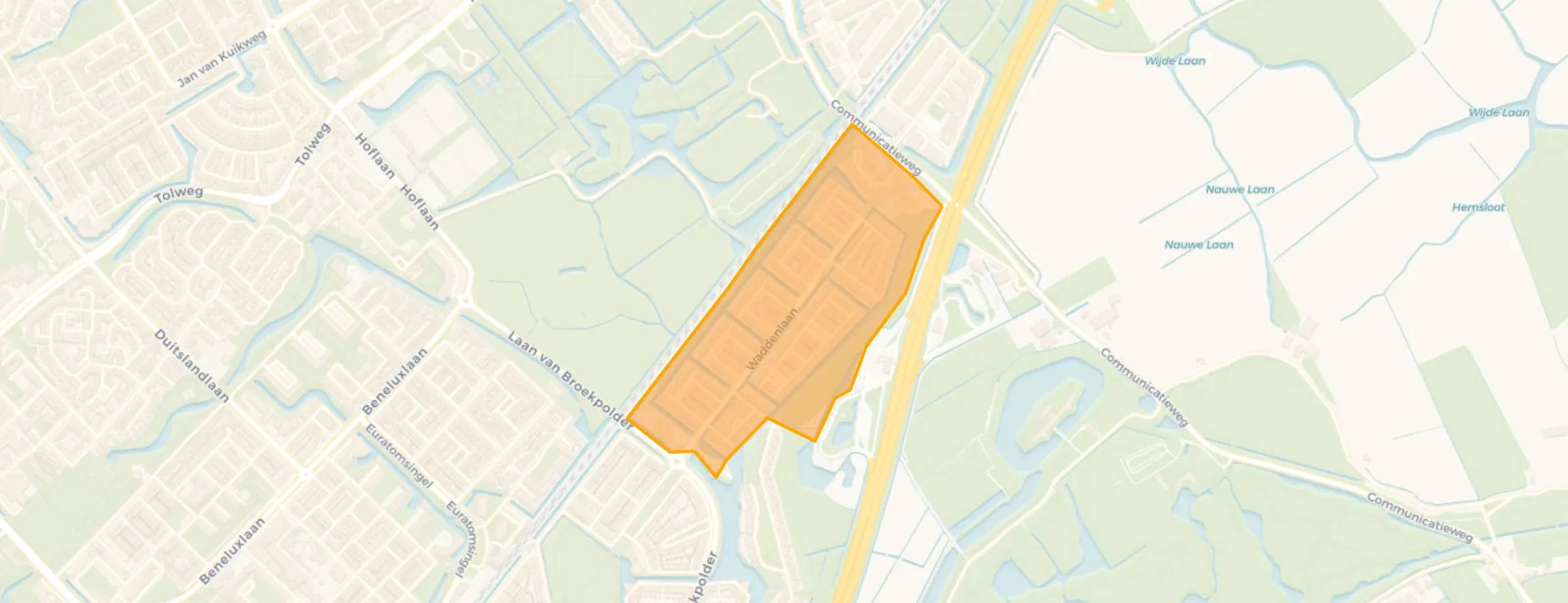
Neighbourhood in Heemskerk
De Wadden is located in the province of Noord-Holland, in the municipality of Heemskerk, in the district Broekpolder The neighbourhood has a total area of 29 hectares, of which 26 hectares are land and 3 hectares are water. The neighbourhood is coded as BU03961002. The postcode area is 1967EA-1967PR.
One resident rates the neighbourhood as more than satisfactory with a score of 6.8. The resident describes this neighbourhood as 'Nice to grow up in'. Based on a limited number of reviews, no clear trends are visible yet in this neighbourhood.
De Wadden has 1.630 residents. Of these, 51,5% are men and 48,5% are women. Most residents are 45 to 65 years (39,0%). The other age groups are 18,7% for '15 to 25 years', 17,2% for '0 to 15 years', 16,9% for '25 to 45 years' and 8,3% for '65 years or older'. Of the residents, 50,3% is unmarried, 43,3% is married, 4,3% is divorced and 1,8% is widowed. 1.270 residents originate from the Netherlands, 120 come from Europe and 245 come from countries outside Europe.
There are 540 households in De Wadden. 13,9% of these are single-person households, 24,1% households without children and 62,0% households with children. The average household size is 3,0 persons.
In De Wadden there are 1.300 income recipients. The average income per income recipient is €42.200, which is €6.400 (18%) higher than the national average of €35.800. Per resident, the average income is €32.600, which is €3.400 (12%) higher than the national average of €29.200. Most residents of De Wadden are educated to an intermediate level. 41,9% have an intermediate education (HAVO, VWO or MBO 2-4), 35,7% have a university or higher professional education (HBO/WO) and 22,5% have a lower education (VMBO or MBO 1).
Of the 1.630 residents, around 76% are in paid employment, which amounts to 1.239 people. This is 11% higher than the national average of 65%. The majority of workers are in salaried employment (87%), while 13% are self-employed. In De Wadden, 11% of residents receive a benefit. The largest group is those receiving a state pension (AOW). 110 people receive this benefit.
In De Wadden there are 532 homes with an average assessed value (WOZ) of €576.000. Of these, around 99% are occupied and 1% unoccupied. Most homes are owner-occupied. This amounts to 9% rental homes and 91% owner-occupied homes. Of the homes, 91% privately owned, 8% owned by housing associations and 1% owned by other landlords. The most common construction periods in De Wadden are 2000-2010 (99%) and 1900-1925 (1%).
There are currently no homes for sale in De Wadden. The most recently listed home is Simonszand 3 by Brantjes Makelaars Heemskerk op Funda. No homes were sold in De Wadden over the past year.
There are currently no homes for rent in De Wadden. No homes were let in De Wadden over the past year.
No recent rental data available for De Wadden.
In De Wadden there are 533 addresses with a registered energy label. The most common labels are A (74%), B (24%) and A+ (1%). On average, an address in De Wadden uses 3.430 kWh of electricity per year. This is 22% above the national average of 2.810 kWh. With an annual consumption of 940 m³ per address, natural gas consumption is 27% below the national average of 1.280 m³.
No one really talks to each other, which leads to a lack of social control. This doesn't always make the neighbourhood safe because of some vandalistic loitering youths; on my street you don't have trouble with them, but on others you often do. The greenery is fine but is also offset by the A9, which is 400 metres from your house. The accessibility of our neighbourhood is quite good; there is a roundabout with 4 exits that are important for traffic flow throughout Heemskerk, which sometimes makes it very busy and unsafe to cross the roundabout by bike. Fortunately, an exception is made for the school at the beginning of the Wadden, and there are enough school zone signs. The neighbourhood is very clean, but that's because everyone contributes to keeping everything as clean as possible. There are no large packages, but there are many cigarette butts and small bits of paper and/or plastic. Amenities are very conveniently located; you can drive to a supermarket with a wide range in about 2 minutes by car or 5 by bike. There is a school at the beginning of the Waddelaan with many children, but I personally don't go there. Other schools are also not far, and are a 15-25 minute bike ride with a young child. These schools have a very different approach; I personally went to the Pantarhei and am friends with people who attended other schools in the village, and we have jointly concluded that these schools have a very different approach. This also applies to higher schools, but that also depends on the level. If you need more than one school or groceries, in the village of Heemskerk, which is a 15-minute bike ride away, there are many shops, including a butcher, a hairdresser, an ice cream parlour, a toy shop, restaurants, bookshops, and much more.
Auto-translated to English by AI
The housing stock is relatively young — 100% dates from after 1990. In addition, the most common type is terraced houses (64%).
Over the past year a home for sale in De Wadden was listed for an average of €578,409 (€3,909 per m²).
Buurt De Wadden has 1,630 residents. The largest age group is 45 to 65 years (39%). Many families: 62% of the households have children.
The housing supply in De Wadden is remarkably efficient: 100% has an A, A+ or B label. The average natural gas consumption per household is 940 m³ per year.
From De Wadden you can on average reach a supermarket at 1.1 km, a GP at 1.1 km, a railway station at 2.1 km, a primary school at 0.5 km (as the crow flies, source: CBS).

Buurtje.nl uses cookies to make the site work and to improve it. In doing so, we process data such as your IP address and the pages you visit.
We use this data for three purposes: running the website (functional), measuring visits so we can improve Buurtje.nl (analytics), and — if you allow it — tailoring ads to your interests (marketing).
How we handle your data is described in our privacy policy. You can change your preferences at any time via 'Cookie preferences' at the bottom of every page.
Choose per category which cookies we may place. Read more in our privacy policy.