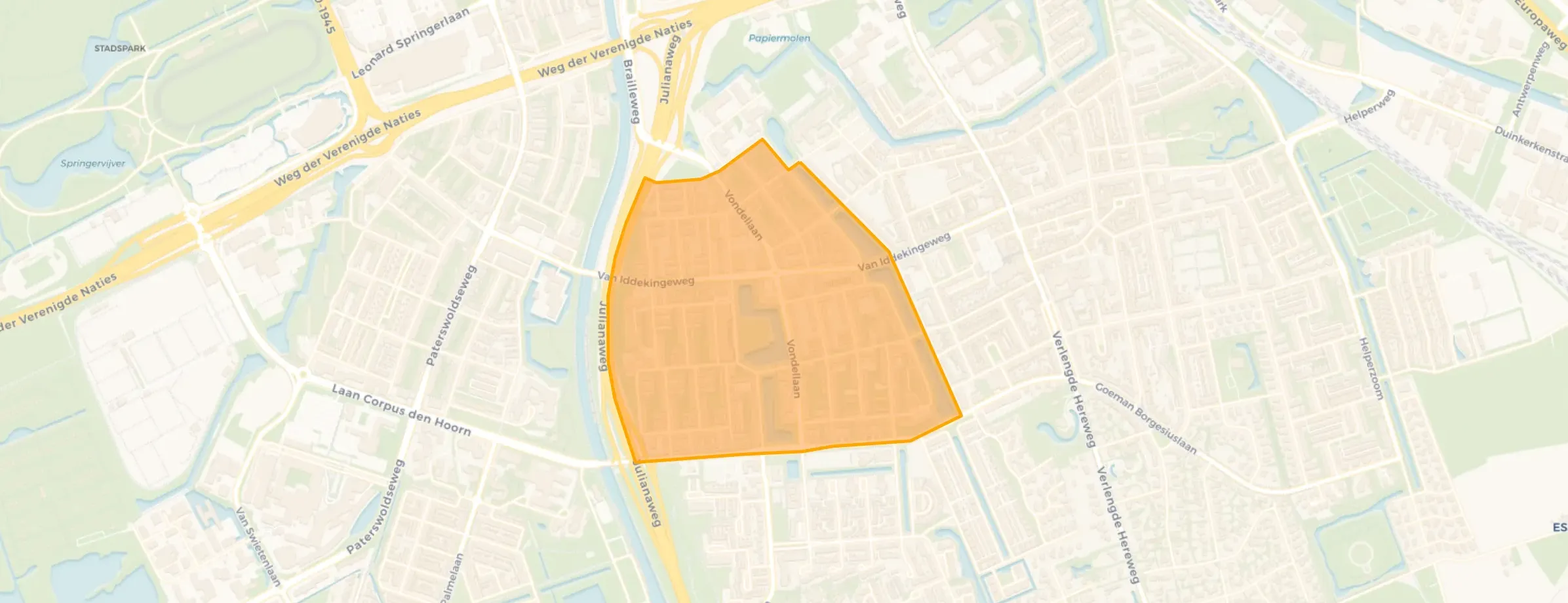
Neighbourhood in Groningen
De Wijert is located in the province of Groningen, in the municipality of Groningen, in the district Helpman en omgeving The neighbourhood has a total area of 60 hectares, of which 59 hectares are land and 1 hectares are water. The neighbourhood is coded as BU00140605. The postcode area is 9721CD-9721SM.
Four residents rate the neighbourhood as very good with a score of 8.1. They describe it as 'Nice', 'Decent neighbourhood but lacks better public transport connections and more greenery' and 'Cosy, everything nearby, green'. Residents are positive about the neighbourhood: nearly all aspects score well. In particular, amenities, community, education are seen as strong points.
De Wijert has 4.575 residents. Of these, 49,6% are men and 50,4% are women. Most residents are 25 to 45 years (38,3%). The other age groups are 20,2% for '45 to 65 years', 15,3% for '15 to 25 years', 13,8% for '65 years or older' and 12,5% for '0 to 15 years'. Of the residents, 70,4% is unmarried, 18,0% is married, 8,0% is divorced and 3,6% is widowed. 2.880 residents originate from the Netherlands, 495 come from Europe and 1.200 come from countries outside Europe.
There are 2.820 households in De Wijert. 60,8% of these are single-person households, 21,1% households without children and 18,1% households with children. The average household size is 1,6 persons.
In De Wijert there are 3.900 income recipients. The average income per income recipient is €30.700, which is €5.100 (14%) lower than the national average of €35.800. Per resident, the average income is €26.100, which is €3.100 (11%) lower than the national average of €29.200. Most residents of De Wijert are educated to an intermediate level. 41,3% have an intermediate education (HAVO, VWO or MBO 2-4), 39,2% have a university or higher professional education (HBO/WO) and 19,5% have a lower education (VMBO or MBO 1).
Of the 4.575 residents, around 61% are in paid employment, which amounts to 2.791 people. This is 4% lower than the national average of 65%. The majority of workers are in salaried employment (90%), while 10% are self-employed. In De Wijert, 25% of residents receive a benefit. The largest group is those receiving a state pension (AOW). 560 people receive this benefit.
In De Wijert there are 2.829 homes with an average assessed value (WOZ) of €230.000. Of these, around 93% are occupied and 7% unoccupied. Most homes are rental properties. This amounts to 71% rental homes and 29% owner-occupied homes. Of the homes, 29% privately owned, 43% owned by housing associations and 28% owned by other landlords. The most common construction periods in De Wijert are 1950-1970 (85%) and 2000-2010 (8%).
There are currently 31 homes for sale in De Wijert. The most recently listed home is Betje Wolffstraat 70 by Schouten + van der Griezen. Over the past year, 141 homes were sold in De Wijert. On average, a home was sold within 20 days.
The average asking price for a home for sale in De Wijert over the past year was €261.305. This is 14% higher than the average assessed value (WOZ) of €230.000. The average asking price per m² of plot is €3.266.
There are currently no homes for rent in De Wijert. The most recent home is Couperusstraat 25, offered by Gruno Vastgoed B.V. op Vastgoed Nederland. Over the past year, 21 homes were let in De Wijert. On average, a listing was let within 26 days.
No recent rental data available for De Wijert.
In De Wijert there are 2.763 addresses with a registered energy label. The most common labels are A (29%), E (20%) and C (17%). On average, an address in De Wijert uses 1.820 kWh of electricity per year. This is 35% below the national average of 2.810 kWh. With an annual consumption of 830 m³ per address, natural gas consumption is 35% below the national average of 1.280 m³.
Very good. Lots of friendly people and there's always something to do
Auto-translated to English by AII lived here for about two years and there is more than enough access to shops/churches/schools etc, that was never a problem. However, this neighbourhood is poorly connected to public transport, which really should be better. This was a major reason for me to want to move, it was too far from e.g. Zernike, friends, or everything on the north side of the city. The neighbourhood always felt safe otherwise. Most of the nuisance came from schoolchildren during breaks at e.g. the shops and around the schools. They often don't put their rubbish in a bin, which I personally found very annoying. Other than that, the neighbourhood is perfectly fine.
Auto-translated to English by AIIt's cosy, the neighbourhood is beautifully green. Shops nearby, public transport nearby and the A28 nearby. Also many schools, primary and secondary. Hoornse Plas is within cycling distance. Open-air swimming pool De Papiermolen is within walking distance. In 10 minutes by bike you're in the city centre, perfect!
Auto-translated to English by AIChild-friendly neighbourhood Social people Lots of activities to do
Auto-translated to English by AI
The housing stock is mainly post-war — 94% was built between 1945 and 1990. In addition, the most common type is flats (85%).
Over the past year a home for sale in De Wijert was listed for an average of €240,725 (€3,280 per m²). Last quarter prices rose by 17%.
Residents give De Wijert a 8.1 out of 10 based on 4 reviews. Especially amenities (9.8) scores well; safety (7.0) receives the lowest rating.
Buurt De Wijert has 4,575 residents. The largest age group is 25 to 45 years (38%). Notably, 61% of the households are single-person households.
From De Wijert you can on average reach a supermarket at 0.4 km, a GP at 0.9 km, a railway station at 2.2 km, a primary school at 0.6 km (as the crow flies, source: CBS).
Right now you will find 43 homes for sale and 3 homes for rent in De Wijert. The market here is fast: a home for sale is listed for an average of just 17 days.

Buurtje.nl uses cookies to make the site work and to improve it. In doing so, we process data such as your IP address and the pages you visit.
We use this data for three purposes: running the website (functional), measuring visits so we can improve Buurtje.nl (analytics), and — if you allow it — tailoring ads to your interests (marketing).
How we handle your data is described in our privacy policy. You can change your preferences at any time via 'Cookie preferences' at the bottom of every page.
Choose per category which cookies we may place. Read more in our privacy policy.