Neighbourhood in Amersfoort
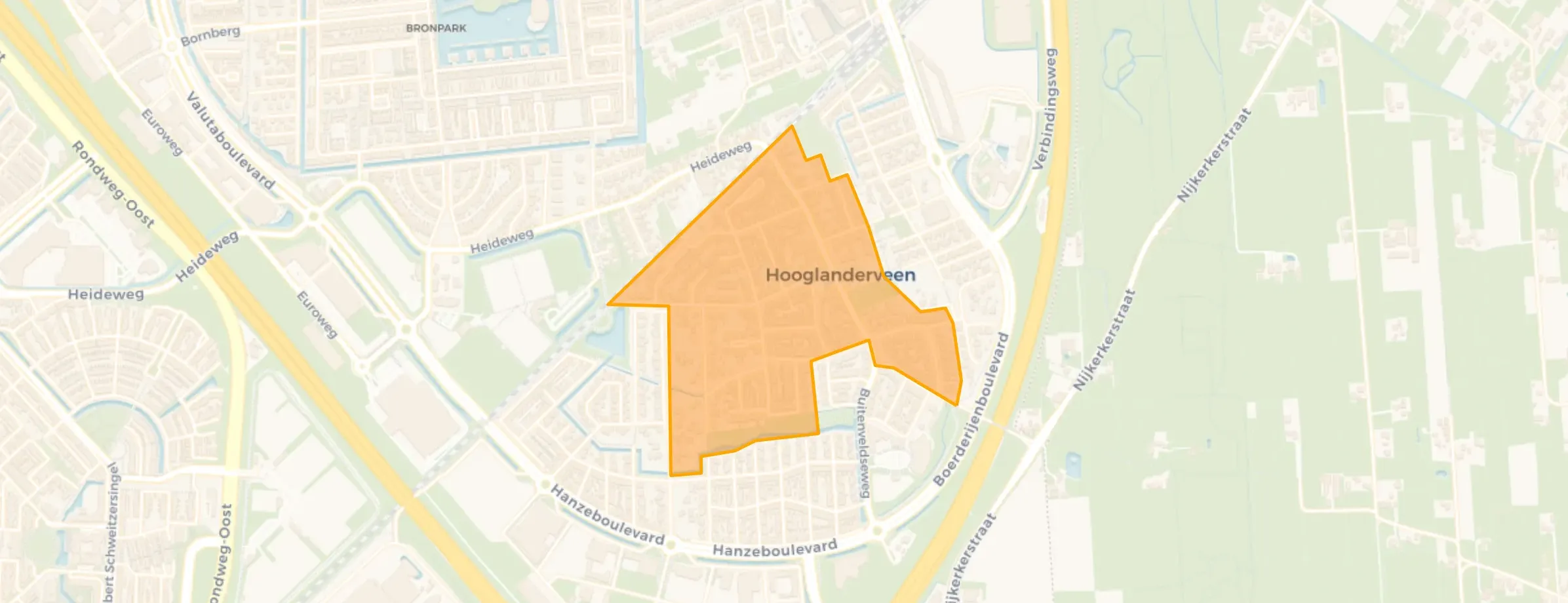
Dorpskern Hooglanderveen is located in the province of Utrecht, in the municipality of Amersfoort, in the district Hooglanderveen The neighbourhood has a total area of 30 hectares, of which 29 hectares are land and 0 hectares are water. The neighbourhood is coded as BU03072600. The postcode area is 3829AA-3829MB.
Four residents rate the neighbourhood as good with a score of 7.5. They describe it as 'lots of green and lots of old people', 'An old-fashioned, but reasonably connected and up-to-date neighbourhood' and 'Social'. Aspects such as safety, accessibility, education are rated well in this neighbourhood, while housing and community score less well.
Dorpskern Hooglanderveen has 1.480 residents. Of these, 49,3% are men and 50,7% are women. Most residents are 45 to 65 years (32,1%). The other age groups are 25,0% for '65 years or older', 16,2% for '25 to 45 years', 14,5% for '15 to 25 years' and 12,8% for '0 to 15 years'. Of the residents, 39,5% is unmarried, 45,9% is married, 6,8% is divorced and 8,4% is widowed. 1.300 residents originate from the Netherlands, 45 come from Europe and 135 come from countries outside Europe.
There are 610 households in Dorpskern Hooglanderveen. 31,1% of these are single-person households, 31,1% households without children and 37,7% households with children. The average household size is 2,3 persons. The national average is 2,1 persons.
In Dorpskern Hooglanderveen there are 1.200 income recipients. The average income per income recipient is €41.100, which is €1.100 (3%) lower than the national average of €42.200. Per resident, the average income is €34.800, which is €100 (0%) lower than the national average of €34.900. Most residents of Dorpskern Hooglanderveen are educated to an intermediate level. 49,5% have an intermediate education (HAVO, VWO or MBO 2-4), 29,4% have a university or higher professional education (HBO/WO) and 21,1% have a lower education (VMBO or MBO 1).
Of the 1.480 residents, around 77% are in paid employment, which amounts to 1.140 people. This is 5% higher than the national average of 72%. The majority of workers are in salaried employment (85%), while 15% are self-employed. In Dorpskern Hooglanderveen, 28% of residents receive a benefit. The largest group is those receiving a state pension (AOW). 340 people receive this benefit.
In Dorpskern Hooglanderveen there are 652 homes with an average assessed value (WOZ) of €508.000. Of these, around 97% are occupied and 3% unoccupied. Most homes are owner-occupied. This amounts to 33% rental homes and 67% owner-occupied homes. Of the homes, 67% privately owned, 28% owned by housing associations and 5% owned by other landlords. The most common construction periods in Dorpskern Hooglanderveen are 1950-1970 (44%) and 1990-2000 (20%).
There are currently no homes for sale in Dorpskern Hooglanderveen. The most recently listed home is Van Tuyllstraat 17C by Makelaardij de Parel. No homes were sold in Dorpskern Hooglanderveen over the past year.
There are currently no homes for rent in Dorpskern Hooglanderveen. The most recent home is Van Tuyllstraat 8B, offered by Govaert Makelaardij Verhuur & Beheer. No homes were let in Dorpskern Hooglanderveen over the past year.
No recent rental data available for Dorpskern Hooglanderveen.
In Dorpskern Hooglanderveen there are 397 addresses with a registered energy label. The most common labels are A (40%), B (22%) and C (20%). On average, an address in Dorpskern Hooglanderveen uses 2.750 kWh of electricity per year. This is 8% above the national average of 2.550 kWh. Natural gas consumption, at 880 m³ per year, is 10% above the national average of 800 m³.
there is a lot of green in my neighbourhood, but there are also many old people
Auto-translated to English by AIWhen I came to live here as a child with my parents and brother, there weren't many facilities, it was all a bit old-fashioned, but over the years this has improved significantly. A new supermarket has opened in the village, Vathorst has been built with, among other things, the station and shopping centre, in the past few years streets have been improved and a tunnel for cyclists has been added. It is being built up more and more, so the peace and quiet is somewhat less present, but it hasn't necessarily become more unsafe because of that. Furthermore, bins are emptied regularly and there is a forest on the edge of the village. There are also a few small parks here and there. The primary school that used to be on the site of the supermarket hasn't disappeared, but has moved to another location in the village. Also, just outside the village is the secondary school, Vathorst College.
Auto-translated to English by AIThe people are very social, everyone greets each other. We have the nicest supermarket in our village, always nicely decorated for holidays. I think it's a great village.
Auto-translated to English by AICosy place to live, practically located
Auto-translated to English by AIThe housing stock is relatively young — 84% dates from after 1990.
Over the past year a home for sale in Dorpskern Hooglanderveen was listed for an average of €753,430 (€4,974 per m²). That is 43% above the Dutch national average.
Residents give Dorpskern Hooglanderveen a 7.5 out of 10 based on 4 reviews. The strongest score is for safety (8.5), the weakest for community (6.8).
Buurt Dorpskern Hooglanderveen has 1,480 residents. The largest age group is 45 to 65 years (32%). Many families: 38% of the households have children.
The housing supply in Dorpskern Hooglanderveen is remarkably efficient: 94% has an A, A+ or B label. The average natural gas consumption per household is 880 m³ per year.
From Dorpskern Hooglanderveen you can on average reach a supermarket at 0.3 km, a GP at 1.6 km, a railway station at 1.2 km, a primary school at 0.6 km (as the crow flies, source: CBS).