Neighbourhood in Westerkwartier
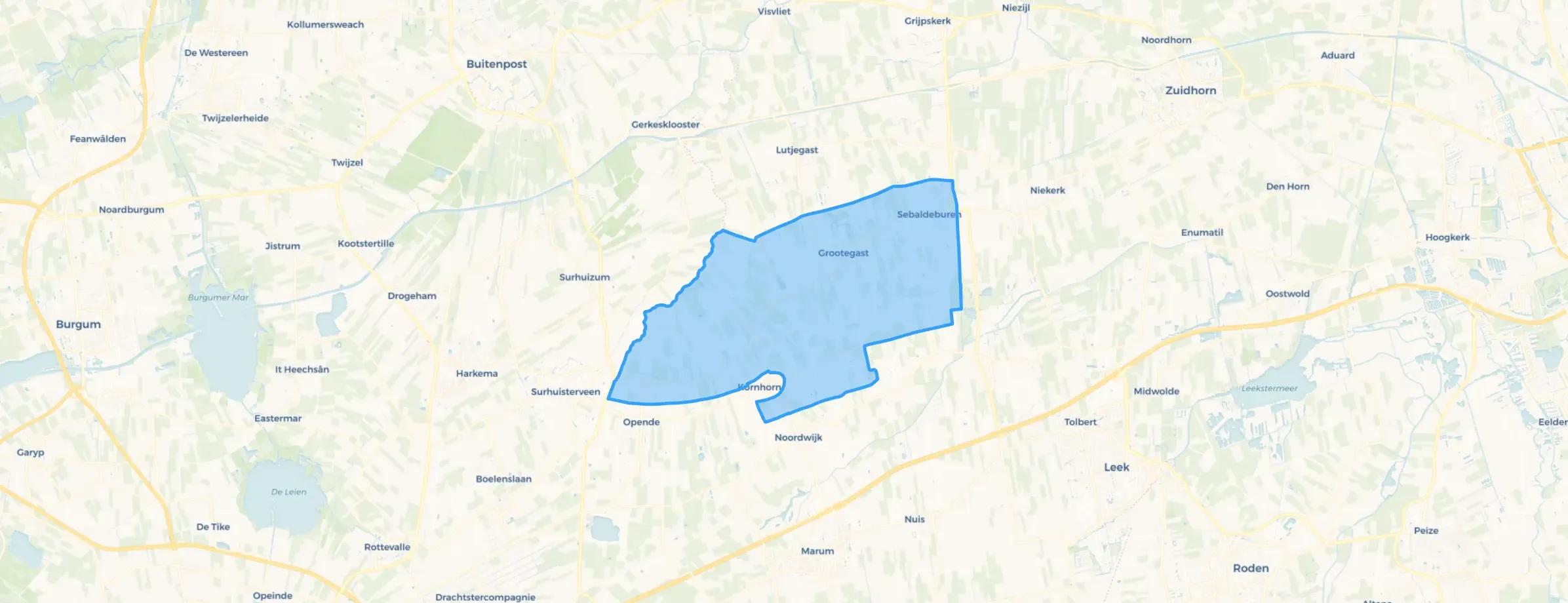
Grootegast is located The neighbourhood has a total area of 3.127 hectares, of which 3.112 hectares are land and 15 hectares are water. The neighbourhood is coded as WK196900. The postcode area is 9861AA-9866TR.
Grootegast has 5.470 residents. Of these, 50,3% are men and 49,6% are women. Most residents are 45 to 65 years (28,6%). The other age groups are 22,7% for '65 years or older', 21,3% for '25 to 45 years', 15,3% for '0 to 15 years' and 12,1% for '15 to 25 years'. Of the residents, 45,0% is unmarried, 42,8% is married, 6,3% is divorced and 5,9% is widowed. 5.080 residents originate from the Netherlands, 195 come from Europe and 195 come from countries outside Europe.
There are 2.305 households in Grootegast. 31,2% of these are single-person households, 31,5% households without children and 37,3% households with children. The average household size is 2,3 persons.
In Grootegast there are 4.300 income recipients. The average income per income recipient is €31.500, which is €4.300 (12%) lower than the national average of €35.800. Per resident, the average income is €25.800, which is €3.400 (12%) lower than the national average of €29.200. Most residents of Grootegast are educated to an intermediate level. 50,5% have an intermediate education (HAVO, VWO or MBO 2-4), 29,9% have a lower education (VMBO or MBO 1) and 19,6% have a university or higher professional education (HBO/WO).
Of the 5.470 residents, around 67% are in paid employment, which amounts to 3.665 people. This is 2% higher than the national average of 65%. The majority of workers are in salaried employment (81%), while 19% are self-employed. In Grootegast, 27% of residents receive a benefit. The largest group is those receiving a state pension (AOW). 1.110 people receive this benefit.
In Grootegast there are 2.353 homes with an average assessed value (WOZ) of €290.000. Of these, around 97% are occupied and 3% unoccupied. Most homes are owner-occupied. This amounts to 31% rental homes and 69% owner-occupied homes. Of the homes, 69% privately owned, 23% owned by housing associations and 8% owned by other landlords. The most common construction periods in Grootegast are 1950-1970 (17%) and 1990-2000 (16%).
There are currently no homes for sale in Grootegast. No homes were sold in Grootegast over the past year.
There are currently no homes for rent in Grootegast. No homes were let in Grootegast over the past year.
No recent rental data available for Grootegast.
In Grootegast there are 2.388 addresses with a registered energy label. The most common labels are A (23%), C (22%) and B (18%). On average, an address in Grootegast uses 2.840 kWh of electricity per year. This is 1% above the national average of 2.810 kWh. Natural gas consumption in this neighbourhood, at 1.280 m³ per year, exactly matches the national average.
The housing stock is mainly post-war — 52% was built between 1945 and 1990. In addition, the most common type is detached houses (49%).
Over the past year a home for sale in Grootegast was listed for an average of €416,373 (€2,889 per m²).
Wijk Grootegast has 5,470 residents. Many families: 37% of the households have children.
A considerable share of the supply in Grootegast is less efficient: 30% has an E, F or G label. The average natural gas consumption per household is 1,280 m³ per year.
From Grootegast you can on average reach a supermarket at 1.4 km, a GP at 1.3 km, a railway station at 7.6 km, a primary school at 0.7 km (as the crow flies, source: CBS).