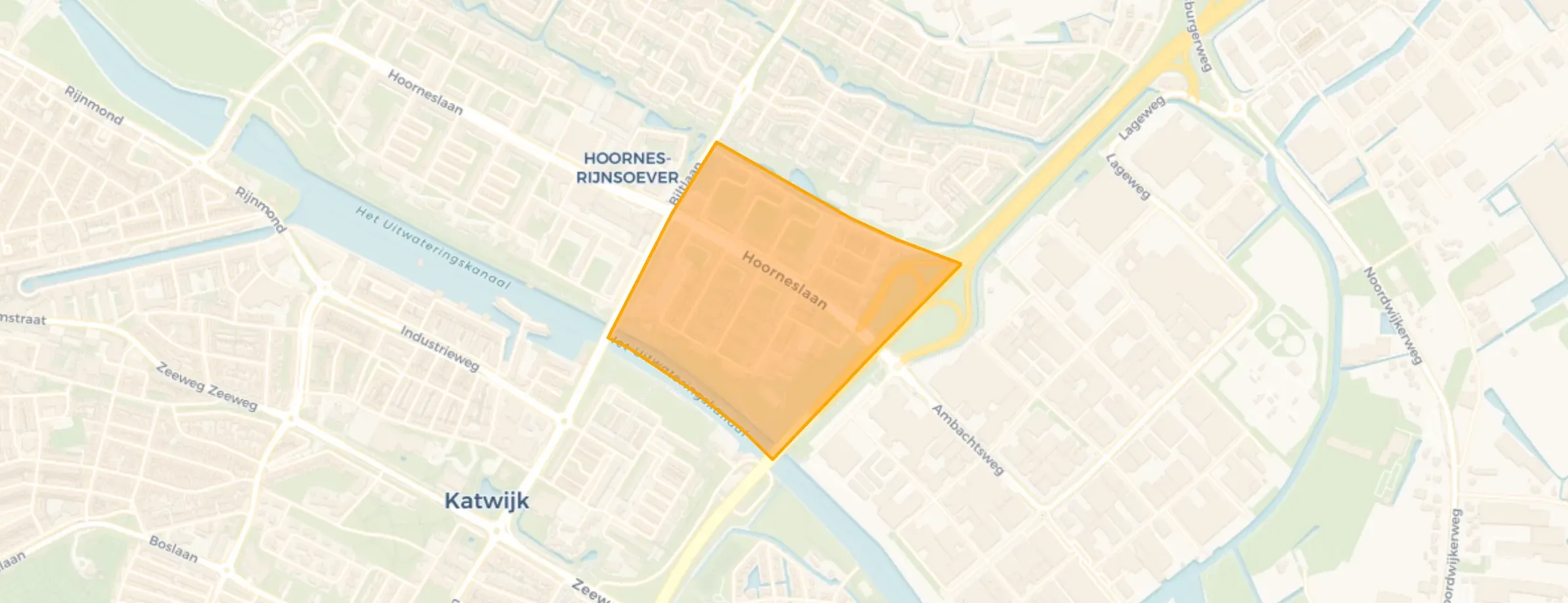
Neighbourhood in Katwijk
Hoornes-Oost is located in the province of Zuid-Holland, in the municipality of Katwijk, in the district Katwijk Noord The neighbourhood has a total area of 28 hectares, of which 26 hectares are land and 1 hectares are water. The neighbourhood is coded as BU05370104. The postcode area is 2221GA-2221VN.
Four residents rate the neighbourhood as good with a score of 7.8. They describe it as 'Cosiness in every corner', 'Green, cosy and diversity in the house neighbourhood and people of all nationalities.' and 'Cosy'. Residents are positive about the neighbourhood: nearly all aspects score well. In particular, greenery, accessibility, community are seen as strong points.
Hoornes-Oost has 2.025 residents. Of these, 49,9% are men and 50,1% are women. Most residents are 25 to 45 years (26,9%). The other age groups are 24,7% for '45 to 65 years', 20,5% for '65 years or older', 15,6% for '0 to 15 years' and 12,3% for '15 to 25 years'. Of the residents, 46,4% is unmarried, 38,5% is married, 9,1% is divorced and 5,7% is widowed. 1.515 residents originate from the Netherlands, 115 come from Europe and 395 come from countries outside Europe.
There are 945 households in Hoornes-Oost. 40,7% of these are single-person households, 24,3% households without children and 34,9% households with children. The average household size is 2,1 persons.
In Hoornes-Oost there are 1.700 income recipients. The average income per income recipient is €27.200, which is €8.600 (24%) lower than the national average of €35.800. Per resident, the average income is €21.800, which is €7.400 (25%) lower than the national average of €29.200. Most residents of Hoornes-Oost are educated to an intermediate level. 49,3% have an intermediate education (HAVO, VWO or MBO 2-4), 36,8% have a lower education (VMBO or MBO 1) and 13,8% have a university or higher professional education (HBO/WO).
Of the 2.025 residents, around 62% are in paid employment, which amounts to 1.256 people. This is 3% lower than the national average of 65%. The majority of workers are in salaried employment (91%), while 9% are self-employed. In Hoornes-Oost, 27% of residents receive a benefit. The largest group is those receiving a state pension (AOW). 370 people receive this benefit.
In Hoornes-Oost there are 949 homes with an average assessed value (WOZ) of €287.000. Of these, around 98% are occupied and 2% unoccupied. Most homes are rental properties. This amounts to 69% rental homes and 31% owner-occupied homes. Of the homes, 31% privately owned and 69% owned by housing associations. The most common construction periods in Hoornes-Oost are 1950-1970 (67%) and 1970-1980 (15%).
There are currently no homes for sale in Hoornes-Oost. The most recently listed home is Schokkingstraat 6 by Potters & Vooijs Makelaardij. No homes were sold in Hoornes-Oost over the past year.
There are currently no homes for rent in Hoornes-Oost. The most recent home is Reygersberglaan 25, offered by www.hureninhollandrijnland.nl. No homes were let in Hoornes-Oost over the past year.
No recent rental data available for Hoornes-Oost.
In Hoornes-Oost there are 950 addresses with a registered energy label. The most common labels are C (36%), E (28%) and A (16%). On average, an address in Hoornes-Oost uses 2.190 kWh of electricity per year. This is 22% below the national average of 2.810 kWh. With an annual consumption of 870 m³ per address, natural gas consumption is 32% below the national average of 1.280 m³.
The neighbourhood is very diverse, all kinds of people from all countries who were once brought together in Katwijk. It is number one, a very safe neighbourhood; I forgot to close my car window, it was open all night and really nothing happened. Whichever window I look out of, everywhere green, the diversity of birds is enormous. I look out over the Rhine, surrounded by greenery and especially on summer days lots of boats and picnic spots, some you have to make yourself but there are also plenty of benches. I always said I would never want to live here, my husband thought this spot was meant for us and within a month we had the certainty that we could live here. WONDERFUL,
Auto-translated to English by AIOur flat is nicely laid out, a safe feeling, beautiful view over the Rhine, people always cycling by, boats mooring and all kinds of cultures and people of all colours, young and old. Shops in the neighbourhood, chats with neighbours and also helpful to each other, very nice. Our house has a wide balcony that spans two rooms, so quite a lot of outdoor space. Sometimes the rubbish container is full and it does happen that a bag is left, but that probably happens everywhere. And because many boats moor and sail away again, there is often litter along the waterfront.
Auto-translated to English by AINice and beautiful surroundings
Auto-translated to English by AII've been living here for 1.5 years with great pleasure. I'm probably a lucky one; I lived in a neighbourhood by the sea for over 33 years, but because it was a big house and we were getting older, we ended up here to our full satisfaction. I'm not afraid here; it's a neighbourhood with many cultures, many different ages, and schools nearby. From my front windows, I see boats sailing by on the Rhine, and now and then a boat where people go picnicking on the grass field in front of the house. From the balcony, people cycle past on a neatly constructed cycle path. I never thought I would enjoy it so much here. You can easily cycle to other villages; the main road runs alongside, but the view is magnificent.
Auto-translated to English by AI
The housing stock is mainly post-war — 84% was built between 1945 and 1990. In addition, the most common type is flats (73%).
Over the past year a home for sale in Hoornes-Oost was listed for an average of €523,038 (€4,823 per m²).
Residents give Hoornes-Oost a 7.9 out of 10 based on 4 reviews. The strongest score is for nature and greenery (8.3), the weakest for cleanliness (7.0).
Buurt Hoornes-Oost has 2,025 residents. Many families: 35% of the households have children.
From Hoornes-Oost you can on average reach a supermarket at 0.7 km, a GP at 0.9 km, a railway station at 7.0 km, a primary school at 0.5 km (as the crow flies, source: CBS).

Buurtje.nl uses cookies to make the site work and to improve it. In doing so, we process data such as your IP address and the pages you visit.
We use this data for three purposes: running the website (functional), measuring visits so we can improve Buurtje.nl (analytics), and — if you allow it — tailoring ads to your interests (marketing).
How we handle your data is described in our privacy policy. You can change your preferences at any time via 'Cookie preferences' at the bottom of every page.
Choose per category which cookies we may place. Read more in our privacy policy.