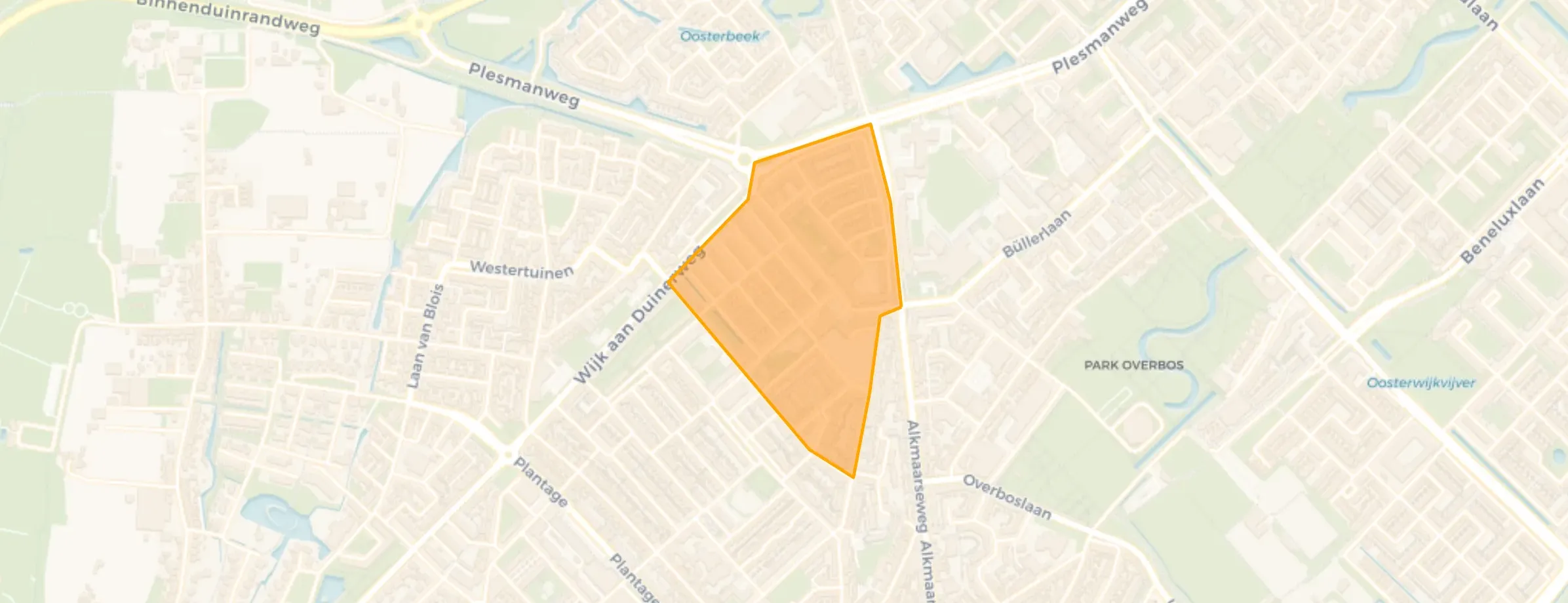
Neighbourhood in Beverwijk
Kuenenplein is located in the province of Noord-Holland, in the municipality of Beverwijk, in the district Kuenenkwartier The neighbourhood has a total area of 17 hectares, of which 17 hectares are land and 0 hectares are water. The neighbourhood is coded as BU03750302. The postcode area is 1944DW-1944XH.
Three residents rate the neighbourhood as satisfactory with a score of 5.8. They describe it as 'Cosy', 'Bad' and 'Life-threatening, but where else can you go'. Residents experience big differences in this neighbourhood: accessibility, education, amenities receive high ratings, while housing and cleanliness are mentioned as weak points.
Kuenenplein has 1.555 residents. Of these, 51,1% are men and 48,9% are women. Most residents are 25 to 45 years (31,2%). The other age groups are 28,3% for '45 to 65 years', 16,1% for '0 to 15 years', 14,1% for '65 years or older' and 10,3% for '15 to 25 years'. Of the residents, 58,2% is unmarried, 27,0% is married, 11,6% is divorced and 3,2% is widowed. 860 residents originate from the Netherlands, 205 come from Europe and 485 come from countries outside Europe.
There are 825 households in Kuenenplein. 50,3% of these are single-person households, 20,0% households without children and 29,7% households with children. The average household size is 1,9 persons.
In Kuenenplein there are 1.300 income recipients. The average income per income recipient is €28.100, which is €7.700 (22%) lower than the national average of €35.800. Per resident, the average income is €23.200, which is €6.000 (21%) lower than the national average of €29.200. Most residents of Kuenenplein are educated to an intermediate level. 46,3% have an intermediate education (HAVO, VWO or MBO 2-4), 38,0% have a lower education (VMBO or MBO 1) and 15,7% have a university or higher professional education (HBO/WO).
Of the 1.555 residents, around 60% are in paid employment, which amounts to 933 people. This is 5% lower than the national average of 65%. The majority of workers are in salaried employment (88%), while 12% are self-employed. In Kuenenplein, 29% of residents receive a benefit. The largest group is those receiving a state pension (AOW). 190 people receive this benefit.
In Kuenenplein there are 806 homes with an average assessed value (WOZ) of €257.000. Of these, around 98% are occupied and 2% unoccupied. Most homes are rental properties. This amounts to 77% rental homes and 23% owner-occupied homes. Of the homes, 23% privately owned, 72% owned by housing associations and 5% owned by other landlords. The most common construction periods in Kuenenplein are 1950-1970 (69%) and 1990-2000 (12%).
There are currently no homes for sale in Kuenenplein. The most recently listed home is Grote Houtweg 172 by Van Gulik Makelaars. No homes were sold in Kuenenplein over the past year.
There are currently no homes for rent in Kuenenplein. The most recent home is Wijk aan Duinerweg 171P, offered by Teer Heerhugowaard op Funda. No homes were let in Kuenenplein over the past year.
No recent rental data available for Kuenenplein.
In Kuenenplein there are 810 addresses with a registered energy label. The most common labels are C (38%), A (12%) and D (10%). On average, an address in Kuenenplein uses 2.030 kWh of electricity per year. This is 28% below the national average of 2.810 kWh. With an annual consumption of 880 m³ per address, natural gas consumption is 31% below the national average of 1.280 m³.
Most residents are very helpful
Auto-translated to English by AIAll addicts and troublemakers, everyone dumps their rubbish bags next to the containers, nobody cleans up their mess. You call the police 100 times but they can't do anything either, a lost neighbourhood.
Auto-translated to English by AIThe grass grows up to your shoulders on fields meant for dogs, and playgrounds for children are life-threatening. The houses are heavily mouldy inside and outside the panels of the apartment block are rotting away. The newer flats are being renovated, but the flats that are severely uninhabitable and a danger to your own life are skipped not only in renovation but also in maintenance. If you complain about it to the housing association, they say they can't do anything about it and you have to solve it yourself, and even if they say they will work on it, no one ever shows up to actually do it. The weeds in front of the door almost reach the windows of the residents on the first floor. Most neighbours don't bother each other and get along fine, but we don't have a real bond either and we are largely satisfied with that.
Auto-translated to English by AI
The most common type is flats (64%).
Over the past year a home for sale in Kuenenplein was listed for an average of €451,500 (€4,359 per m²).
Residents give Kuenenplein a 5.8 out of 10 based on 3 reviews. Accessibility stands out with a 8.0; cleanliness lags behind with a 2.7.
Buurt Kuenenplein has 1,555 residents. The largest age group is 25 to 45 years (31%). Notably, 50% of the households are single-person households.
A considerable share of the supply in Kuenenplein is less efficient: 29% has an E, F or G label. The average natural gas consumption per household is 880 m³ per year.
From Kuenenplein you can on average reach a supermarket at 0.4 km, a GP at 0.7 km, a railway station at 2.2 km, a primary school at 0.7 km (as the crow flies, source: CBS).

Buurtje.nl uses cookies to make the site work and to improve it. In doing so, we process data such as your IP address and the pages you visit.
We use this data for three purposes: running the website (functional), measuring visits so we can improve Buurtje.nl (analytics), and — if you allow it — tailoring ads to your interests (marketing).
How we handle your data is described in our privacy policy. You can change your preferences at any time via 'Cookie preferences' at the bottom of every page.
Choose per category which cookies we may place. Read more in our privacy policy.