Neighbourhood in Gouda
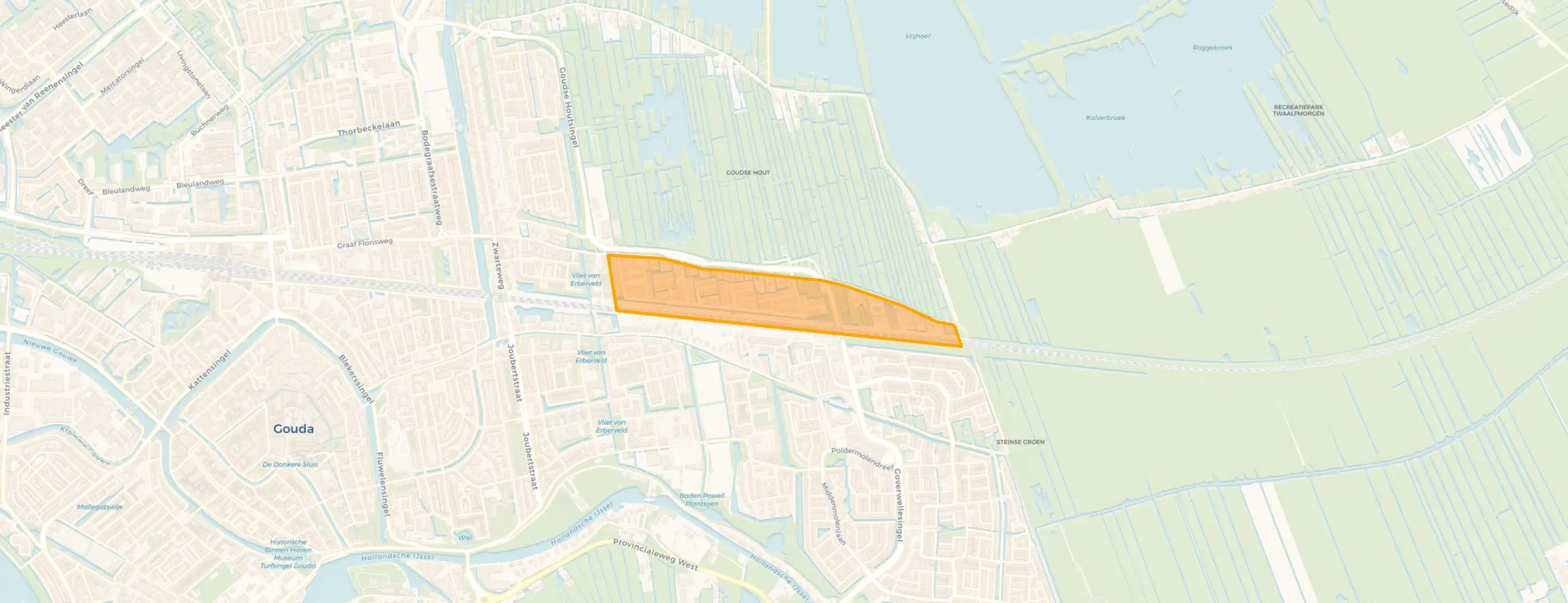
Middenwillens is located in the province of Zuid-Holland, in the municipality of Gouda, in the district Noord The neighbourhood has a total area of 26 hectares, of which 26 hectares are land and 0 hectares are water. The neighbourhood is coded as BU05130505. The postcode area is 2805KB-2805KX.
One resident rates the neighbourhood as very good with a score of 8.0. The resident describes this neighbourhood as 'Great neighbourhood'. Based on a limited number of reviews, no clear trends are visible yet in this neighbourhood.
Middenwillens has 1.130 residents. Of these, 51,3% are men and 48,2% are women. Most residents are 0 to 15 years (26,5%). The other age groups are 26,1% for '25 to 45 years', 23,5% for '45 to 65 years', 15,5% for '15 to 25 years' and 8,8% for '65 years or older'. Of the residents, 54,0% is unmarried, 40,7% is married, 3,1% is divorced and 1,8% is widowed. 900 residents originate from the Netherlands, 55 come from Europe and 180 come from countries outside Europe.
There are 370 households in Middenwillens. 18,9% of these are single-person households, 23,0% households without children and 58,1% households with children. The average household size is 3,1 persons. The national average is 2,1 persons.
In Middenwillens there are 800 income recipients. The average income per income recipient is €51.100, which is €8.900 (21%) higher than the national average of €42.200. Per resident, the average income is €36.900, which is €2.000 (6%) higher than the national average of €34.900. Most residents of Middenwillens are highly educated. 47,5% have a university or higher professional education (HBO/WO), 35,0% have an intermediate education (HAVO, VWO or MBO 2-4) and 17,5% have a lower education (VMBO or MBO 1).
Of the 1.130 residents, around 82% are in paid employment, which amounts to 927 people. This is 10% higher than the national average of 72%. The majority of workers are in salaried employment (81%), while 19% are self-employed. In Middenwillens, 12% of residents receive a benefit. The largest group is those receiving a state pension (AOW). 90 people receive this benefit.
In Middenwillens there are 349 homes with an average assessed value (WOZ) of €641.000. Of these, around 99% are occupied and 1% unoccupied. Most homes are owner-occupied. This amounts to 22% rental homes and 78% owner-occupied homes. Of the homes, 78% privately owned, 10% owned by housing associations and 12% owned by other landlords. The most common construction periods in Middenwillens are 2010-2020 (73%) and 2000-2010 (20%).
There are currently no homes for sale in Middenwillens. The most recently listed home is Citroenvlinderstraat 16 by Kolpa van der Hoek Oostvoorne. Over the past year, 12 homes were sold in Middenwillens. On average, a home was sold within 22 days.
There are currently no homes for rent in Middenwillens. The most recent home is Middenwillenseweg 79, offered by Stienstra op Pararius. Over the past year, 1 homes were let in Middenwillens. On average, a listing was let within 3 days.
No recent rental data available for Middenwillens.
In Middenwillens there are 268 addresses with a registered energy label. The most common labels are A (83%), A+ (9%) and B (3%). On average, an address in Middenwillens uses 3.180 kWh of electricity per year. This is 25% above the national average of 2.550 kWh. With an annual consumption of 780 m³ per address, natural gas consumption is 3% below the national average of 800 m³.
It's a great neighbourhood, with many growing children and families, unfortunately the education in Goverwelle is not so good and the good primary schools are far away.
Auto-translated to English by AIThe housing stock is mainly post-war — 57% was built between 1945 and 1990. In addition, the most common type is terraced houses (41%).
Over the past year a home for sale in Middenwillens was listed for an average of €414,792 (€4,688 per m²). That is 22% below the Dutch national average.
A rental home in Middenwillens cost an average of €1,308 per month (€16 per m²). That is 39% below the national average.
Buurt Middenwillens has 1,130 residents. Many families: 58% of the households have children.
A considerable share of the supply in Middenwillens is less efficient: 25% has an E, F or G label. The average natural gas consumption per household is 780 m³ per year.
From Middenwillens you can on average reach a supermarket at 1.3 km, a GP at 1.4 km, a railway station at 2.2 km, a primary school at 1.1 km (as the crow flies, source: CBS).