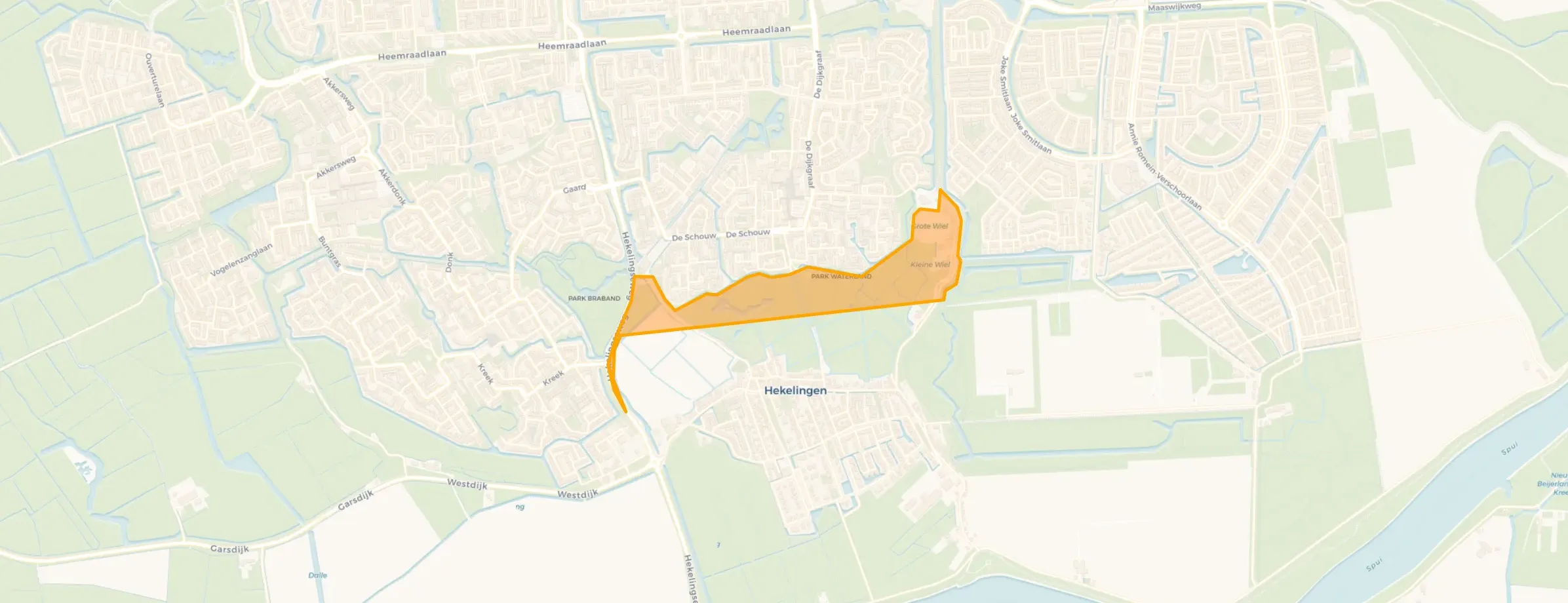
Neighbourhood in Nissewaard
Park Waterland is located in the province of Zuid-Holland, in the municipality of Nissewaard, in the district Waterland The neighbourhood has a total area of 24 hectares, of which 21 hectares are land and 2 hectares are water. The neighbourhood is coded as BU19301411. The postcode area is 3205LA-3205SB.
Park Waterland has 50 residents. Of these, 50,0% are men and 50,0% are women. Most residents are 25 to 45 years (30,0%). The other age groups are 20,0% for '0 to 15 years', 20,0% for '45 to 65 years', 20,0% for '65 years or older' and 10,0% for '15 to 25 years'. Of the residents, 30,0% is unmarried, 50,0% is married, 10,0% is divorced and 10,0% is widowed. 50 residents originate from the Netherlands and 5 come from Europe.
There are 20 households in Park Waterland. 0,0% of these are single-person households, 50,0% households without children and 50,0% households with children. The average household size is 2,7 persons.
Most residents of Park Waterland are highly educated. 33,3% have a university or higher professional education (HBO/WO), 33,3% have an intermediate education (HAVO, VWO or MBO 2-4) and 33,3% have a lower education (VMBO or MBO 1).
In Park Waterland, 20% of residents receive a benefit. The largest group is those receiving a state pension (AOW). 10 people receive this benefit.
In Park Waterland there are 19 homes. The most common construction periods in Park Waterland are 1980-1990 (25%) and 1950-1970 (15%).
There are currently no homes for sale in Park Waterland. No homes were sold in Park Waterland over the past year.
There are currently no homes for rent in Park Waterland. No homes were let in Park Waterland over the past year.
No recent rental data available for Park Waterland.
In Park Waterland there are 17 addresses with a registered energy label. The most common labels are B (29%), A (18%) and C (18%). On average, an address in Park Waterland uses 4.150 kWh of electricity per year. This is 48% above the national average of 2.810 kWh. Natural gas consumption, at 1.480 m³ per year, is 16% above the national average of 1.280 m³.


Buurtje.nl uses cookies to make the site work and to improve it. In doing so, we process data such as your IP address and the pages you visit.
We use this data for three purposes: running the website (functional), measuring visits so we can improve Buurtje.nl (analytics), and — if you allow it — tailoring ads to your interests (marketing).
How we handle your data is described in our privacy policy. You can change your preferences at any time via 'Cookie preferences' at the bottom of every page.
Choose per category which cookies we may place. Read more in our privacy policy.