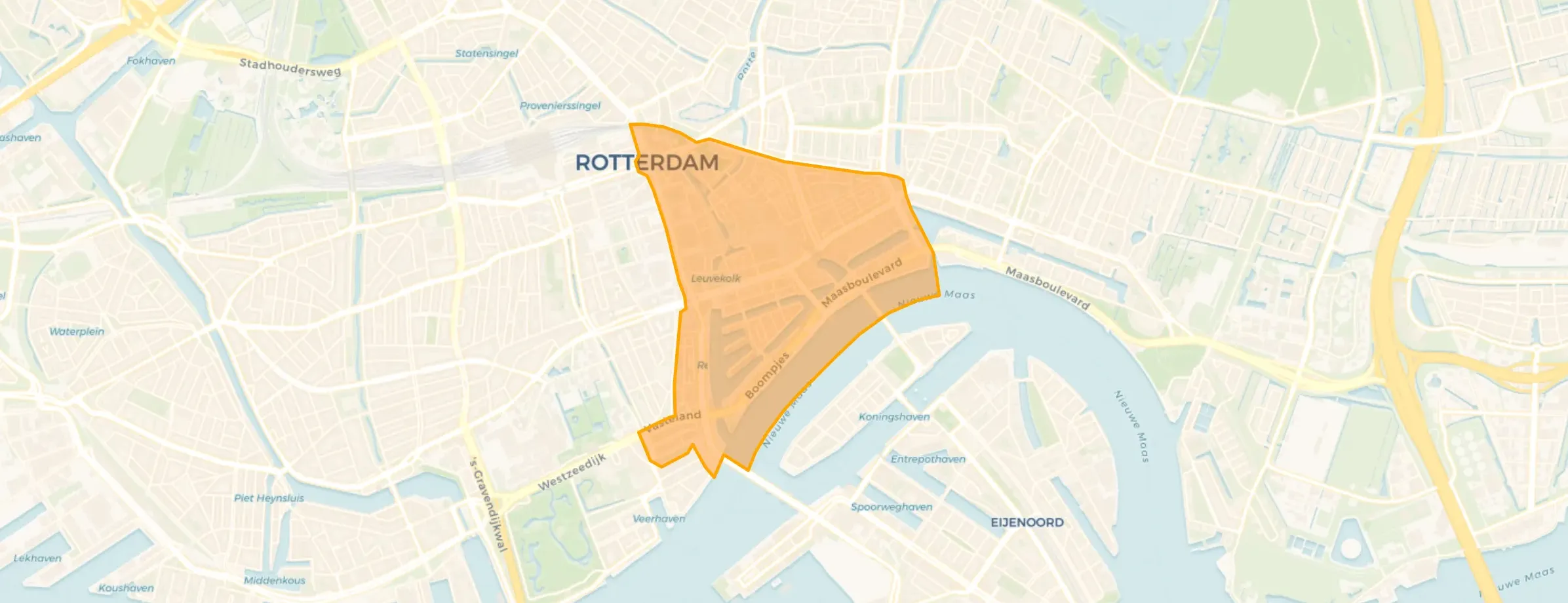
Neighbourhood in Rotterdam
Stadsdriehoek is located in the province of Zuid-Holland, in the municipality of Rotterdam, in the district Rotterdam Centrum The neighbourhood has a total area of 173 hectares, of which 136 hectares are land and 37 hectares are water. The neighbourhood is coded as BU05990110. The postcode area is 3011AA-3032EM.
Seven residents rate the neighbourhood as good with a score of 7.2. They describe it as 'Ideal location', 'Criminal drug neighbourhood next to the city.' and 'A Pleasant Living Environment with Room for Improvement'. Residents experience big differences in this neighbourhood: amenities, accessibility, safety receive high ratings, while cleanliness and greenery are mentioned as weak points.
Stadsdriehoek has 20.440 residents. Of these, 52,9% are men and 47,1% are women. Most residents are 25 to 45 years (44,6%). The other age groups are 20,2% for '15 to 25 years', 18,4% for '45 to 65 years', 9,8% for '65 years or older' and 6,9% for '0 to 15 years'. Of the residents, 72,7% is unmarried, 18,7% is married, 6,8% is divorced and 1,9% is widowed. 8.190 residents originate from the Netherlands, 3.855 come from Europe and 8.395 come from countries outside Europe.
There are 12.365 households in Stadsdriehoek. 63,2% of these are single-person households, 25,9% households without children and 10,9% households with children. The average household size is 1,5 persons.
In Stadsdriehoek there are 14.400 income recipients. The average income per income recipient is €48.200, which is €12.400 (35%) higher than the national average of €35.800. Per resident, the average income is €43.300, which is €14.100 (48%) higher than the national average of €29.200. Most residents of Stadsdriehoek are highly educated. 57,3% have a university or higher professional education (HBO/WO), 30,0% have an intermediate education (HAVO, VWO or MBO 2-4) and 12,7% have a lower education (VMBO or MBO 1).
Of the 20.440 residents, around 67% are in paid employment, which amounts to 13.695 people. This is 2% higher than the national average of 65%. The majority of workers are in salaried employment (85%), while 15% are self-employed. In Stadsdriehoek, 14% of residents receive a benefit. The largest group is those receiving a state pension (AOW). 1.730 people receive this benefit.
In Stadsdriehoek there are 10.409 homes with an average assessed value (WOZ) of €415.000. Of these, around 93% are occupied and 7% unoccupied. Most homes are rental properties. This amounts to 69% rental homes and 31% owner-occupied homes. Of the homes, 31% privately owned, 18% owned by housing associations and 51% owned by other landlords. The most common construction periods in Stadsdriehoek are 1950-1970 (23%) and 1980-1990 (21%).
There are currently 217 homes for sale in Stadsdriehoek. The most recently listed home is Schilderstraat 20D by Kolpa van der Hoek Makelaars Rotterdam op Funda. Over the past year, 700 homes were sold in Stadsdriehoek. On average, a home was sold within 71 days.
The average asking price for a home for sale in Stadsdriehoek over the past year was €526.858. This is 27% higher than the average assessed value (WOZ) of €415.000. The average asking price per m² of plot is €5.605.
There are 178 homes for rent in Stadsdriehoek. The most recent home is Burgemeester van Walsumweg 218, offered by Schep Vastgoedmakelaars. Over the past year, 1.471 homes were let in Stadsdriehoek. On average, a listing was let within 30 days.
The average rent for a rental home in Stadsdriehoek over the past year was €2.296 per month. Per m² of plot area that is €24 per month.
In Stadsdriehoek there are 13.192 addresses with a registered energy label. The most common labels are A (34%), C (20%) and B (18%). On average, an address in Stadsdriehoek uses 2.000 kWh of electricity per year. This is 29% below the national average of 2.810 kWh. With an annual consumption of 100 m³ per address, natural gas consumption is 92% below the national average of 1.280 m³.
Lived there during my student days
Auto-translated to English by AII live diagonally opposite a coffee shop. When the coffee shop is closed, dealing continues cheerfully in a parking lot that I look out onto from my apartment. I really don't find that pleasant or safe. And my porch is used as a toilet by homeless people, which is also not very pleasant. This is because close to where I live there is a Salvation Army shelter.
Auto-translated to English by AIThe neighbourhood, to which I gave a satisfactory rating on the aspects of community, hygiene, housing, education, green spaces, amenities and accessibility, generally offers a pleasant living environment. The community is friendly and approachable, with residents who often know each other and occasionally come together for neighbourhood activities. However, there is room for more initiatives to further promote social cohesion. Regarding hygiene, the neighbourhood is well-maintained and predominantly clean, although in some places more attention to litter and maintenance would be desirable. The housing stock is diverse and offers a good mix of apartments, terraced houses and detached houses, which are generally in good condition. House prices are acceptable, but there may be some pressure on the housing market due to the popularity of the area. Educational facilities are adequate, with sufficient primary and secondary schools in the vicinity. The quality of the schools is average to good, but parents looking for specific types of education may have to rely on surrounding neighbourhoods. Green spaces are present and provide a pleasant environment where residents can walk, exercise or relax. However, some parts of the neighbourhood would benefit from more or better maintained green areas. In terms of amenities, there are plenty of shops, supermarkets and sports facilities nearby, making daily life easy. The accessibility of the neighbourhood is also good, both by car and public transport, connecting the area to the city and other neighbourhoods. In summary, the neighbourhood is pleasant to live in, but there is room for improvement in some areas.
Auto-translated to English by AIThe centre is very dynamic and great to visit if you like to go out. Living there is different from visiting. It's not very tidy, relatively many tourists with different norms and values, and little greenery. You're surrounded by tall buildings and partying students who leave mess behind at the weekend. Furthermore, the neighbourhood is perfectly accessible thanks to good public transport and there are many shops and restaurants.
Auto-translated to English by AIThe neighbourhood is perfect if you want to live centrally in Rotterdam while avoiding extreme crowds on the street. All amenities are within walking distance and you can reach all parts of the city by metro.
Auto-translated to English by AIStadsdriehoek is ideal to live in. Public transport, shops and supermarkets are very close by. You can do everything on foot. A downside of Stadsdriehoek is sometimes noise pollution. You know this in advance when you come to live here, but for me it's mainly about noise pollution on the Meent. Many people with faster cars often deliberately drive very hard through the street. This causes a lot of noise pollution and unrest. The municipality is already working on a campaign to keep faster cars out of the city centre. Finally, there is always something fun in the city or to watch from your balcony. In other neighbourhoods in Rotterdam you don't have that!
Auto-translated to English by AIPros: 1 minute from the centre, cosy, metro easily accessible Cons: - cars can drive very fast - it's mainly apartments (buildings), so when you walk home at night there's really no one to be seen and that's a bit scary.
Auto-translated to English by AI
The housing stock is relatively young — 57% dates from after 1990. In addition, the most common type is flats (99%).
Over the past year a home for sale in Stadsdriehoek was listed for an average of €495,060 (€5,818 per m²).
A rental home in Stadsdriehoek cost an average of €2,200 per month (€26 per m²).
Residents give Stadsdriehoek a 7.2 out of 10 based on 7 reviews. Especially amenities (9.1) scores well; nature and greenery (5.3) receives the lowest rating.
Buurt Stadsdriehoek has 20,440 residents. The largest age group is 25 to 45 years (45%). Notably, 63% of the households are single-person households.
The housing supply in Stadsdriehoek is remarkably efficient: 75% has an A, A+ or B label. The average natural gas consumption per household is 100 m³ per year.
From Stadsdriehoek you can on average reach a supermarket at 0.4 km, a GP at 0.5 km, a railway station at 1.0 km, a primary school at 0.7 km (as the crow flies, source: CBS).
Right now you will find 241 homes for sale and 239 homes for rent in Stadsdriehoek. A home for sale here is listed for an average of 86 days — relatively long for the current market.

Buurtje.nl uses cookies to make the site work and to improve it. In doing so, we process data such as your IP address and the pages you visit.
We use this data for three purposes: running the website (functional), measuring visits so we can improve Buurtje.nl (analytics), and — if you allow it — tailoring ads to your interests (marketing).
How we handle your data is described in our privacy policy. You can change your preferences at any time via 'Cookie preferences' at the bottom of every page.
Choose per category which cookies we may place. Read more in our privacy policy.