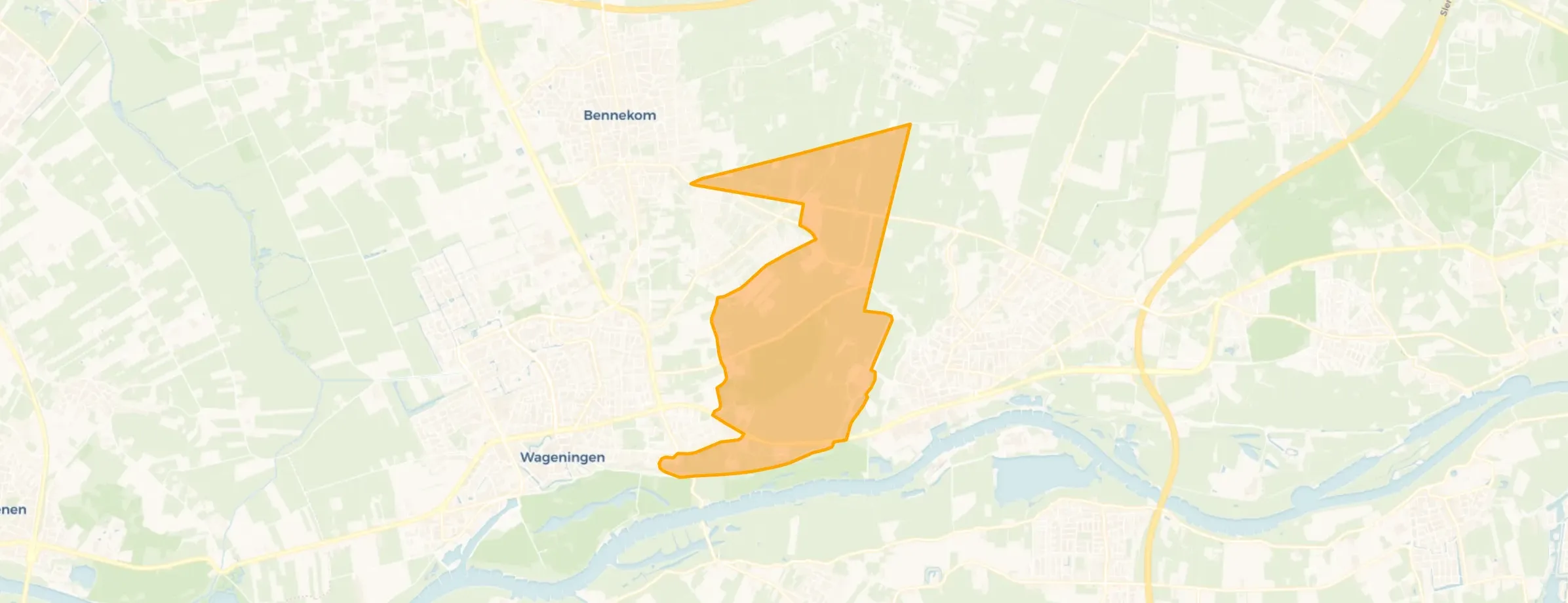
Neighbourhood in Wageningen
Wageningse Berg is located in the province of Gelderland, in the municipality of Wageningen, in the district Buitengebied The neighbourhood has a total area of 579 hectares, of which 579 hectares are land and 0 hectares are water. The neighbourhood is coded as BU02891203. The postcode area is 6703DS-6705BN.
Two residents rate the neighbourhood as very good with a score of 8.0. They describe it as 'Calm and well-maintained' and 'Nice surroundings'. Based on a limited number of reviews, no clear trends are visible yet in this neighbourhood.
Wageningse Berg has 865 residents. Of these, 57,8% are men and 42,2% are women. Most residents are 25 to 45 years (32,9%). The other age groups are 32,4% for '65 years or older', 14,5% for '15 to 25 years', 14,5% for '45 to 65 years' and 6,4% for '0 to 15 years'. Of the residents, 46,2% is unmarried, 33,5% is married, 5,2% is divorced and 15,0% is widowed. 355 residents originate from the Netherlands, 55 come from Europe and 450 come from countries outside Europe.
There are 115 households in Wageningse Berg. 47,8% of these are single-person households, 30,4% households without children and 21,7% households with children. The average household size is 1,8 persons. The national average is 2,1 persons.
In Wageningse Berg there are 200 income recipients. The average income per income recipient is €37.100, which is €5.100 (12%) lower than the national average of €42.200. Per resident, the average income is €31.400, which is €3.500 (10%) lower than the national average of €34.900. Most residents of Wageningse Berg are educated to a lower level. 61,9% have a lower education (VMBO or MBO 1), 26,2% have a university or higher professional education (HBO/WO) and 11,9% have an intermediate education (HAVO, VWO or MBO 2-4).
In Wageningse Berg, 32% of residents receive a benefit. The largest group is those receiving a state pension (AOW). 250 people receive this benefit.
In Wageningse Berg there are 162 homes with an average assessed value (WOZ) of €351.000. Of these, around 91% are occupied and 9% unoccupied. Most homes are rental properties. This amounts to 79% rental homes and 21% owner-occupied homes. Of the homes, 21% privately owned, 16% owned by housing associations and 63% owned by other landlords. The most common construction periods in Wageningse Berg are 1925-1950 (32%) and 1900-1925 (20%).
There is currently 1 homes for sale in Wageningse Berg. The most recently listed home is Keijenbergseweg 24 by Barten Tiemessen NVM Makelaars. Over the past year, 1 homes were sold in Wageningse Berg. On average, a home was sold within 130 days.
The average asking price for a home for sale in Wageningse Berg over the past year was €925.000. This is 164% higher than the average assessed value (WOZ) of €351.000. The average asking price per m² of plot is €4.818.
There are currently no homes for rent in Wageningse Berg. No homes were let in Wageningse Berg over the past year.
No recent rental data available for Wageningse Berg.
In Wageningse Berg there are 120 addresses with a registered energy label. The most common labels are F (61%), B (17%) and C (10%). On average, an address in Wageningse Berg uses 2.310 kWh of electricity per year. This is 9% below the national average of 2.550 kWh. Natural gas consumption, at 890 m³ per year, is 11% above the national average of 800 m³.
This neighbourhood is one of the most beautiful in the area, it's gorgeous. The people are friendly but keep to themselves. Unfortunately, there are no neighbourhood activities like barbecues or parties. The neighbourhood group chat is active, which gives a sense of trust. The residents are relatively old, there are few children, which can be difficult as a family. But luckily there are a few exceptions. The neighbourhood is kept very tidy and it's very hygienic. There are very few amenities; you often have to leave the neighbourhood for them. For example, there is no school, pharmacy/GP/dentist or supermarket. There is one large playing field. The neighbourhood is relatively far from the centre but easily accessible. The neighbourhood feels safe apart from the occasional burglary every now and then. But that's to be expected since it's a relatively high-income neighbourhood. The surroundings are also beautiful, with the Belmonte Arboretum, the woods and the floodplains.
Auto-translated to English by AIA bit of a dull and wealthy neighbourhood. Lots of detached houses. As a result, contact with neighbours is less than with terraced houses. The neighbourhood is nice though, as there is also an arboretum next to it and it is located on the Wageningse berg. It is a clean neighbourhood and I always feel safe. There is a school relatively nearby with good education. Accessibility is good for both cycling and cars.
Auto-translated to English by AIThe housing stock is predominantly pre-war — 57% of the homes date from before 1945. In addition, the most common type is flats (47%).
Over the past year a home for sale in Wageningse Berg was listed for an average of €1,048,548 (€4,365 per m²). That is 98% above the Dutch national average.
Buurt Wageningse Berg has 865 residents. The largest age group is 25 to 45 years (33%).
The housing supply in Wageningse Berg is remarkably efficient: 53% has an A, A+ or B label. The average natural gas consumption per household is 890 m³ per year.
From Wageningse Berg you can on average reach a supermarket at 2.2 km, a GP at 2.0 km, a railway station at 7.0 km, a primary school at 2.1 km (as the crow flies, source: CBS).







