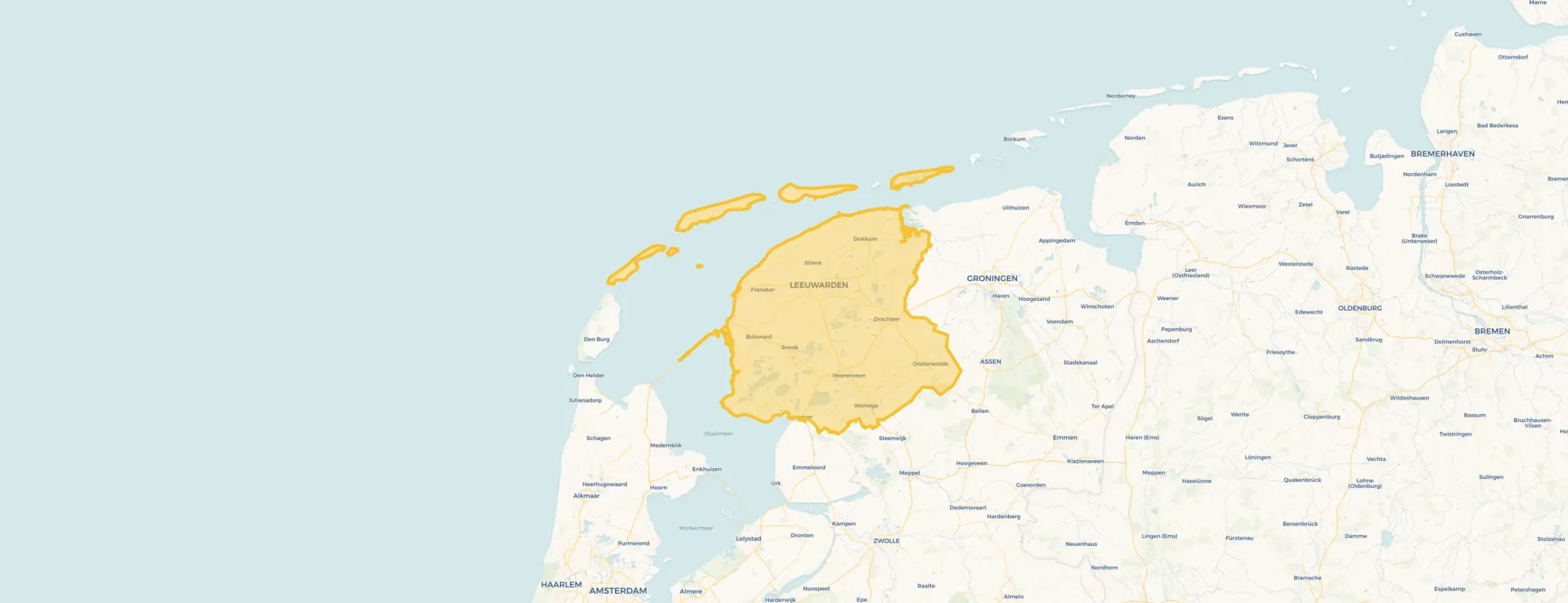
Province in the Netherlands
Friesland is famous for its eleven cities, lakes and its own language, Frisian. The province has a total area of 575.327 hectares, of which 334.011 hectares are land and 241.315 hectares are water. The province is coded as PV21. The postcode area is 8388MA-9873TK.
Friesland has 664.222 residents. Of these, 50,2% are men and 49,8% are women. Most residents are 45 to 65 years (27,0%). The other age groups are 23,5% for '65 years or older', 22,6% for '25 to 45 years', 14,8% for '0 to 15 years' and 12,1% for '15 to 25 years'. Of the residents, 47,9% is unmarried, 38,9% is married, 7,8% is divorced and 5,5% is widowed. 575.857 residents originate from the Netherlands, 32.065 come from Europe and 56.300 come from countries outside Europe.
There are 306.801 households in Friesland. 38,6% of these are single-person households, 30,4% households without children and 31,1% households with children. The average household size is 2,1 persons. The national average is 2,1 persons.
In Friesland there are 536.400 income recipients. The average income per income recipient is €36.947, which is €5.253 (12%) lower than the national average of €42.200. Per resident, the average income is €30.685, which is €4.215 (12%) lower than the national average of €34.900. Most residents of Friesland are educated to an intermediate level. 46,7% have an intermediate education (HAVO, VWO or MBO 2-4), 26,7% have a lower education (VMBO or MBO 1) and 26,6% have a university or higher professional education (HBO/WO).
Of the 664.222 residents, around 71% are in paid employment, which amounts to 471.598 people. This is 1% lower than the national average of 72%. The majority of workers are in salaried employment (82%), while 18% are self-employed. In Friesland, 29% of residents receive a benefit. The largest group is those receiving a state pension (AOW). 140.370 people receive this benefit.
In Friesland there are 312.294 homes with an average assessed value (WOZ) of €303.728. Of these, around 96% are occupied and 4% unoccupied. Most homes are owner-occupied. This amounts to 38% rental homes and 62% owner-occupied homes. Of the homes, 62% privately owned, 26% owned by housing associations and 12% owned by other landlords. The most common construction periods in Friesland are 1950-1970 (18%) and 1970-1980 (18%).
There are currently no homes for sale in Friesland. The most recently listed home is S. van der Molenstrjitte 5 by Stegenga Makelaars op Funda. No homes were sold in Friesland over the past year.
There are currently no homes for rent in Friesland. The most recent home is Molenkrite 74, offered by www.frieslandhuurt.nl. No homes were let in Friesland over the past year.
No recent rental data available for Friesland.
In Friesland there are 207.504 addresses with a registered energy label. The most common labels are A (31%), C (23%) and B (16%). On average, an address in Friesland uses 2.504 kWh of electricity per year. This is 2% below the national average of 2.550 kWh. Natural gas consumption, at 911 m³ per year, is 14% above the national average of 800 m³.








Voldoende ruimte voor rustige woonomgeving, waarbij we te maken hebben met t merendeel slecht geïsoleerde woningen met gehorige bouw. Groter percentage ouderen ook alleenstaanden welke niet door kunnen stromen naar leeftijdsbestendige woningbouw in eigen dorp of gemeente. Omdat t sociale netwerk belangrijk is met een dorp op afstand van stad, is het openbaar vervoer essentieel. De inkomens liggen gemiddeld lager dus de noodzaak voor betaalbaarheid van woning en zorg is essentieel
Auto-translated to English by AIYou can sum it up as follows: > My experience with the Bloemenbuurt is very negative. In two consecutive situations, we had neighbours who caused a lot of nuisance. There were concerns about drug activities, the safety of children, and serious incidents in the neighbourhood, including a car explosion. As a result, I don't feel safe here and I wouldn't choose to live in this neighbourhood myself. The housing is reasonable, but in my opinion, the houses on Azaleastraat are in need of a thorough renovation. Additionally, there are few to no amenities in the immediate vicinity, which does not improve the liveability of the neighbourhood. Based on my personal experiences, I would therefore not recommend the Bloemenbuurt as a place to live.
Auto-translated to English by AIAtmospheric neighbourhood with nice neighbours. Houses with a stately character interspersed with smaller workers' cottages. You can feel the history, you can walk straight into the city centre.
Auto-translated to English by AItoo few bus connections cannot always plan the call bus the early and late times are also inconvenient long walk to the stop facilities: an extra restaurant would be nice and a butcher
Auto-translated to English by AIA quiet neighbourhood where people know each other and are involved with one another. Many beautiful houses on very spacious plots.
Auto-translated to English by AIeverywhere drunk people, many empty dilapidated houses
Auto-translated to English by AIyes
Auto-translated to English by AIOur village is quiet and nothing happens because there is very little here.
Auto-translated to English by AIOver the past year a home for sale in Friesland was listed for an average of €442,579 (€3,322 per m²). That is 16% below the Dutch national average.
A rental home in Friesland cost an average of €1,137 per month (€14 per m²). That is 47% below the national average.
Residents give Friesland a 7.8 out of 10 based on 249 reviews.
The housing supply in Friesland is remarkably efficient: 50% has an A, A+ or B label. The average natural gas consumption per household is 911 m³ per year.
From Friesland you can on average reach a supermarket at 1.5 km, a GP at 1.6 km, a railway station at 8.8 km, a primary school at 0.9 km (as the crow flies, source: CBS).
Right now you will find 4,606 homes for sale and 297 homes for rent in Friesland.