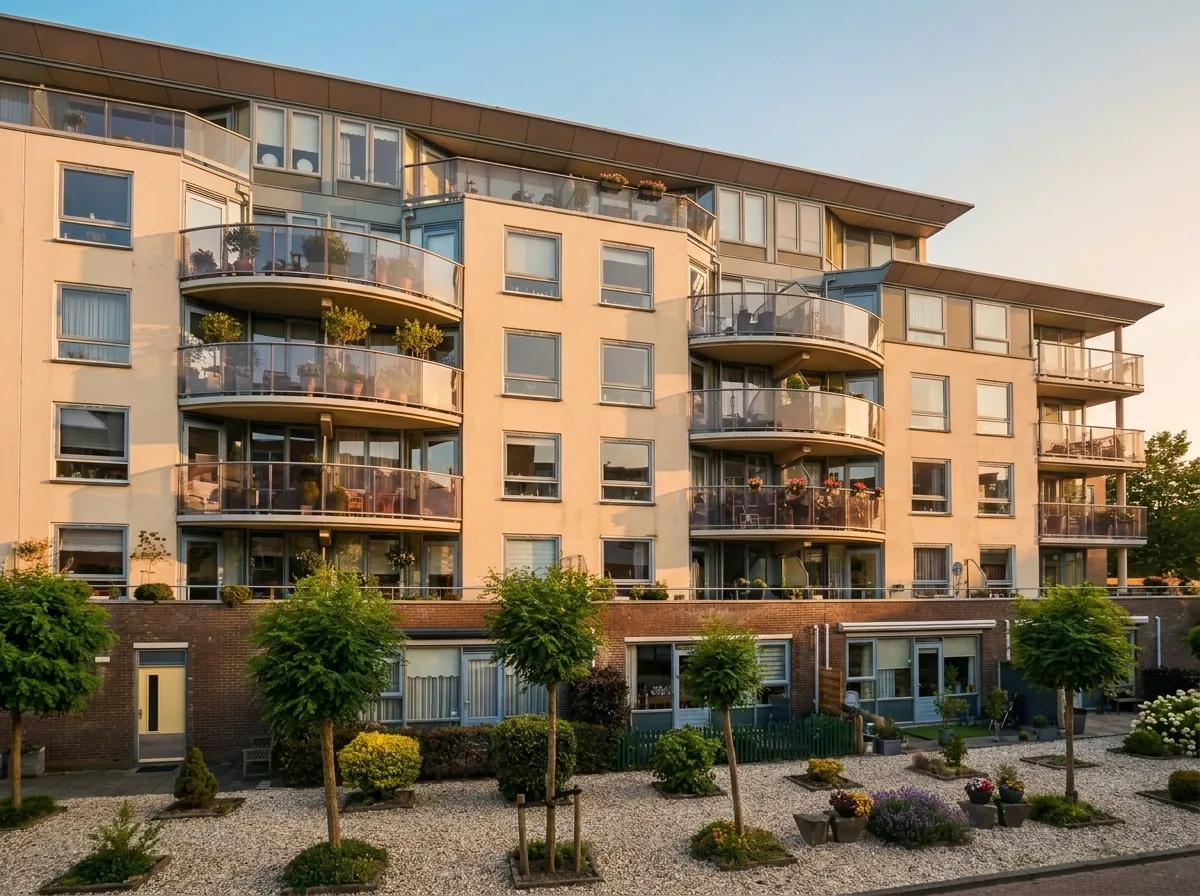
When you buy an apartment, you are not just buying a home but also a share in the entire building. The roof, the facade, the foundation and the stairwell are shared property, managed by the Vereniging van Eigenaars (VvE), the Dutch owners' association. A healthy VvE is therefore just as important as the condition of the apartment itself. Especially in cities with many apartments, such as Amsterdam, Rotterdam and Utrecht, checking the VvE should be a standard part of your buying process. Here is how to go about it.
Why you cannot avoid the VvE
When you buy an apartment, you automatically become a member of the VvE. That is not a choice: membership is legally tied to the ownership and you remain a member until you sell the apartment again. You pay monthly service charges and have a vote on maintenance and spending. The basic rules are clearly explained by the Dutch government.
Request these documents before you bid
The seller is obliged to provide information about the VvE. Request at least these documents, preferably before the viewing:
- Deed of division and division regulations: what exactly is yours and what is communal, and how large is your share of the costs.
- Multi-year maintenance plan (MJOP): what maintenance is planned for the next ten years and what it will cost.
- Minutes of the last two or three general meetings: this is where you read what is really going on, from leaks to conflicts.
- Annual accounts and budget: is the VvE financially sound and are the contributions realistic.
- Statement of the reserve fund: how much has been saved for major maintenance.
- Building insurance and house rules: is the building properly insured and which rules apply, for instance on letting or flooring.
Reserve fund and MJOP: how to judge them
Since 2018, every VvE has been legally required to reserve money for maintenance each year: at least 0.5 percent of the building's rebuild value, or an amount substantiated by an MJOP. Mandatory unfortunately does not mean it happens everywhere, so check it yourself.
Divide the reserve fund by the number of apartments and compare that with the maintenance planned in the MJOP. A fund of 40,000 euros sounds fine, but for a building with twenty apartments and a roof that needs replacing in five years it is far too little. Also look at the quality of the MJOP itself: a good plan is no more than about five years old, based on an actual inspection of the building and linked to the annual contributions in the budget.
Service charges: low is not always good news
The level of the service charges depends on the facilities: a lift, a water pressure system or a communal garden simply costs money. So do not be alarmed by a substantial monthly amount. The reverse applies too: suspiciously low service charges often mean too little is being reserved. The maintenance will come regardless, only then as a one-off levy the moment the roof starts leaking.
Red flags
- A dormant VvE: no meetings, no contributions, no reserves. Many lenders are reluctant to finance apartments with a dormant VvE, and you share in every piece of postponed maintenance.
- No or outdated MJOP: without a plan, every reservation is a guess.
- Big decisions without funding: the minutes mention a facade renovation, but the budget contains no money for it. A one-off levy is then almost certain.
- Visibly overdue maintenance: paper is patient, the facade is not. Cracks, rusting balconies or rotting woodwork sometimes tell a different story than the annual accounts. A building inspection of the communal parts then provides clarity.
- Conflicts in the minutes: a VvE that has been arguing over every expense for years rarely gets major maintenance organised on time.
What does this mean for your offer?
A poorly filled fund or announced major maintenance is not a reason to walk away immediately, but it is a reason to do the maths. An upcoming one-off levy of 10,000 euros belongs in your offer, just like structurally low service charges that will soon have to rise. Keep asking until you are sure: the seller and the managing agent are obliged to be transparent, and a serious question about the reserve fund has never killed a deal.
Want to understand the surroundings as well as the building? On Buurtje.nl you can see how residents rate their street, how the neighbourhood scores on safety and amenities, and what homes cost there. That way you can be sure you are buying not just the right apartment, but also the right neighbourhood.