District in Amsterdam
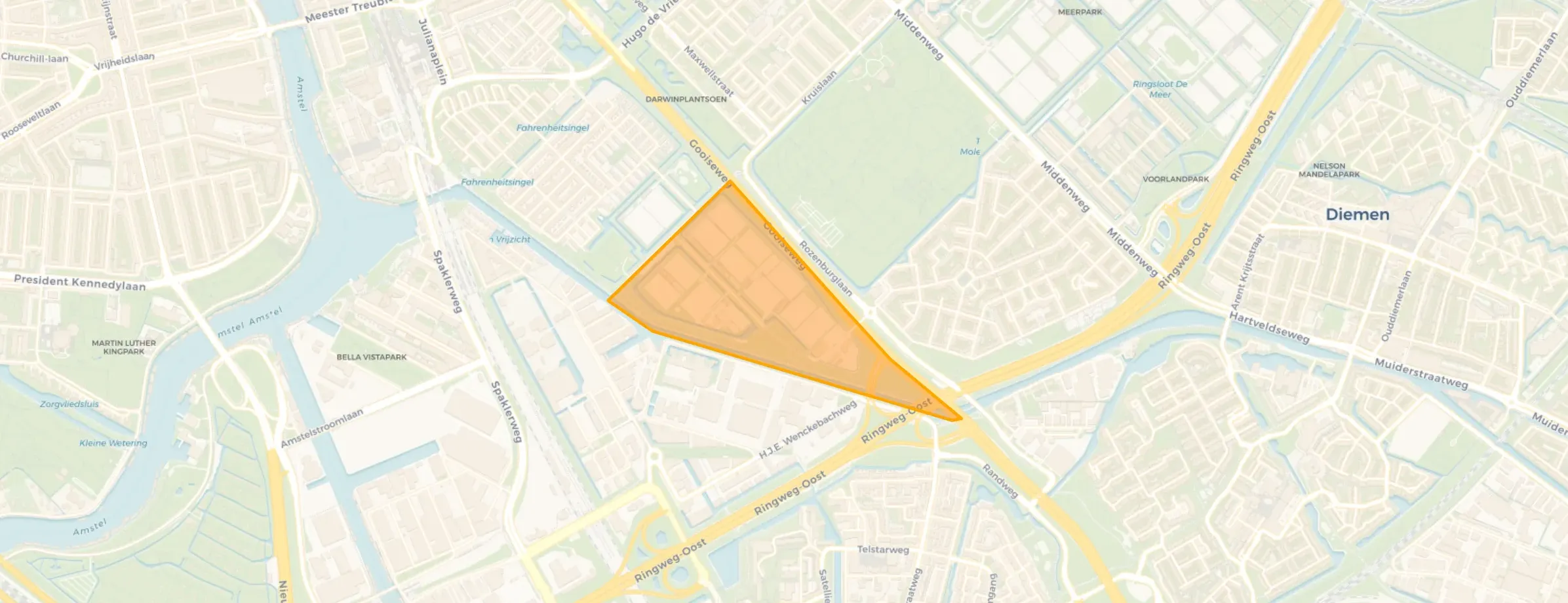
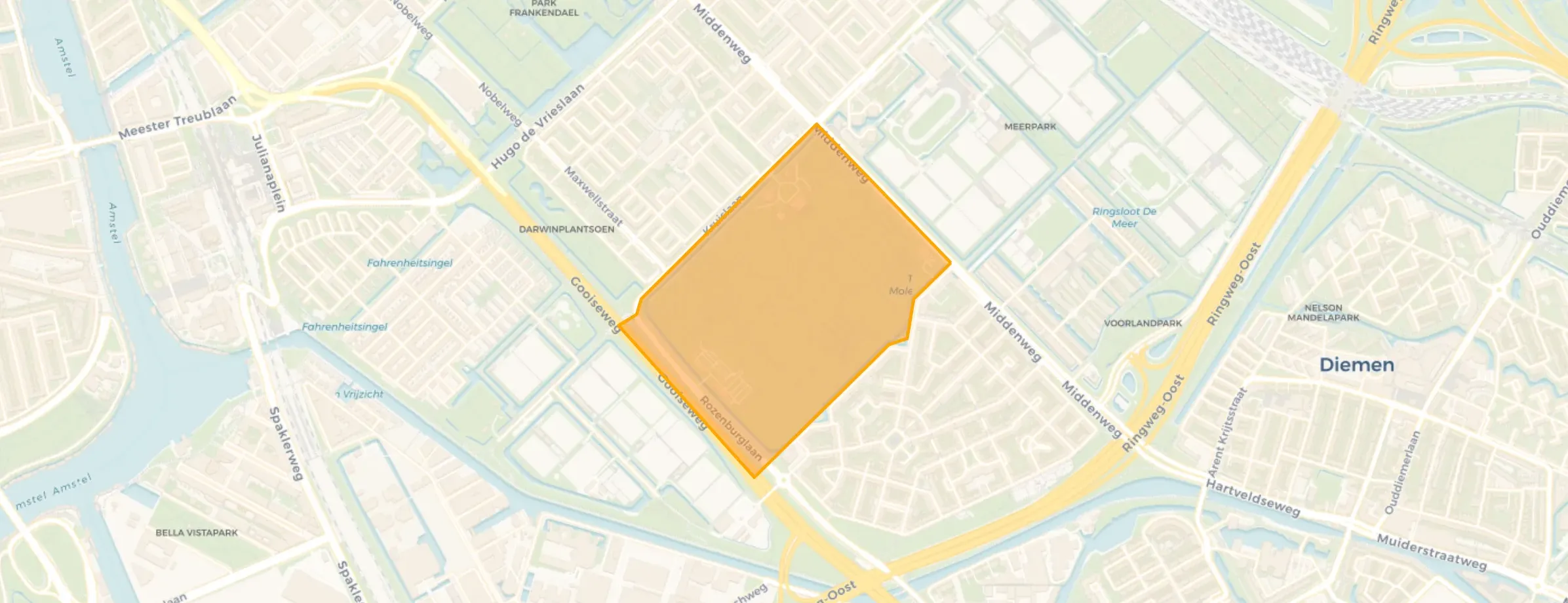
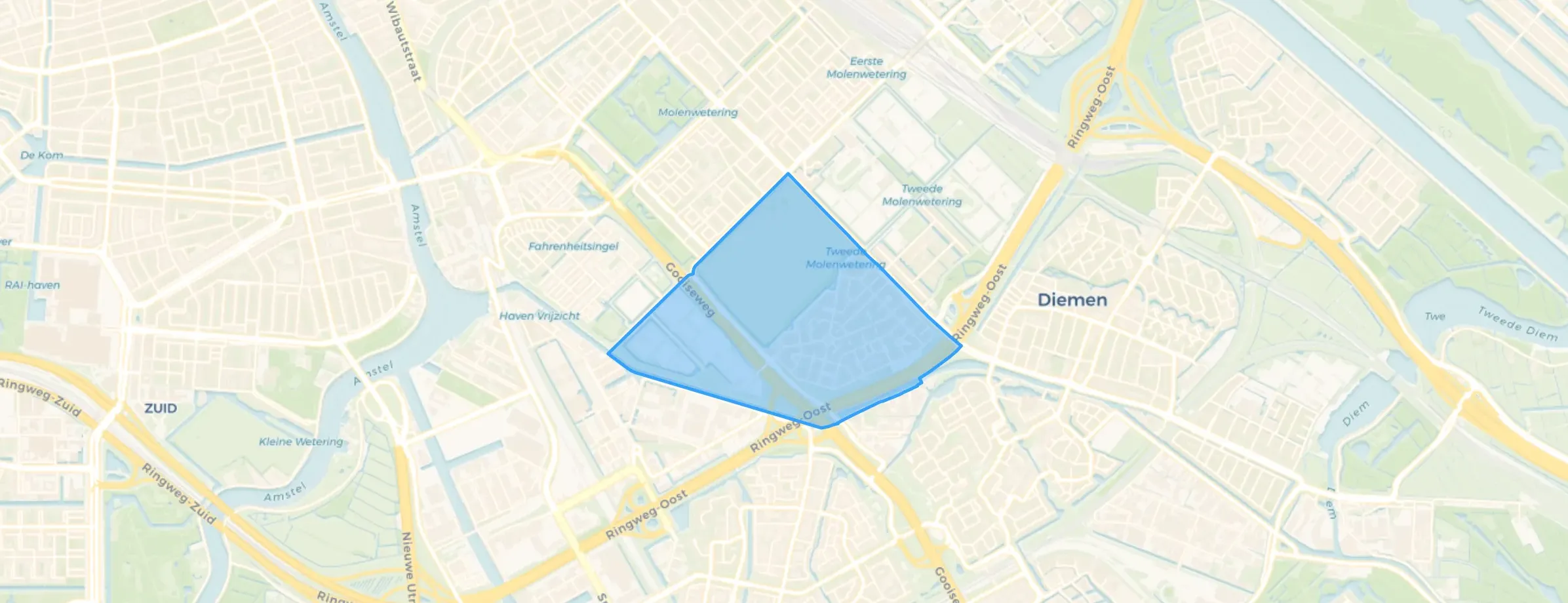
Betondorp is located in the province of Noord-Holland, in the municipality of Amsterdam The district has a total area of 113 hectares, of which 109 hectares are land and 5 hectares are water. The district is coded as WK0363MP. The postcode area is 1097EC-1097ZZ.
Betondorp has 3.010 residents. Of these, 47,2% are men and 52,8% are women. Most residents are 45 to 65 years (28,1%). The other age groups are 27,4% for '25 to 45 years', 22,8% for '65 years or older', 12,8% for '0 to 15 years' and 8,8% for '15 to 25 years'. Of the residents, 59,5% is unmarried, 22,6% is married, 13,3% is divorced and 4,7% is widowed. 1.735 residents originate from the Netherlands, 310 come from Europe and 960 come from countries outside Europe.
There are 1.825 households in Betondorp. 59,5% of these are single-person households, 18,6% households without children and 21,9% households with children. The average household size is 1,7 persons.
In Betondorp there are 2.600 income recipients. The average income per income recipient is €32.200, which is €3.600 (10%) lower than the national average of €35.800. Per resident, the average income is €27.600, which is €1.600 (5%) lower than the national average of €29.200. Most residents of Betondorp are highly educated. 40,3% have a university or higher professional education (HBO/WO), 30,0% have an intermediate education (HAVO, VWO or MBO 2-4) and 29,6% have a lower education (VMBO or MBO 1).
Of the 3.010 residents, around 56% are in paid employment, which amounts to 1.686 people. This is 9% lower than the national average of 65%. The majority of workers are in salaried employment (82%), while 18% are self-employed. In Betondorp, 34% of residents receive a benefit. The largest group is those receiving a state pension (AOW). 620 people receive this benefit.
In Betondorp there are 1.957 homes with an average assessed value (WOZ) of €453.000. Of these, around 91% are occupied and 9% unoccupied. Most homes are rental properties. This amounts to 82% rental homes and 18% owner-occupied homes. Of the homes, 18% privately owned, 78% owned by housing associations and 4% owned by other landlords. The most common construction periods in Betondorp are 1900-1925 (70%) and 1925-1950 (27%).
There are currently no homes for sale in Betondorp. The most recently listed home is Veeteeltstraat 12B by Aland Makelaars op Pararius. No homes were sold in Betondorp over the past year.
There are currently no homes for rent in Betondorp. The most recent home is Ploegstraat 36, offered by www.vva.amsterdam. No homes were let in Betondorp over the past year.
No recent rental data available for Betondorp.
In Betondorp there are 1.986 addresses with a registered energy label. The most common labels are C (30%), B (23%) and G (15%). On average, an address in Betondorp uses 1.670 kWh of electricity per year. This is 41% below the national average of 2.810 kWh. With an annual consumption of 830 m³ per address, natural gas consumption is 35% below the national average of 1.280 m³.
Quite good. When the children went to school, there was more involvement. People want to live larger when children come. So before you get to know a new resident, they've already left. Then you really miss the togetherness. But you can always turn to someone if you need someone. By placing fences between the gardens and more lighting, they try to offer more safety. Everyone is warned if something unusual happens. For all advice if you are alone, never just open the door. Call someone who can be with you quickly is always the advice.
Auto-translated to English by AIBetondorp is a village in the city of Amsterdam. At least, that's how it feels. Social but also built in a very urban way on the edge of the city. Lots of greenery and children can play outside. Various childcare options for young children. There are only few shops for daily groceries. There is a good bakery, de lekkernij, where you can also eat a sandwich or take one away. Only on Thursday mornings there is a cheese seller. There is also a café-restaurant, De Avonden, where various meals can be eaten. Or just have a drink. There is a community centre, Brinkhuis, where various activities are organised. For both young and old. But the lack of shops is a drawback. You really have to go out to do your shopping. Betondorp celebrated its 100th anniversary last year. In the past there were many shops, which have all disappeared one by one. About 40 shops, I think. There were also many more children attending school at Zuivelplein. This school now has other functions, including studios, childcare and an Islamic organisation. It would be nice if some small specialist shops would come to Betondorp. Like a mini-supermarket and a greengrocer. A place to quietly enjoy a cup of coffee with something sweet. But otherwise I am a happy resident of Betondorp. I love this green little village. I hope to live here for a long time with great pleasure.
Auto-translated to English by AIBetondorp is a nice green neighbourhood. With many low-rise buildings. People know each other and there is a village atmosphere. There is a lot of greenery in the neighbourhood and there are plans for more. Unfortunately no supermarket or grocer. But there is a very good bakery (de Lekkernij) that opens early. There is also a cosy (eatery) Cafe de Avonden. With heated terrace. In it, the Brinkhuis, a community centre where many things are organised for the neighbourhood. For example, you can enjoy a hot meal twice a week for a small fee. There are also many creative clubs in the Brinkhuis. It is nice to live in Betondorp, only a pity that there is no shop for daily groceries. There is childcare for the very young. For older children there is no school in Betondorp. Finally, for me the ideal neighbourhood, spacious, green and low-rise.
Auto-translated to English by AIUnfortunately no supermarket, but a lovely bakery where you can also sit with a terrace in summer. Community centre on the Brink, the Brinkhuis, former library, which is very active and connecting for young and old. There is a living room project by the Salvation Army where you can have coffee and a chat. It's not yet open all day. There is a lot of greenery in the neighbourhood and also many gardens, which emphasises the village character. There is a good public transport connection. Various buses and tram 19. There are several childcare options. Betondorp has a neighbourhood concierge for cultural matters, located at Onderlangs 36. They organise exhibitions and other cultural events within Betondorp that are well worth seeing. Onderlangs is the green strip around Betondorp with playground equipment and (picnic) benches. It's just a shame that rubbish is often put out too early. Disfiguring for such a beautiful place. Last year this neighbourhood celebrated its hundredth anniversary, and it was celebrated extensively. The architecture is still striking. Definitely worth a look. I have been a resident of this village for two years and every day I count myself lucky to have a house here. In a village 15 minutes from the centre of Amsterdam. Ideal.
Auto-translated to English by AIPleasant, I live nicely. Unfortunately only one bakery in the village. While it used to be bustling with shops. Now you have to leave the village for your groceries. That's not for everyone. Many elderly population. More shops, more frequent or better rubbish collection service. Enforcement. Many children playing until late in the evening.
Auto-translated to English by AII've lived here for 50 years. Of a nice neighbourhood where people knew each other, nothing is what it seems. Activities are organised quite a bit. But I miss the togetherness and care in the neighbourhood. Only a baker left, nothing more. No school anymore. Village is becoming polluted. Not only the people, but also institutions do little to nothing about it. Renovated 40 years ago, little done since. Such a shame. This is how a neighbourhood deteriorates. We have lighting everywhere, also gates for which only residents have keys. Plenty of tips via the community centre.
Auto-translated to English by AII've been living here for a year and am very satisfied. A village character but in the big city. The best of both worlds. Lots of leisure clubs. People here are involved in their surroundings and there is a lot of greenery. Both public and (front) gardens. Residents are satisfied and not without reason. There could be a few more shops, but the ones that are here are top-notch. A very nice bakery, good hairdresser and pedicure. And the Avonden (eet) café has delicious dishes and is super cosy. The Brinkhuis, the community centre, is very active with many daily activities for young and old. I hear around me that people don't move away quickly and that is very understandable.
Auto-translated to English by AI
The most common type is flats (69%).
Over the past year a home for sale in Betondorp was listed for an average of €689,166 (€8,598 per m²).
A rental home in Betondorp cost an average of €2,722 per month (€35 per m²).
Residents give Betondorp a 7.1 out of 10 based on 7 reviews. Community stands out with a 8.3; education lags behind with a 4.8.
Wijk Betondorp has 3,010 residents. Notably, 59% of the households are single-person households.
The housing supply in Betondorp is remarkably efficient: 71% has an A, A+ or B label. The average natural gas consumption per household is 830 m³ per year.
From Betondorp you can on average reach a supermarket at 1.4 km, a GP at 0.3 km, a railway station at 2.1 km, a primary school at 1.4 km (as the crow flies, source: CBS).
Right now you will find 20 homes for sale in Betondorp.

Buurtje.nl uses cookies to make the site work and to improve it. In doing so, we process data such as your IP address and the pages you visit.
We use this data for three purposes: running the website (functional), measuring visits so we can improve Buurtje.nl (analytics), and — if you allow it — tailoring ads to your interests (marketing).
How we handle your data is described in our privacy policy. You can change your preferences at any time via 'Cookie preferences' at the bottom of every page.
Choose per category which cookies we may place. Read more in our privacy policy.