District in Nijmegen
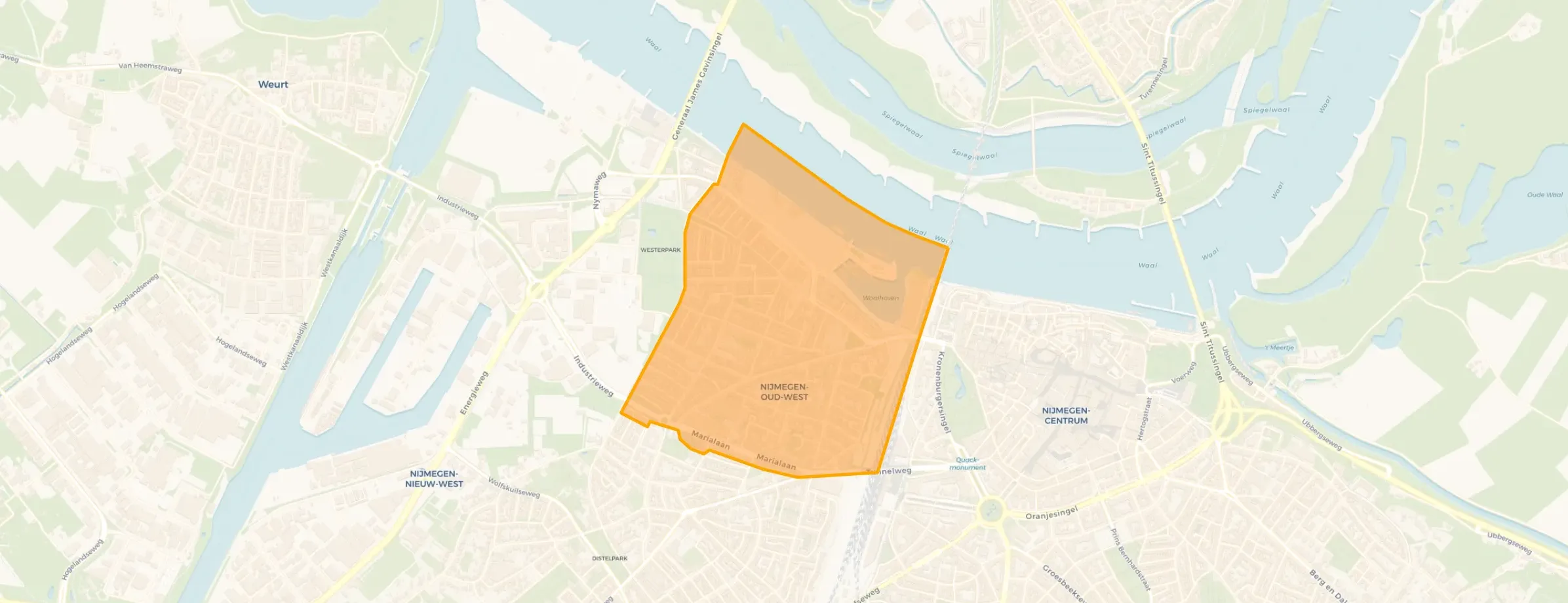
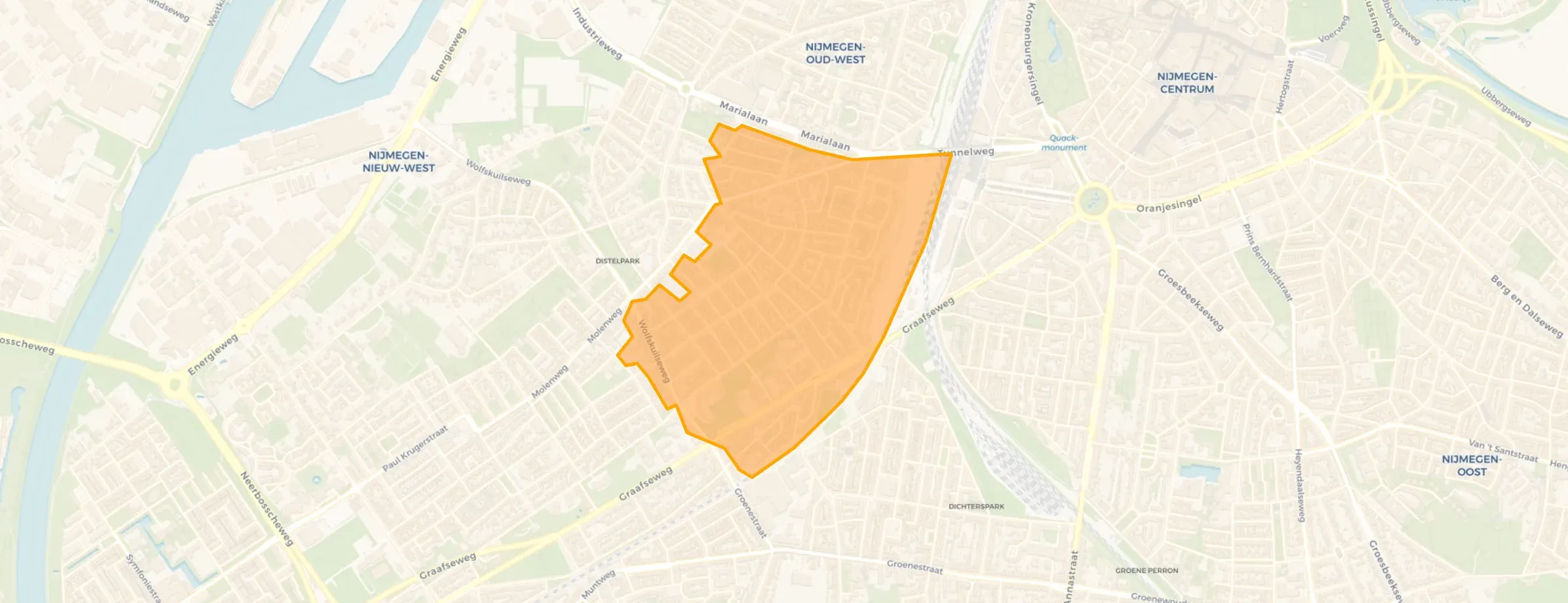
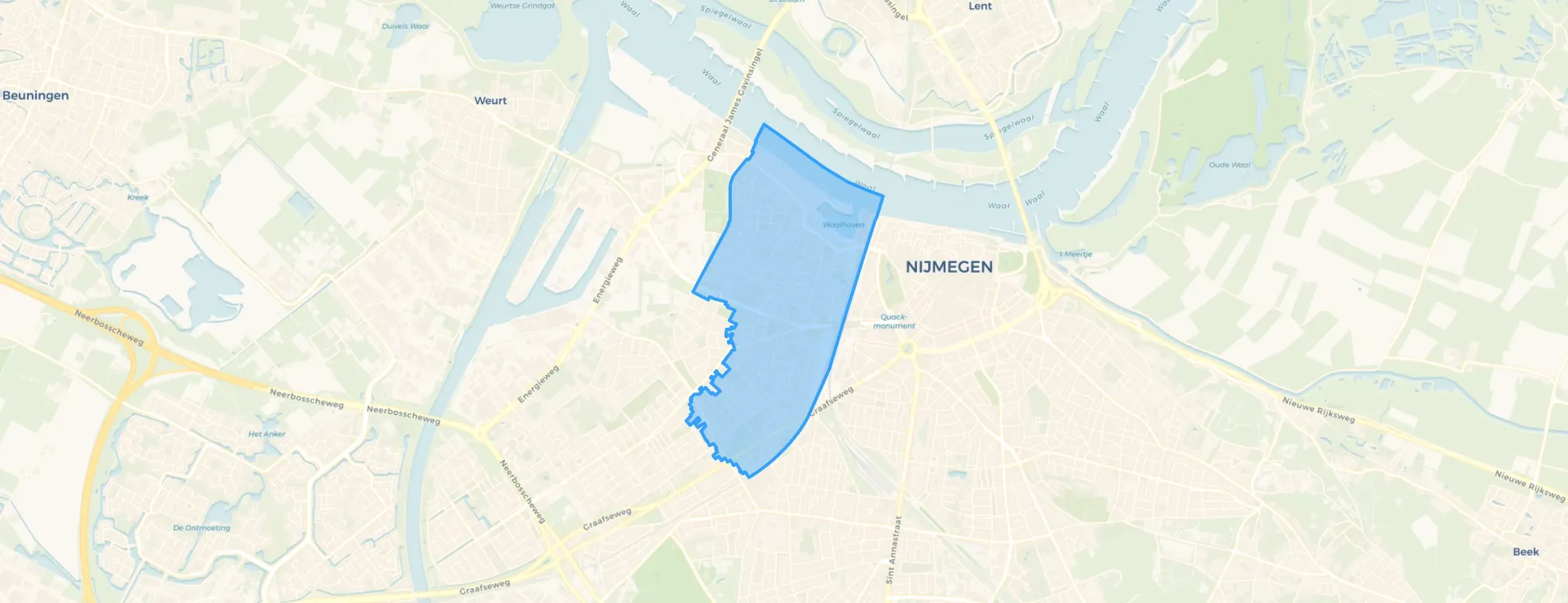
Nijmegen-Oud-West is located in the province of Gelderland, in the municipality of Nijmegen The district has a total area of 200 hectares, of which 181 hectares are land and 19 hectares are water. The district is coded as WK026803. The postcode area is 6511XV-6543SK.
Nijmegen-Oud-West has 16.100 residents. Of these, 46,9% are men and 53,1% are women. Most residents are 25 to 45 years (35,6%). The other age groups are 22,7% for '45 to 65 years', 15,8% for '15 to 25 years', 13,9% for '65 years or older' and 12,0% for '0 to 15 years'. Of the residents, 66,2% is unmarried, 22,4% is married, 8,3% is divorced and 3,1% is widowed. 11.220 residents originate from the Netherlands, 1.665 come from Europe and 3.215 come from countries outside Europe.
There are 9.325 households in Nijmegen-Oud-West. 56,8% of these are single-person households, 22,6% households without children and 20,6% households with children. The average household size is 1,7 persons.
In Nijmegen-Oud-West there are 12.700 income recipients. The average income per income recipient is €33.500, which is €2.300 (6%) lower than the national average of €35.800. Per resident, the average income is €28.600, which is €600 (2%) lower than the national average of €29.200. Most residents of Nijmegen-Oud-West are highly educated. 46,2% have a university or higher professional education (HBO/WO), 31,7% have an intermediate education (HAVO, VWO or MBO 2-4) and 22,1% have a lower education (VMBO or MBO 1).
Of the 16.100 residents, around 63% are in paid employment, which amounts to 10.143 people. This is 2% lower than the national average of 65%. The majority of workers are in salaried employment (87%), while 13% are self-employed. In Nijmegen-Oud-West, 24% of residents receive a benefit. The largest group is those receiving a state pension (AOW). 1.920 people receive this benefit.
In Nijmegen-Oud-West there are 7.656 homes with an average assessed value (WOZ) of €348.000. Of these, around 96% are occupied and 4% unoccupied. Most homes are rental properties. This amounts to 66% rental homes and 34% owner-occupied homes. Of the homes, 34% privately owned, 47% owned by housing associations and 19% owned by other landlords. The most common construction periods in Nijmegen-Oud-West are 1925-1950 (24%) and 2010-2020 (21%).
There are currently no homes for sale in Nijmegen-Oud-West. The most recently listed home is Korenbloemstraat 16 by ST Makelaars. No homes were sold in Nijmegen-Oud-West over the past year.
There are currently no homes for rent in Nijmegen-Oud-West. The most recent home is Kaapstander 42, offered by REBO Huurwoningen. No homes were let in Nijmegen-Oud-West over the past year.
No recent rental data available for Nijmegen-Oud-West.
In Nijmegen-Oud-West there are 7.985 addresses with a registered energy label. The most common labels are A (34%), C (18%) and B (13%). On average, an address in Nijmegen-Oud-West uses 2.190 kWh of electricity per year. This is 22% below the national average of 2.810 kWh. With an annual consumption of 780 m³ per address, natural gas consumption is 39% below the national average of 1.280 m³.
Fine
Auto-translated to English by AInone
Auto-translated to English by AII haven't lived here very long, the social cohesion between me and the neighbours is very good. I think it's a nice neighbourhood, also conveniently next to the city within a 15-minute walk.
Auto-translated to English by AII think it's a lovely neighbourhood to live in. I feel very safe.
Auto-translated to English by AIOur Waterkwartier is a cosy neighbourhood. Not far from the centre. It has a mixed community. Various cosy eateries in the area. And of course a good school. The elderly have also been catered for with various residential locations including the Griffioen. All kinds of activities are organised there. And there is also a good neighbourhood restaurant.
Auto-translated to English by AIWhat a top location to live! I've been living here for almost 10 years and I really enjoy it! All amenities and motorways are nearby. It could be a bit greener though, and especially the tunnel at the central station could be safer.
Auto-translated to English by AIThe neighbourhood is very cosy Not enough green
Auto-translated to English by AIHygiene: the waste policy in the neighbourhood causes a lot of vermin. Residual waste and plastic waste are put out on the street in bags. The residual waste in particular stinks. Another problem is that the waste is collected early on Monday morning, making it difficult for students to dispose of waste easily. My house and several other student houses in the area therefore sometimes had the problem that waste piled up significantly because no one was home on Sunday evening to put the waste out. Housing: many buildings have been poorly maintained for years, poorly insulated. From the outside, however, they are beautiful. As far as greenery is concerned, it could always be better in my opinion, but we certainly don't have it bad.
Auto-translated to English by AI
The most common type is flats (52%).
Over the past year a home for sale in Nijmegen-Oud-West was listed for an average of €464,270 (€4,924 per m²). Last quarter prices rose by 13%.
A rental home in Nijmegen-Oud-West cost an average of €1,620 per month (€18 per m²).
Residents give Nijmegen-Oud-West a 8.0 out of 10 based on 10 reviews. The strongest score is for amenities (9.0), the weakest for nature and greenery (7.1).
Wijk Nijmegen-Oud-West has 16,100 residents. The largest age group is 25 to 45 years (36%). Notably, 57% of the households are single-person households.
The housing supply in Nijmegen-Oud-West is remarkably efficient: 65% has an A, A+ or B label. The average natural gas consumption per household is 780 m³ per year.
From Nijmegen-Oud-West you can on average reach a supermarket at 0.6 km, a GP at 0.8 km, a railway station at 1.5 km, a primary school at 0.6 km (as the crow flies, source: CBS).
Right now you will find 48 homes for sale and 7 homes for rent in Nijmegen-Oud-West.

Buurtje.nl uses cookies to make the site work and to improve it. In doing so, we process data such as your IP address and the pages you visit.
We use this data for three purposes: running the website (functional), measuring visits so we can improve Buurtje.nl (analytics), and — if you allow it — tailoring ads to your interests (marketing).
How we handle your data is described in our privacy policy. You can change your preferences at any time via 'Cookie preferences' at the bottom of every page.
Choose per category which cookies we may place. Read more in our privacy policy.