





21 homes for sale in De Rijp, Alkmaar
Discover the current supply of homes for sale in De Rijp and compare prices, neighbourhood data, and resident reviews to determine if this historic polder core suits you.












House prices and market figures De Rijp, Alkmaar
The owner-occupied market in De Rijp is pronounced. Three quarters of the more than 1,876 homes are owner-occupied, giving the neighbourhood a homeowners' community with little turnover. The average WOZ value is €420,000, slightly below the district average of Graft-De Rijp (€448,000), but well above the municipal average of Alkmaar (€342,000). That difference says something about the character of this polder: historic buildings, spacious plots and a location that people consciously choose.
Over the past twelve months, 25 homes were sold with an average purchase price of €508,640 and an average living area of 133 m². That works out to around €3,825 per square metre. The range runs from €200,000 to €1,145,000, indicating that both entry-level homes and substantial detached houses change hands. The supply mainly consists of ground-floor homes: detached houses, semi-detached houses and terraced houses. Apartments are scarce. At the top of this page, view the current asking prices and average time to sell for the most recent market situation.
Living in De Rijp, Alkmaar
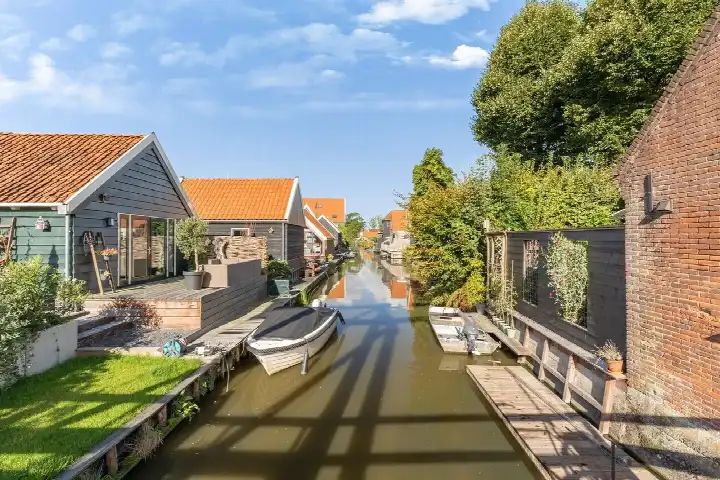
De Rijp is a protected village view in the North Holland polder, and you notice that as soon as you walk around. De Rijp was founded in the seventeenth century by whalers and herring fishermen, and the historic core along the Rechtestraat and the harbour still breathes that era. The buildings range from centuries-old canal houses to post-war expansion neighbourhoods on the edges, with a fair share of homes from the 1970s and 1980s. It is not a neighbourhood you come across by accident: you drive there deliberately.
The population of 4,270 residents is predominantly middle-aged and older: the largest group is 45 to 65 years old, followed by those aged 65 and over. Families with children are the most common household type, and 41% of residents are married. That says something about the stability of the neighbourhood. It is quiet, green and clear, but certainly not a bustling urban environment.
For daily groceries, there is a small supermarket in De Rijp itself, but for a wider range, most residents drive to Alkmaar or Graft. Primary schools are available in the village, and for secondary education, children depend on Alkmaar. Sports club VV De Rijp offers football, and there are opportunities for water sports via the surrounding lakes and canals. The rural area of the Beemster and the Eilandspolder is literally around the corner, attracting walkers and cyclists.
Accessibility by car is via the N243 towards Alkmaar, which takes about twenty minutes in quiet periods. During rush hour, that can increase. De Rijp does not have a train station. Bus line 315 connects the village with Alkmaar, but the frequency is limited. This is a neighbourhood for people who take a car for granted. Cyclists can reach Alkmaar via the polder routes, although that is a distance of about twelve kilometres.
Residents appreciate the peace, the close community and the historic atmosphere. One resident writes: "De Rijp has something you don't find in new-build neighbourhoods, it really feels like a village where people know each other." Criticisms concern the limited public transport connections and the scarce local shopping facilities. View all scores and ratings on the neighbourhood page of De Rijp for a complete picture.
Compared to neighbouring communities such as Graft and Noordeinde, De Rijp has the most facilities and the largest core. Oost-Graftdijk and West-Graftdijk are even quieter and more sparsely populated. Those looking for more urban dynamism should look at the homes for sale in Graft-De Rijp as a whole, or move to neighbourhoods such as Oudorp or West in Alkmaar itself.
Who is a home in De Rijp interesting for?
De Rijp mainly attracts families and over-fifties who consciously choose peace, space and a recognisable village community. Starters find it difficult to find an affordable entry-level home here: the average purchase price of over €508,000 and a lower limit of €200,000 for the cheapest homes make it difficult for single earners without substantial equity or own capital. Overbidding occurs, especially on well-maintained historic properties. Those who doubt whether buying is feasible at this time can also look at the rental homes in De Rijp as a temporary alternative. Also expect higher maintenance costs for older buildings in the historic core.
What residents say about De Rijp
Residents generally give De Rijp high scores for liveability, greenery and social cohesion. The neighbourhood scores lower on accessibility and level of facilities, which consistently comes back in the reviews. One resident sums it up: "You really have to choose to live here, but once you do, you never want to leave." Read all reviews and sub-scores on the full neighbourhood page of De Rijp, where the scores per category are also displayed.
Compare homes for sale in and around De Rijp
Buurtje.nl bundles the supply from more than 1,500 sources in one place, supplemented with resident reviews and neighbourhood data that you won't find anywhere else on a purchase page. This way you can compare not only homes, but also neighbourhoods. View the total supply in the district Graft-De Rijp, broaden your search to all homes for sale in Alkmaar, or explore specific neighbourhoods such as Starnmeer and Markenbinnen. More about the municipality can be found on the website of the municipality of Alkmaar.
What does a home cost in De Rijp?
Over the past twelve months, the average purchase price in De Rijp was €508,640, with an average living area of 133 m². That works out to approximately €3,825 per square metre. The cheapest sold property was €200,000, the most expensive €1,145,000. Buying a home in De Rijp therefore requires a substantial budget, although there is some variation in the supply.
What is the WOZ value in De Rijp?
The average WOZ value in De Rijp is €420,000. That is slightly below the average for the Graft-De Rijp district (€448,000), but significantly higher than the municipal average of Alkmaar (€342,000). The higher WOZ value reflects the historic buildings, spacious plots and the sought-after location in the polder.
What is it like to live in De Rijp?
Living in De Rijp means choosing a quiet, historic polder core with a close-knit community. The neighbourhood has a protected village view, little traffic and plenty of green space around the centre. Residents appreciate the social cohesion and tranquillity, but also point out the limited public transport connections and the relatively small local shopping offer. It is a neighbourhood you choose deliberately, not one you end up in by chance.
Is De Rijp suitable for families with children?
Yes, De Rijp is popular among families. The largest household type is households with children, and the neighbourhood offers primary education, outdoor space and a safe living environment. For secondary education, children depend on Alkmaar, about a twenty-minute drive away. The relatively high purchase prices do make entry challenging for young families without existing equity.
How accessible is De Rijp?
De Rijp does not have its own train station. By car, Alkmaar can be reached via the N243 in about twenty minutes, although rush hour can extend this. Bus line 315 runs towards Alkmaar, but with a limited frequency that is not workable for everyone. Cyclists can reach Alkmaar via polder routes, but the distance of about twelve kilometres makes this less suitable for daily commuting.
What type of homes are for sale in De Rijp?
The supply in De Rijp mainly consists of ground-based homes: detached houses, semi-detached houses and terraced houses. Buying an apartment in De Rijp is rarely possible, as that type of home is hardly present. The construction period ranges from historic canal houses in the centre to post-war homes from the 1970s and 1980s on the edges of the village.
Are there many homes for sale in De Rijp?
De Rijp has over 1,876 homes, of which 75% are owner-occupied. That sounds ample, but turnover is low: residents live there for a long time and the supply changes little. Over the past twelve months, only 25 homes were sold, illustrating the scarcity. Anyone wanting to buy in De Rijp would do well to respond alertly as soon as something becomes available, and to regularly check the current supply at the top of this page.