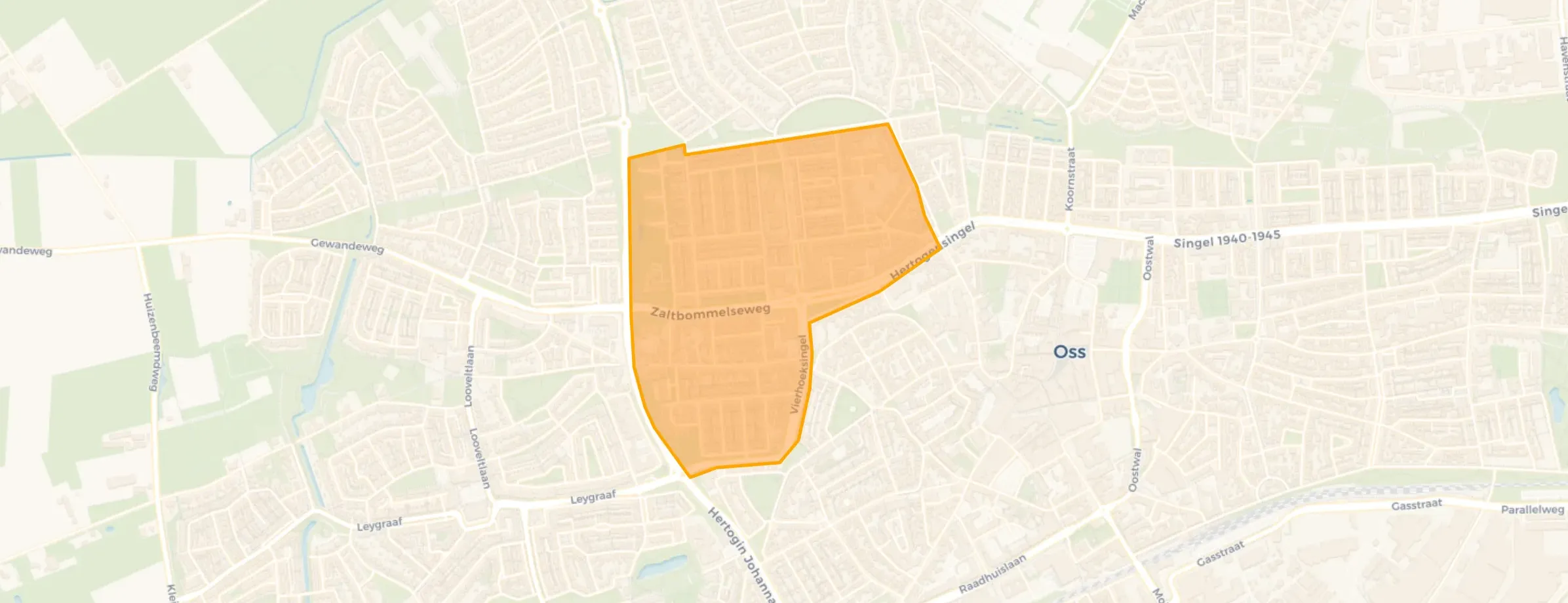
Neighbourhood in Oss
Hertogenbuurt is located in the province of Noord-Brabant, in the municipality of Oss, in the district Krinkelhoek The neighbourhood has a total area of 54 hectares, of which 54 hectares are land and 0 hectares are water. The neighbourhood is coded as BU08280401. The postcode area is 5341AB-5346SX.
Three residents rate the neighbourhood as good with a score of 7.5. They describe it as 'Cosy flat, unpleasant surroundings', 'Together a companion' and 'Together in a neighbourhood as a club'. Aspects such as accessibility, greenery, housing are rated well in this neighbourhood, while community and cleanliness score less well.
Hertogenbuurt has 2.960 residents. Of these, 49,2% are men and 50,8% are women. Most residents are 25 to 45 years (30,4%). The other age groups are 24,8% for '45 to 65 years', 18,1% for '65 years or older', 15,4% for '0 to 15 years' and 11,5% for '15 to 25 years'. Of the residents, 52,4% is unmarried, 32,8% is married, 9,8% is divorced and 4,9% is widowed. 1.900 residents originate from the Netherlands, 300 come from Europe and 760 come from countries outside Europe.
There are 1.445 households in Hertogenbuurt. 43,3% of these are single-person households, 24,2% households without children and 32,5% households with children. The average household size is 2,0 persons.
In Hertogenbuurt there are 2.500 income recipients. The average income per income recipient is €27.500, which is €8.300 (23%) lower than the national average of €35.800. Per resident, the average income is €24.100, which is €5.100 (17%) lower than the national average of €29.200. Most residents of Hertogenbuurt are educated to an intermediate level. 45,5% have an intermediate education (HAVO, VWO or MBO 2-4), 39,2% have a lower education (VMBO or MBO 1) and 15,3% have a university or higher professional education (HBO/WO).
Of the 2.960 residents, around 61% are in paid employment, which amounts to 1.806 people. This is 4% lower than the national average of 65%. The majority of workers are in salaried employment (88%), while 12% are self-employed. In Hertogenbuurt, 31% of residents receive a benefit. The largest group is those receiving a state pension (AOW). 480 people receive this benefit.
In Hertogenbuurt there are 1.409 homes with an average assessed value (WOZ) of €265.000. Of these, around 97% are occupied and 3% unoccupied. Most homes are rental properties. This amounts to 63% rental homes and 37% owner-occupied homes. Of the homes, 37% privately owned, 56% owned by housing associations and 7% owned by other landlords. The most common construction periods in Hertogenbuurt are 1950-1970 (75%) and 1990-2000 (11%).
There are currently 5 homes for sale in Hertogenbuurt. The most recently listed home is Ussenstraat 37 by Makelaarsland. Over the past year, 27 homes were sold in Hertogenbuurt. On average, a home was sold within 40 days.
The average asking price for a home for sale in Hertogenbuurt over the past year was €379.407. This is 43% higher than the average assessed value (WOZ) of €265.000. The average asking price per m² of plot is €2.386.
There are 5 homes for rent in Hertogenbuurt. The most recent home is Zaltbommelseweg 83, offered by www.thuispoort.nl. Over the past year, 24 homes were let in Hertogenbuurt. On average, a listing was let within 41 days.
The average rent for a rental home in Hertogenbuurt over the past year was €1.070 per month. Per m² of plot area that is €10 per month.
In Hertogenbuurt there are 1.418 addresses with a registered energy label. The most common labels are A (24%), C (22%) and D (16%). On average, an address in Hertogenbuurt uses 2.500 kWh of electricity per year. This is 11% below the national average of 2.810 kWh. With an annual consumption of 1.000 m³ per address, natural gas consumption is 22% below the national average of 1.280 m³.
The togetherness in the apartment is great and I get along with most neighbours, except for a few whiners... But the surroundings, the neighbourhood, are less pleasant: drug dealers and users, youths on fatbikes, cyclists riding on the pavement where you walk your dog, and a lot of rubbish and junk at the underground bins are the order of the day. But if you walk a little further, there is a beautiful green area with a survival trail for children, although I've never seen a child do it, it is there, but certainly nice for walking too and a nice off-leash area for dogs, nothing to complain about on that point. But on the street itself, it's a filthy mess, with all that rubbish at the underground bins, including household waste (plastic waste from people who were too late putting it out and then left it standing) but also furniture because the thrift shop no longer collects everything or does so but for a fee that people don't want or can't pay (previously it was free here). That means the underground bins usually become a large dumping ground: if one thing is there, the next person just adds to it, and so the pile grows bigger and bigger...
Auto-translated to English by AIOur neighbourhood is very cosy and helpful; if something is needed, you can easily ask your neighbours.
Auto-translated to English by AIMy experience is positive, because everyone is respectful and sociable with each other
Auto-translated to English by AI
The housing stock is mainly post-war — 62% was built between 1945 and 1990. In addition, the most common type is terraced houses (40%).
Over the past year a home for sale in Hertogenbuurt was listed for an average of €377,200 (€3,232 per m²).
A rental home in Hertogenbuurt cost an average of €1,136 per month (€12 per m²).
Residents give Hertogenbuurt a 7.5 out of 10 based on 3 reviews. The strongest score is for accessibility (9.0), the weakest for cleanliness (6.0).
Buurt Hertogenbuurt has 2,960 residents. The largest age group is 25 to 45 years (30%).
The housing supply in Hertogenbuurt is remarkably efficient: 56% has an A, A+ or B label. The average natural gas consumption per household is 1,000 m³ per year.
From Hertogenbuurt you can on average reach a supermarket at 0.5 km, a GP at 1.3 km, a railway station at 1.9 km, a primary school at 0.5 km (as the crow flies, source: CBS).

Buurtje.nl uses cookies to make the site work and to improve it. In doing so, we process data such as your IP address and the pages you visit.
We use this data for three purposes: running the website (functional), measuring visits so we can improve Buurtje.nl (analytics), and — if you allow it — tailoring ads to your interests (marketing).
How we handle your data is described in our privacy policy. You can change your preferences at any time via 'Cookie preferences' at the bottom of every page.
Choose per category which cookies we may place. Read more in our privacy policy.