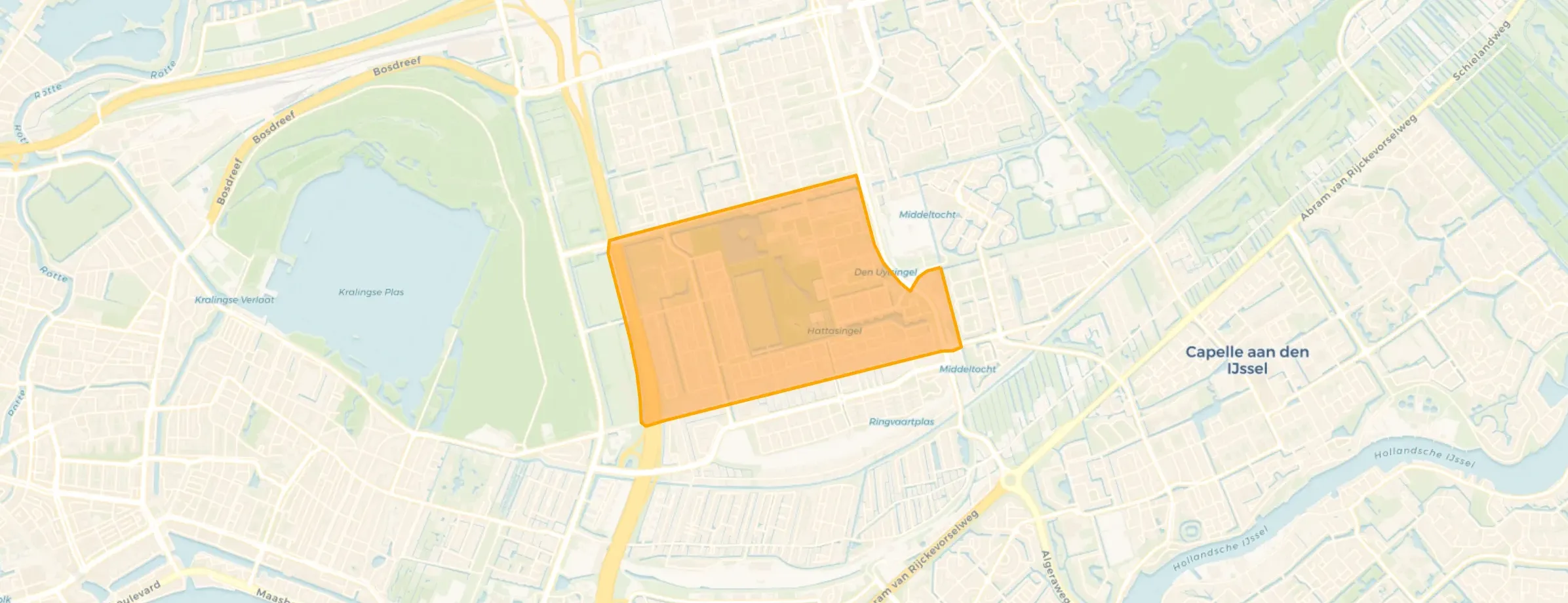
Neighbourhood in Rotterdam
Prinsenland is located in the province of Zuid-Holland, in the municipality of Rotterdam, in the district Prins Alexander The neighbourhood has a total area of 180 hectares, of which 172 hectares are land and 8 hectares are water. The neighbourhood is coded as BU05991448. The postcode area is 3066AA-3066XB.
Three residents rate the neighbourhood as very good with a score of 8.0. They describe it as 'Beautiful neighbourhood', 'Diversity in background, faith and culture.' and 'My neighbourhood is a neighbourhood with many young people who like to get up to mischief'. Residents are positive about the neighbourhood: nearly all aspects score well. In particular, amenities, accessibility, community are seen as strong points.
Prinsenland has 10.350 residents. Of these, 47,7% are men and 52,3% are women. Most residents are 45 to 65 years (28,5%). The other age groups are 27,3% for '65 years or older', 23,3% for '25 to 45 years', 12,3% for '0 to 15 years' and 8,6% for '15 to 25 years'. Of the residents, 47,0% is unmarried, 34,5% is married, 12,2% is divorced and 6,3% is widowed. 5.790 residents originate from the Netherlands, 1.030 come from Europe and 3.535 come from countries outside Europe.
There are 5.525 households in Prinsenland. 48,9% of these are single-person households, 25,2% households without children and 26,0% households with children. The average household size is 1,8 persons.
In Prinsenland there are 8.100 income recipients. The average income per income recipient is €38.100, which is €2.300 (6%) higher than the national average of €35.800. Per resident, the average income is €32.100, which is €2.900 (10%) higher than the national average of €29.200. Most residents of Prinsenland are educated to an intermediate level. 40,3% have an intermediate education (HAVO, VWO or MBO 2-4), 31,5% have a university or higher professional education (HBO/WO) and 28,2% have a lower education (VMBO or MBO 1).
Of the 10.350 residents, around 57% are in paid employment, which amounts to 5.900 people. This is 8% lower than the national average of 65%. The majority of workers are in salaried employment (84%), while 16% are self-employed. In Prinsenland, 34% of residents receive a benefit. The largest group is those receiving a state pension (AOW). 2.500 people receive this benefit.
In Prinsenland there are 5.163 homes with an average assessed value (WOZ) of €347.000. Of these, around 96% are occupied and 4% unoccupied. Most homes are rental properties. This amounts to 62% rental homes and 38% owner-occupied homes. Of the homes, 38% privately owned, 54% owned by housing associations and 8% owned by other landlords. The most common construction periods in Prinsenland are 1990-2000 (46%) and 1950-1970 (36%).
There are currently 38 homes for sale in Prinsenland. The most recently listed home is Rietkerkweg 318 by Woonvisie Makelaars op Vastgoed Nederland. Over the past year, 119 homes were sold in Prinsenland. On average, a home was sold within 62 days.
The average asking price for a home for sale in Prinsenland over the past year was €554.815. This is 60% higher than the average assessed value (WOZ) of €347.000. The average asking price per m² of plot is €4.548.
There are 5 homes for rent in Prinsenland. The most recent home is Mahatma Gandhistraat 88B, offered by Interhouse makelaars Rotterdam op Funda. Over the past year, 64 homes were let in Prinsenland. On average, a listing was let within 40 days.
The average rent for a rental home in Prinsenland over the past year was €2.809 per month. Per m² of plot area that is €30 per month.
In Prinsenland there are 5.510 addresses with a registered energy label. The most common labels are A (38%), B (27%) and C (13%). On average, an address in Prinsenland uses 2.220 kWh of electricity per year. This is 21% below the national average of 2.810 kWh. With an annual consumption of 680 m³ per address, natural gas consumption is 47% below the national average of 1.280 m³.
Good
Auto-translated to English by AII have been living in Prinsenland for a number of years now, in an apartment with my family, and I experience the neighbourhood as a pleasant and lively environment. What strikes me most is the great diversity of residents: people with different backgrounds, faiths and cultures live together here in a respectful way. This creates a dynamic atmosphere in which you always discover something new — whether it's about food, traditions or encounters on the street. The neighbourhood generally feels safe. During the day you often see people walking or children playing in the parks, and even in the evening I dare to walk the streets without worry. The community is friendly and helpful, but it would be nicer if there were a few more meeting places where neighbours could get to know each other. In terms of hygiene and maintenance, most of the neighbourhood is tidy, although there are certain spots — especially near the shopping centres — where it sometimes looks a bit messier. Housing is well organised, although you notice that some buildings are in need of renovation. I am also satisfied with the facilities: schools, supermarkets and public transport are all easily accessible. Accessibility is definitely a big plus of this district — you can be in the centre of Rotterdam in no time, and the main roads are also nearby. What I personally really appreciate is the nature in the area. The proximity of the Kralingse Bos and the quiet walking routes make Prinsenland a nice place to escape the hustle and bustle. All in all, I am very happy with this living environment. There is room for improvement, but the balance between tranquillity, accessibility and diversity makes Prinsenland a pleasant neighbourhood to live in.
Auto-translated to English by AIFun and not fun because children often come to play ding-dong ditch
Auto-translated to English by AI
The housing stock is relatively young — 77% dates from after 1990. In addition, the most common type is flats (68%).
Over the past year a home for sale in Prinsenland was listed for an average of €560,487 (€4,668 per m²).
A rental home in Prinsenland cost an average of €2,414 per month (€23 per m²).
Residents give Prinsenland a 8.0 out of 10 based on 3 reviews. The strongest score is for amenities (8.7), the weakest for education (7.0).
The housing supply in Prinsenland is remarkably efficient: 80% has an A, A+ or B label. The average natural gas consumption per household is 680 m³ per year.
From Prinsenland you can on average reach a supermarket at 0.8 km, a GP at 1.0 km, a railway station at 2.8 km, a primary school at 0.5 km (as the crow flies, source: CBS).
Right now you will find 47 homes for sale and 5 homes for rent in Prinsenland. A home for sale here is listed for an average of 72 days — relatively long for the current market.

Buurtje.nl uses cookies to make the site work and to improve it. In doing so, we process data such as your IP address and the pages you visit.
We use this data for three purposes: running the website (functional), measuring visits so we can improve Buurtje.nl (analytics), and — if you allow it — tailoring ads to your interests (marketing).
How we handle your data is described in our privacy policy. You can change your preferences at any time via 'Cookie preferences' at the bottom of every page.
Choose per category which cookies we may place. Read more in our privacy policy.