



First things first: for a number of years now, you have been allowed to finance the house itself entirely with your mortgage (100% of the property value). What you are not allowed to finance are the purchase costs. Those come out of your own pocket. As a first-time buyer under the starter's exemption, you pay no transfer tax, and often only a few thousand euros of your own money remain: for the notary, valuation and mortgage advice. If you do pay 2% transfer tax, the amount increases significantly. Below I calculate this concretely for you.
Can you borrow the entire house?
Yes. The maximum mortgage relative to the property value (the loan-to-value or LTV) is set at 100%. If you buy a house that is valued by the appraiser at the purchase price, you can borrow that amount in full. In the past, you had to contribute a portion yourself, but that is a thing of the past. Good news for first-time buyers, because you no longer need a large savings pot for the house itself.
So the limit is not in the house, but in everything around it.
What is included in the purchase costs?
Purchase costs (k.k.) are the one-off costs associated with the purchase that you pay on top of the purchase price and that you are not allowed to borrow. The main items:
- Transfer tax: 0% with the starter's exemption, otherwise 2% for owner-occupation.
- Notary costs: deed of transfer and mortgage deed, average around €1,800 for a house of around €400,000 with a mortgage (rule of thumb 0.3% to 0.5% of the purchase price).
- Valuation: expect around €500 to €800.
- Mortgage advice and brokerage: expect around €2,500 to €3,500.
- NHG fee (optional, but often sensible): 0.4% of the mortgage amount. More on this later.
- Buying agent (optional): around €2,500 to €4,000, or 1% to 2% of the purchase price.
What exactly does the starter's exemption save?
This is the difference that matters most. With the starter's exemption you pay 0% transfer tax. The conditions in 2026:
- The property value is a maximum of €555,000.
- You are 18 to 34 years old at the time of purchase.
- You will live there yourself.
- You have not used the exemption before (one-time only).
- You make a declaration with the notary.
If you do not meet the conditions, you pay 2% transfer tax for owner-occupation. If you buy a house to rent out or not to live in yourself, a rate of 8% applies from 1 January 2026.
Calculate the difference for a house of €400,000: a first-time buyer with exemption pays €0 transfer tax. Someone who pays 2% adds €8,000 on top. The same house, the same income, but due to the exemption it saves €8,000 of your own money.
How much of your own money do you really need?
Take a house of €400,000 as an example.
As a first-time buyer with exemption (0% transfer tax):
- Notary: approximately €1,800
- Valuation: approximately €600
- Mortgage advice and brokerage: approximately €3,000
In total roughly €5,000 to €6,000 of your own money. Part of this is also deductible from income tax (see below). If you choose NHG, add 0.4%, so for a €400,000 mortgage that is €1,600 (also deductible).
Without exemption, with 2% transfer tax, an additional €8,000 is added. Then you quickly end up at €13,000 to €14,000 of your own money for the same house. If you also hire a buying agent, expect several thousand euros more.
What if you have to overbid?
Watch out for this pitfall. The bank finances a maximum of the appraised value of the house. If you bid above that value, for example because you have to overbid in a popular neighbourhood, the amount above the appraised value is not financed. You pay that difference entirely from your own money, on top of the purchase costs.
For a deposit or bank guarantee, expect around 1% of the deposit (for a bank guarantee via the bank). The deposit itself (often 10% of the purchase price) is returned to you at the transfer, but you must be able to come up with it temporarily or arrange a bank guarantee.
Can your parents help out?
Yes, within the gift tax exemptions of 2026. A parent may give a child €6,908 per year tax-free. In addition, there is a one-off increased exemption of €33,129 for a child between 18 and 40 years old, free to spend. So you can use that amount for the purchase costs or to overbid.
The old increased gift exemption for the owner-occupied home (the "jubelton") no longer exists; it was abolished in 2024. So don't count on it.
What does NHG do for you?
With the National Mortgage Guarantee you pay a one-time guarantee fee of 0.4% of your mortgage amount, but you get two things in return: a lower mortgage interest rate and a safety net if you are forced to sell your home unexpectedly. In June 2026, the average interest rate for a 10-year fixed rate with NHG is around 4%. NHG in 2026 can be used up to a property value of €470,000, or €498,200 if you finance energy-saving measures. For many first-time buyers, that fits perfectly.
What do you get back from the tax authorities?
Not all purchase costs are truly "lost" money. Part of the one-off purchase costs is deductible from your income tax:
- Deductible: mortgage advice and brokerage, the NHG fee, the mortgage deed at the notary (with the associated land registry costs) and the valuation for the financing.
- Not deductible: transfer tax, the deed of transfer, agent's commission and a structural survey.
As a result, your net own contribution is in practice somewhat lower than the gross amount you transfer upfront.
How much house do you get for your money?
How much of your own money you need naturally depends on the price of the house, and that varies enormously per city. In our own current housing supply, the median asking prices (the middle price, a fairer picture than the average which is skewed by expensive outliers) in June 2026 are as follows:
- Groningen: approximately €325,000
- Enschede: approximately €375,000
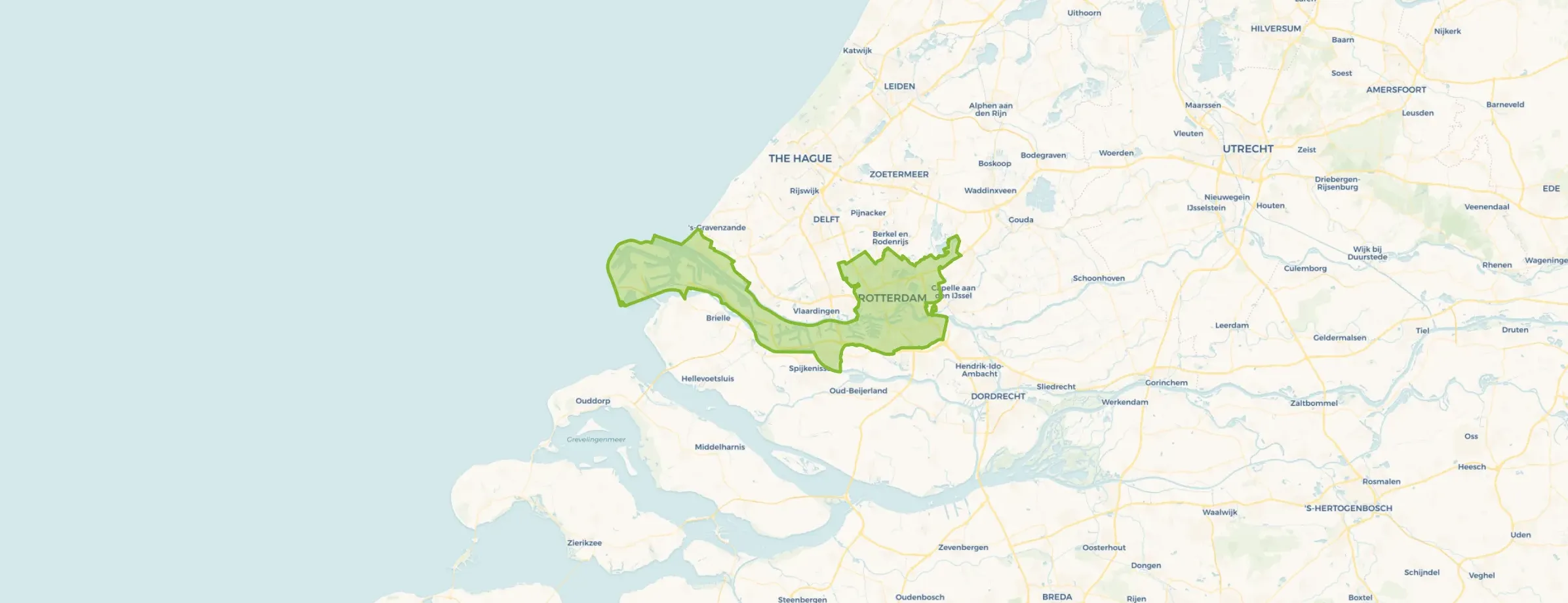
- Rotterdam: approximately €410,000
- Zwolle: approximately €450,000
- Amsterdam: approximately €595,000
A median house in Groningen of €325,000 falls well below the limit of €555,000, so as a first-time buyer you fully benefit from the exemption. In Amsterdam, at €595,000 you are well above the limit; then the exemption lapses and you pay 2% transfer tax, almost €12,000 that you have to bring yourself. Nationally, the median asking price is €470,000 (average around €539,000).
In short: for the house itself you need little of your own money these days, but for the purchase costs you do. As a first-time buyer with exemption, expect roughly €5,000 to €6,000, and significantly more as soon as you pay 2% transfer tax or have to overbid. This article is for information purposes and is not financial or tax advice; always have your situation calculated by an advisor.
Source: own current housing supply on Buurtje.nl, median asking prices. Asking prices are not transaction prices. Author: Laurens van den Assem.