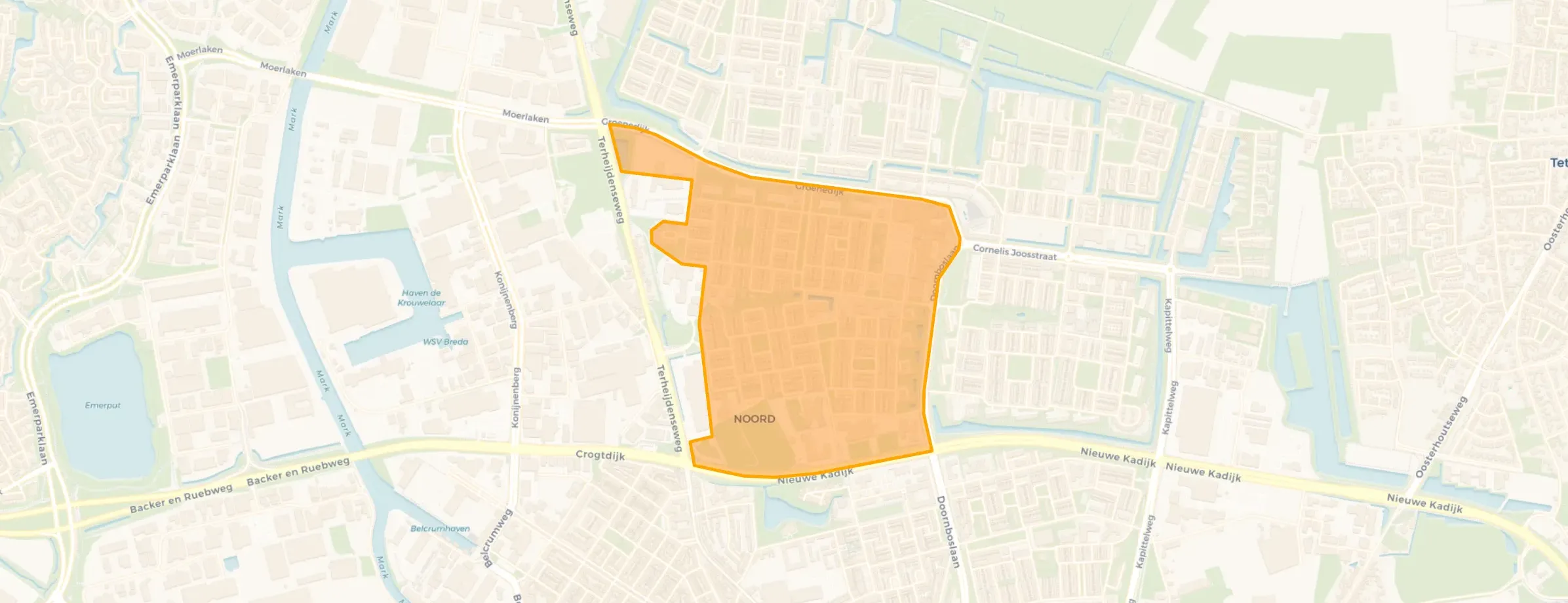
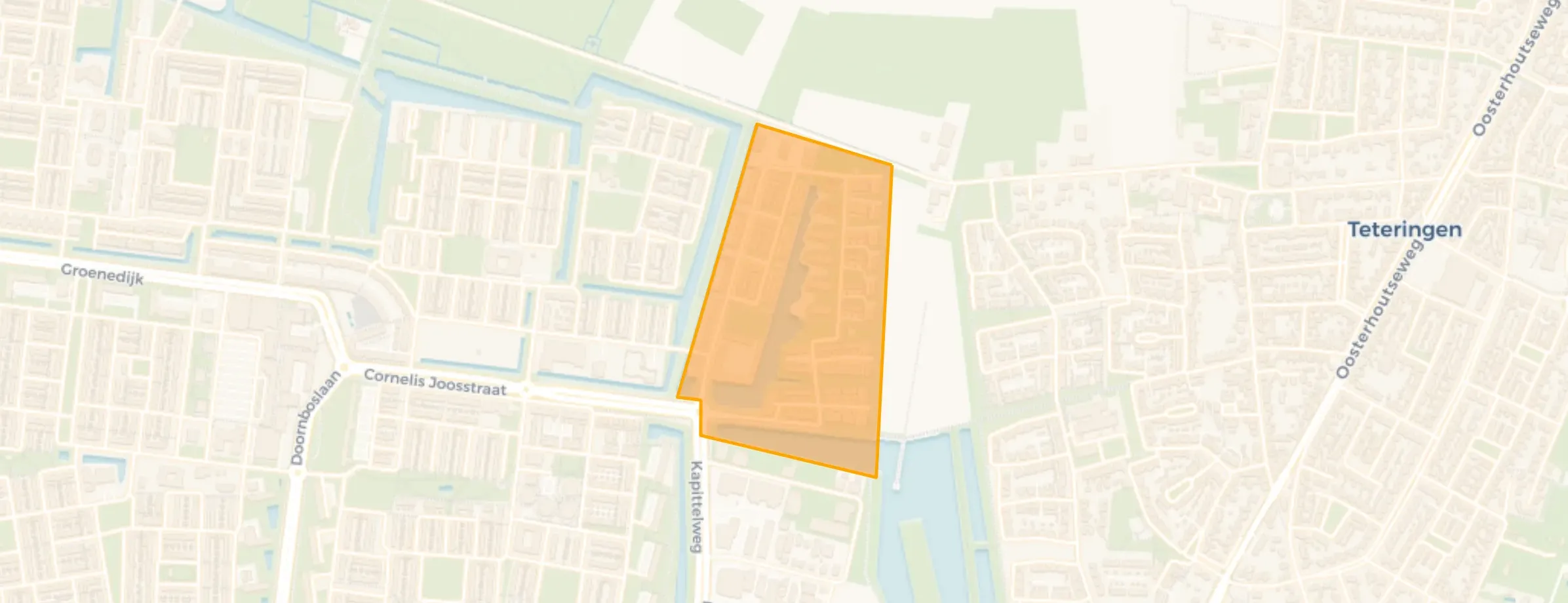
District in Breda
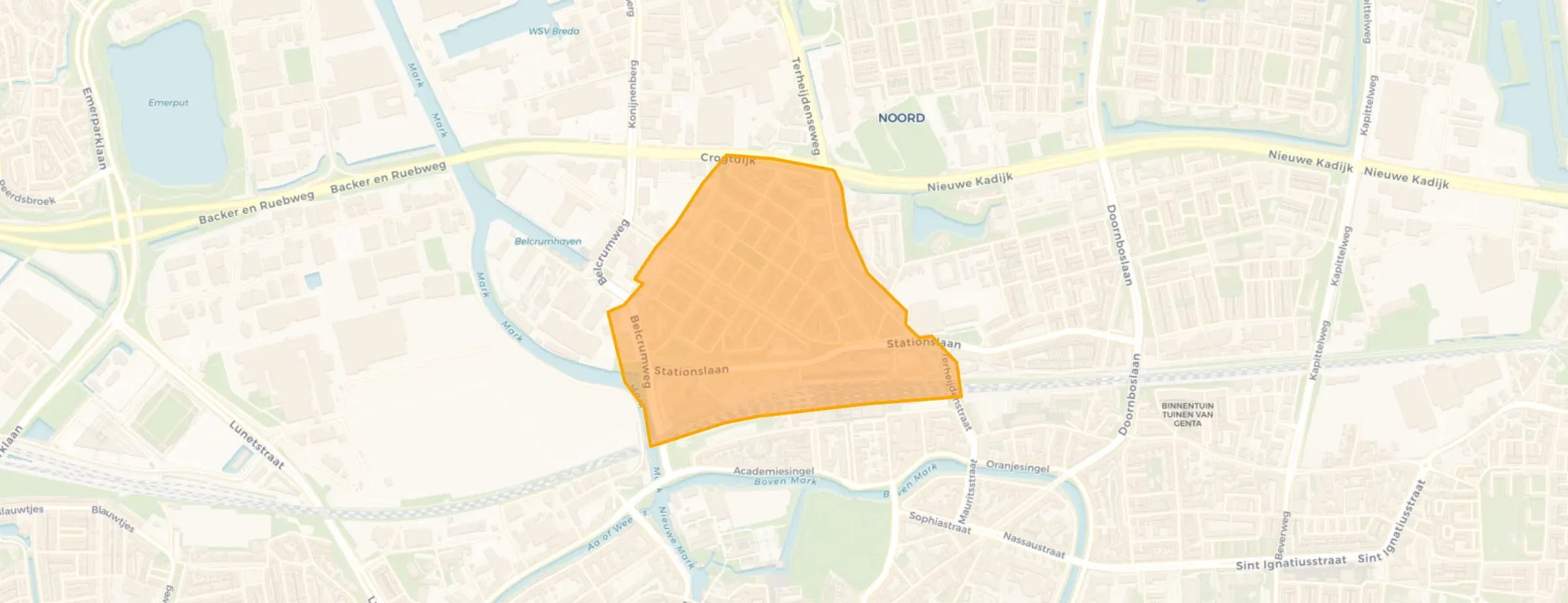
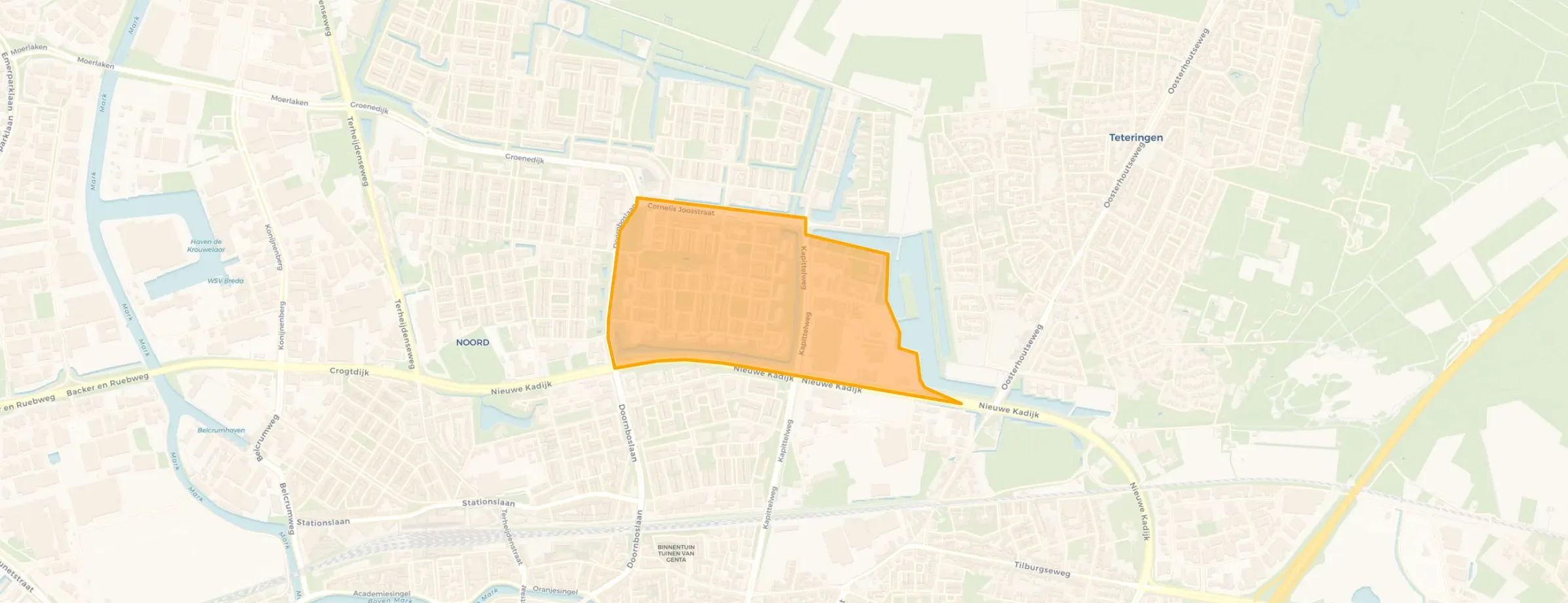
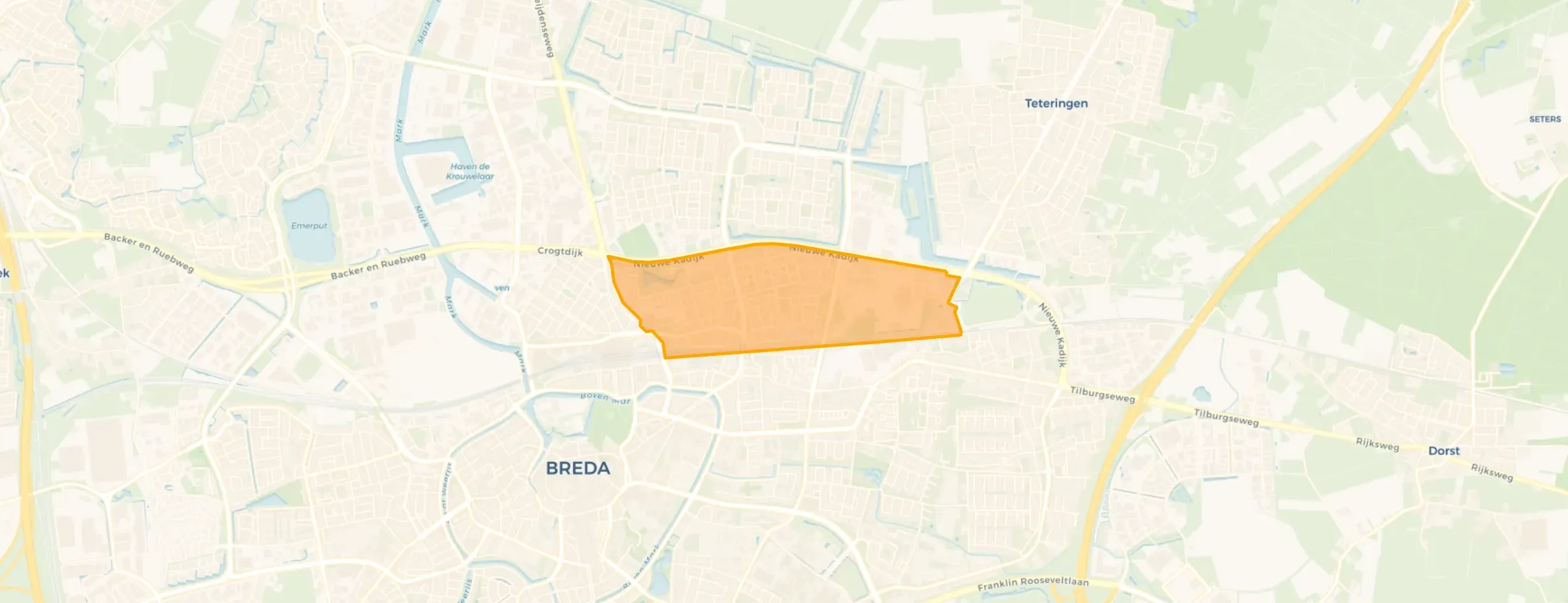
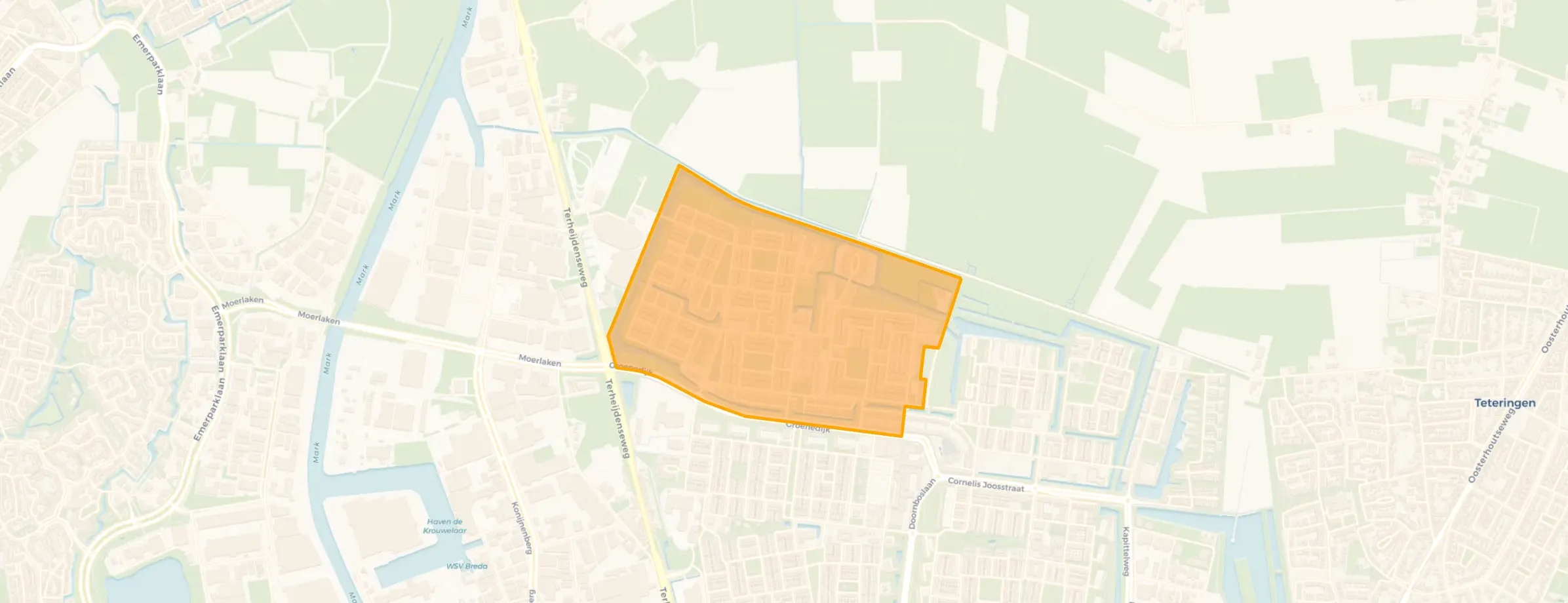
Breda noord is located in the province of Noord-Brabant, in the municipality of Breda The district has a total area of 883 hectares, of which 847 hectares are land and 36 hectares are water. The district is coded as WK075801. The postcode area is 4811BL-4827PH.
Breda noord has 26.120 residents. Of these, 49,6% are men and 50,4% are women. Most residents are 25 to 45 years (31,5%). The other age groups are 23,4% for '45 to 65 years', 16,0% for '65 years or older', 15,5% for '0 to 15 years' and 13,7% for '15 to 25 years'. Of the residents, 57,0% is unmarried, 29,6% is married, 9,2% is divorced and 4,2% is widowed. 14.035 residents originate from the Netherlands, 2.775 come from Europe and 9.310 come from countries outside Europe.
There are 12.920 households in Breda noord. 47,1% of these are single-person households, 23,6% households without children and 29,3% households with children. The average household size is 2,0 persons.
In Breda noord there are 20.300 income recipients. The average income per income recipient is €32.200, which is €3.600 (10%) lower than the national average of €35.800. Per resident, the average income is €26.100, which is €3.100 (11%) lower than the national average of €29.200. Most residents of Breda noord are educated to an intermediate level. 37,2% have an intermediate education (HAVO, VWO or MBO 2-4), 31,4% have a lower education (VMBO or MBO 1) and 31,3% have a university or higher professional education (HBO/WO).
Of the 26.120 residents, around 63% are in paid employment, which amounts to 16.456 people. This is 2% lower than the national average of 65%. The majority of workers are in salaried employment (88%), while 12% are self-employed. In Breda noord, 24% of residents receive a benefit. The largest group is those receiving a state pension (AOW). 3.650 people receive this benefit.
In Breda noord there are 11.842 homes with an average assessed value (WOZ) of €281.000. Of these, around 97% are occupied and 3% unoccupied. Most homes are rental properties. This amounts to 61% rental homes and 39% owner-occupied homes. Of the homes, 39% privately owned, 47% owned by housing associations and 14% owned by other landlords. The most common construction periods in Breda noord are 1950-1970 (51%) and 2010-2020 (10%).
There are currently no homes for sale in Breda noord. The most recently listed home is Stationslaan 41 by Storimans en Partners. No homes were sold in Breda noord over the past year.
There are currently no homes for rent in Breda noord. The most recent home is Deinzestraat 63, offered by vb&t Verhuurmakelaars op Funda. No homes were let in Breda noord over the past year.
No recent rental data available for Breda noord.
In Breda noord there are 12.730 addresses with a registered energy label. The most common labels are A (27%), C (23%) and E (10%). On average, an address in Breda noord uses 2.430 kWh of electricity per year. This is 14% below the national average of 2.810 kWh. With an annual consumption of 440 m³ per address, natural gas consumption is 66% below the national average of 1.280 m³.
Very dangerous my neighbourhood. I work as a volunteer for the last 32 years, but the situation is very very dangerous. Police don't listen. There is no gathering of the neighbourhood in the last two years. I always clean my street. Geeren Zuid Park. I have worked with Werk aan de wijk. I made art workshops. Municipality Breda didn't give 400 euros for material costs, only gave 200, so I asked my family for 1000 US dollars so I could buy materials. I'm sorry, but senior people get no respect here in Breda. (I was racially abused by a security guard in ALDI supermarket as I was giving my trolley to an old lady.) It hurts a lot as I worked for United Nations Goodwill Ambassadors for the last 50 long years, UNICEF, UNESCO, SAVE THE CHILDREN, NCIV Mr Pronk, Voices Of The Earth, for enlightenment in the visions of tomorrow. Pass the torch on to others. Hold on to the memories of yesterday. Even a small memory goes a long, long way and fulfils its purpose in eternity. Quote by M. Bugi. Help declare KALASH a tribe in the Hindukush Mountains as a United Nations World Heritage Site. We have been helping Kalash since 1980 - http://www.indigenouspeople.net/chitral.htm...
Auto-translated to English by AIWell, I think it's going downhill. I've lived here for 26 years. Everything is mixed together and that sometimes clashes. I don't have any trouble with anyone, I don't meddle with anyone either, I greet everyone and go back inside. Recently they kicked in the gates and the sheds because I live downstairs and they looked in mine, but there was only junk. I think they were looking for electric bikes. Well, I don't have a scooter, so tough luck. No, the neighbourhood is going downhill. It's a shame because I like living here, but there's no cosiness anymore. At 6 o'clock you don't see a soul outside. I sit in my garden and I just don't see anyone walking on the galleries, because that's what I look out onto. I was born in a working-class neighbourhood, everything was different there. We were there for each other and at the time we'd have coffee together and have a good gossip hahahahah. That's not the case here, which I think is a shame. Groendijplein is also difficult to reach for deliveries, that's also rubbish. You have to go to a pickup point. I don't have a car, so you have to bother people again to give me a lift. Really annoying. This used to be a 55-plus flat, now it's not anymore. Everything mixed together.
Auto-translated to English by AII grew up here and have lived in Breda since birth. I do think the neighbourhood could use a new facility. When young people want to do something here in Geeren Zuid, they usually go to the shopping centre, which only results in more loitering youths.
Auto-translated to English by AIEveryone greets each other, Dutch and foreigners
Auto-translated to English by AINo trouble at all
Auto-translated to English by AIIt's a decent neighbourhood overall, but around the shops it can sometimes be unsafe. There are sometimes characters who find girls a bit too interesting.
Auto-translated to English by AII am currently doing an internship in Hart voor Breda Noord, where we deal with many residents and issues in the neighbourhood. The neighbourhood is very pleasant to live in, though not always safe as there are many incidents. This could of course be better; deploying a lot of police would not be a good idea, as it only scares the residents! Furthermore, more camera surveillance and weekly patrols would sometimes be nice. A neighbourhood officer who is social and open to the neighbourhood and residents could help a lot with this. In terms of location, residents, accessibility, and social cohesion, it is a good neighbourhood. Our neighbourhood is seen as a deprived area, which actually carries a negative connotation, while if you have lived here for 20 years, you have a very different view than people from outside the neighbourhood. It is a cosy neighbourhood with a lot of diversity, which you might think would not promote social cohesion, but that is certainly the case. We are interested in each other's culture and way of life, and this actually brings everyone closer together! Our differences also make us special compared to others. Not everyone knows each other in the neighbourhood, but from what I have experienced, everyone, regardless of their situation, gets along well. We also take good care of the neighbourhood itself; streets are mostly always tidy, filled with trees and small canals, very beautiful. And then we have the various large diverse playgrounds, from swings to zip lines, found in almost every corner! Very nice for both children and the whole family :).
Auto-translated to English by AIWhether it's summer or winter, it's always cosy in the Belcrum! There's lots of greenery and fun things to do for children! Traffic follows the rules. A perfect neighbourhood for your family and your children!
Auto-translated to English by AI
The housing stock is mainly post-war — 60% was built between 1945 and 1990. In addition, the most common type is flats (48%).
Over the past year a home for sale in Breda noord was listed for an average of €434,945 (€4,368 per m²).
A rental home in Breda noord cost an average of €1,491 per month (€16 per m²).
Residents give Breda noord a 7.1 out of 10 based on 9 reviews. Accessibility stands out with a 7.8; safety lags behind with a 6.1.
Wijk Breda noord has 26,120 residents. The largest age group is 25 to 45 years (31%).
The housing supply in Breda noord is remarkably efficient: 59% has an A, A+ or B label. The average natural gas consumption per household is 440 m³ per year.
From Breda noord you can on average reach a supermarket at 0.7 km, a GP at 0.5 km, a railway station at 2.7 km, a primary school at 0.5 km (as the crow flies, source: CBS).
Right now you will find 89 homes for sale and 11 homes for rent in Breda noord.

Buurtje.nl uses cookies to make the site work and to improve it. In doing so, we process data such as your IP address and the pages you visit.
We use this data for three purposes: running the website (functional), measuring visits so we can improve Buurtje.nl (analytics), and — if you allow it — tailoring ads to your interests (marketing).
How we handle your data is described in our privacy policy. You can change your preferences at any time via 'Cookie preferences' at the bottom of every page.
Choose per category which cookies we may place. Read more in our privacy policy.