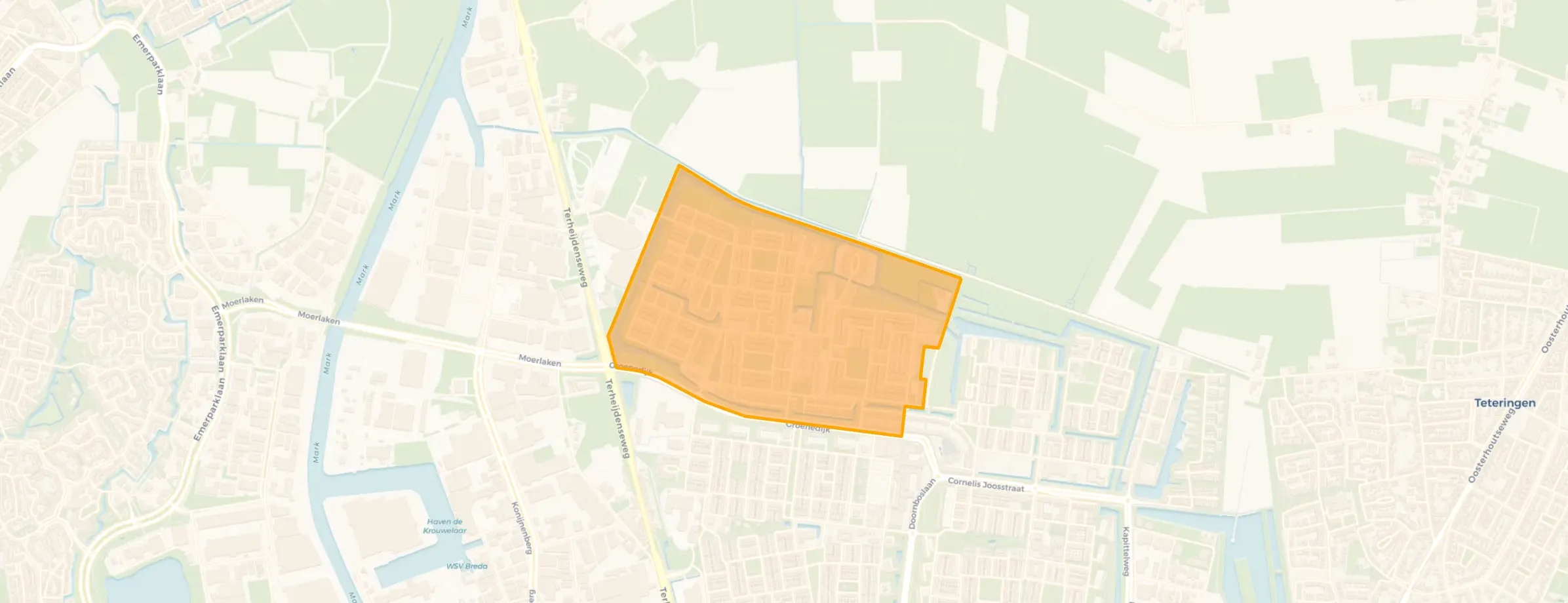
Neighbourhood in Breda
Wisselaar is located in the province of Noord-Brabant, in the municipality of Breda, in the district Breda noord The neighbourhood has a total area of 78 hectares, of which 75 hectares are land and 3 hectares are water. The neighbourhood is coded as BU07580104. The postcode area is 4826AD-4826GX.
One resident rates the neighbourhood as more than satisfactory with a score of 6.6. The resident describes this neighbourhood as 'Diversity in our neighbourhood makes us a'. Based on a limited number of reviews, no clear trends are visible yet in this neighbourhood.
Wisselaar has 4.205 residents. Of these, 49,3% are men and 50,8% are women. Most residents are 25 to 45 years (27,7%). The other age groups are 23,9% for '45 to 65 years', 18,8% for '65 years or older', 15,8% for '0 to 15 years' and 13,8% for '15 to 25 years'. Of the residents, 51,7% is unmarried, 34,4% is married, 9,8% is divorced and 4,2% is widowed. 2.030 residents originate from the Netherlands, 460 come from Europe and 1.720 come from countries outside Europe.
There are 1.960 households in Wisselaar. 41,8% of these are single-person households, 26,8% households without children and 31,4% households with children. The average household size is 2,1 persons.
In Wisselaar there are 3.300 income recipients. The average income per income recipient is €28.700, which is €7.100 (20%) lower than the national average of €35.800. Per resident, the average income is €22.800, which is €6.400 (22%) lower than the national average of €29.200. Most residents of Wisselaar are educated to an intermediate level. 41,8% have an intermediate education (HAVO, VWO or MBO 2-4), 40,2% have a lower education (VMBO or MBO 1) and 18,0% have a university or higher professional education (HBO/WO).
Of the 4.205 residents, around 58% are in paid employment, which amounts to 2.439 people. This is 7% lower than the national average of 65%. The majority of workers are in salaried employment (87%), while 13% are self-employed. In Wisselaar, 27% of residents receive a benefit. The largest group is those receiving a state pension (AOW). 690 people receive this benefit.
In Wisselaar there are 1.876 homes with an average assessed value (WOZ) of €252.000. Of these, around 98% are occupied and 2% unoccupied. Most homes are rental properties. This amounts to 57% rental homes and 43% owner-occupied homes. Of the homes, 43% privately owned, 43% owned by housing associations and 14% owned by other landlords. The most common construction periods in Wisselaar are 1950-1970 (75%) and 1980-1990 (13%).
There are currently 10 homes for sale in Wisselaar. The most recently listed home is Hobokenstraat 69 by Kin Makelaars. Over the past year, 39 homes were sold in Wisselaar. On average, a home was sold within 28 days.
The average asking price for a home for sale in Wisselaar over the past year was €341.551. This is 36% higher than the average assessed value (WOZ) of €252.000. The average asking price per m² of plot is €3.450.
There are 2 homes for rent in Wisselaar. The most recent home is Deinzestraat 63, offered by vb&t Verhuurmakelaars op Funda. Over the past year, 16 homes were let in Wisselaar. On average, a listing was let within 16 days.
The average rent for a rental home in Wisselaar over the past year was €1.355 per month. Per m² of plot area that is €14 per month.
In Wisselaar there are 1.887 addresses with a registered energy label. The most common labels are C (44%), A (17%) and B (11%). On average, an address in Wisselaar uses 2.450 kWh of electricity per year. This is 13% below the national average of 2.810 kWh. With an annual consumption of 90 m³ per address, natural gas consumption is 93% below the national average of 1.280 m³.
I am currently doing an internship in Hart voor Breda Noord, where we deal with many residents and issues in the neighbourhood. The neighbourhood is very pleasant to live in, though not always safe as there are many incidents. This could of course be better; deploying a lot of police would not be a good idea, as it only scares the residents! Furthermore, more camera surveillance and weekly patrols would sometimes be nice. A neighbourhood officer who is social and open to the neighbourhood and residents could help a lot with this. In terms of location, residents, accessibility, and social cohesion, it is a good neighbourhood. Our neighbourhood is seen as a deprived area, which actually carries a negative connotation, while if you have lived here for 20 years, you have a very different view than people from outside the neighbourhood. It is a cosy neighbourhood with a lot of diversity, which you might think would not promote social cohesion, but that is certainly the case. We are interested in each other's culture and way of life, and this actually brings everyone closer together! Our differences also make us special compared to others. Not everyone knows each other in the neighbourhood, but from what I have experienced, everyone, regardless of their situation, gets along well. We also take good care of the neighbourhood itself; streets are mostly always tidy, filled with trees and small canals, very beautiful. And then we have the various large diverse playgrounds, from swings to zip lines, found in almost every corner! Very nice for both children and the whole family :).
Auto-translated to English by AI
The housing stock is mainly post-war — 78% was built between 1945 and 1990. In addition, the most common type is terraced houses (51%).
Over the past year a home for sale in Wisselaar was listed for an average of €342,604 (€3,565 per m²).
The housing supply in Wisselaar is remarkably efficient: 53% has an A, A+ or B label. The average natural gas consumption per household is 90 m³ per year.
From Wisselaar you can on average reach a supermarket at 0.8 km, a GP at 0.5 km, a railway station at 3.4 km, a primary school at 0.5 km (as the crow flies, source: CBS).
Right now you will find 10 homes for sale and 1 homes for rent in Wisselaar.

Buurtje.nl uses cookies to make the site work and to improve it. In doing so, we process data such as your IP address and the pages you visit.
We use this data for three purposes: running the website (functional), measuring visits so we can improve Buurtje.nl (analytics), and — if you allow it — tailoring ads to your interests (marketing).
How we handle your data is described in our privacy policy. You can change your preferences at any time via 'Cookie preferences' at the bottom of every page.
Choose per category which cookies we may place. Read more in our privacy policy.