Rental homes in F-buurt, Amsterdam
View the current rental property listings in F-buurt, Amsterdam. Compare prices, check neighbourhood scores and find a rental property that suits you.

Rental prices and market figures for F-buurt, Amsterdam
F-buurt is a typical rental neighbourhood: 73% of homes are rental properties, and only 27% are owner-occupied. Of the total housing stock, 30% is owned by housing associations (social housing) and 43% is rented out by other landlords, such as private investors and institutional parties. This means the free-market rental sector is well represented here. In the free sector (excluding social housing), the average rent over the past year was €1,387 per month, with a range from €731 to €8,000. With an average floor area of 55 m², this works out to about €25 per m². The average WOZ value in F-buurt is €327,000. This is significantly higher than the district average for Amsterdamse Poort and surroundings (€226,000), but still well below the Amsterdam average of €517,000. The average income of €34,500 is on par with the district but below the municipal average of €44,276. Renting in F-buurt is therefore relatively affordable compared to many other parts of Amsterdam. At the top of this page you will always find the current daily prices and available supply.
Living in F-buurt, Amsterdam
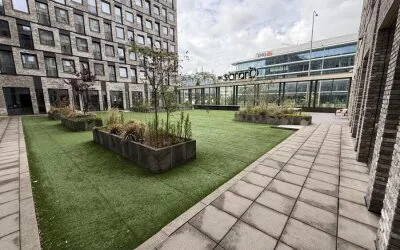
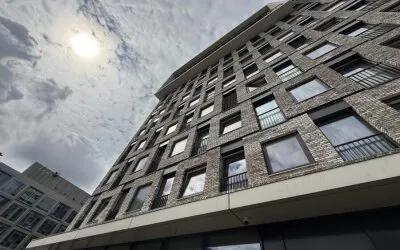
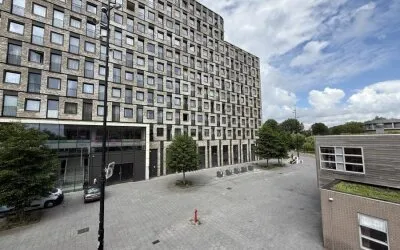
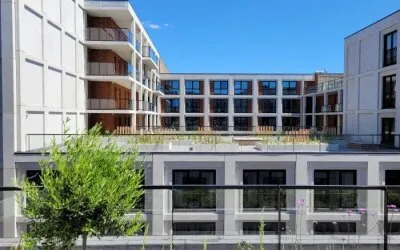
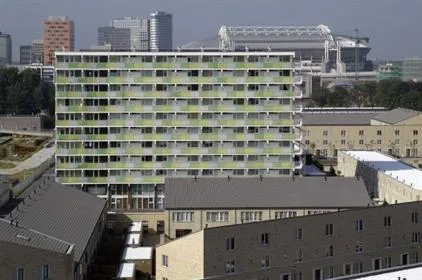
F-buurt is part of Amsterdam-Zuidoost and lies between the Bijlmerdreef, the Karspeldreef and the railway line. It is a neighbourhood that has changed significantly over the past decades. After the major urban renewal, many of the original honeycomb flats were demolished and replaced by new-build: a mix of low-rise, single-family homes and modern apartment complexes. However, some 1970s and 1980s porch-access flats still remain. As a result, the neighbourhood has a varied streetscape, with both social housing and free-market apartments. It is a multicultural neighbourhood with a young population: the largest age group is 25 to 45 years (1,645 residents), and there are relatively many single-person households (1,290 of the households). Only 19% of residents are married, which fits the character of a neighbourhood with many starters and singles.
Facilities in F-buurt
For daily shopping, you are well served: Amsterdamse Poort shopping centre is within walking distance and offers, among others, an Albert Heijn, Lidl, Kruidvat and various specialist shops. There are several primary schools in and around the neighbourhood, and the ZAAM Interconfessional Secondary Education is nearby. For healthcare, there is Amsterdam UMC, location AMC, within cycling distance. For sports, there are facilities at Sportpark Bijlmer and the nearby Nelson Mandelabad. Resident Emely confirms this in her review: "All primary facilities such as supermarkets, dentists or hospitals are just in the neighbourhood and easily accessible." The score for facilities is therefore 8.0. For more experiences, you can visit the neighbourhood page of F-buurt with all reviews and neighbourhood data.
Accessibility from F-buurt
Accessibility scores a 7.5 among residents, and rightly so. Kraaiennest metro station (lines 53/54) is a few minutes' walk away and takes you to Amsterdam Central in about 15 minutes. Bijlmer ArenA station is also nearby, with intercity trains towards Utrecht, Schiphol and The Hague. By car, you are quickly on the A2 and A9. Cycling to the city centre takes about 25 to 30 minutes. Parking here is still relatively easy and cheaper than in the city centre, although paid parking is being expanded further. Keep an eye on the website of the municipality of Amsterdam for current parking regulations.
Compared to nearby neighbourhoods, F-buurt has its own character. D-buurt is largely new-build and attracts many young families, while Amsterdamse Poort revolves mainly around the shopping centre and feels more urban. Nelson Mandelapark offers more greenery but fewer direct facilities. F-buurt sits in between: practical, affordable and well-connected, but with a somewhat rougher appearance than some neighbourhoods further away.
Is a rental home in F-buurt right for you?
With an average income of €34,500 and relatively affordable rents, F-buurt is particularly interesting for starters, singles and young professionals looking for an affordable rental home in Amsterdam. The neighbourhood is also suitable for students: the 15-25 age group has 775 residents, and public transport to the universities is excellent. For families with children, there are schools and playgrounds, although the supply of larger homes is limited. If you want to rent an apartment in F-buurt, prepare your documents and respond quickly: in the free sector, homes go fast. For social housing, registration with WoningNet is necessary, but expect long waiting lists. Would you rather buy? Then also check the supply of homes for sale in F-buurt.
What residents say about renting in F-buurt
F-buurt receives an overall score of 7.4 from residents, based on 2 reviews. Safety (8.5) and sense of community (8.5) score notably high. Accessibility (7.5), education (8.0) and facilities (8.0) also do well. The lowest score is for beauty: a 5.0. That fits the honest picture residents paint. Emely (8.2/10) calls the neighbourhood "inclusive" but also notes that some residents "can be quite antisocial, for example throwing their rubbish everywhere." Green space scores a 6.5, which is accurate: there is some greenery along the main roads, but it is not a park-rich neighbourhood. View all reviews on the review page of F-buurt.
Compare rental homes in and around F-buurt
Do you want to rent a home in F-buurt but also see what is available in the surrounding area? In the broader district of Amsterdamse Poort and surroundings you will find similar rents, but each neighbourhood has its own atmosphere. Vogeltjeswei is smaller and quieter, while neighbourhoods like the Jordaan or Grachtengordel-West have a completely different price level. On Buurtje.nl you can compare neighbourhood scores, resident reviews and available rental homes based on more than 1,500 sources, so you can find the neighbourhood that truly suits you.
Frequently asked questions
What is the average rent in F-buurt, Amsterdam?
In the free sector, the average rent in F-buurt over the past year was €1,387 per month, with an average area of 55 m² (approximately €25/m²). The range runs from €731 to €8,000. Social housing through housing associations is considerably cheaper, but has long waiting lists.
Are there social housing units in F-buurt?
Yes, approximately 30% of homes in F-buurt are owned by housing associations. To qualify for social housing, you must register with WoningNet. Waiting times in Amsterdam-Zuidoost can run up to several years, so start as early as possible.
What is it like to live in F-buurt?
Residents give F-buurt a 7.4 out of 10. The neighbourhood scores high on safety (8.5) and community (8.5), and amenities are easily accessible. The beauty of the neighbourhood scores lower (5.0). It is a multicultural, lively neighbourhood with a mix of new-build and older flats.
Is F-buurt suitable for starters and singles?
Definitely. Most households are single-person households (1,290) and the largest age group is 25-45 years. Rents in the free sector are lower than the Amsterdam average, making the neighbourhood attractive for starters looking for an affordable rental home in Amsterdam.
How is the accessibility of F-buurt?
Good. Kraaiennest metro station is within walking distance and takes you to Amsterdam Central in about 15 minutes. Bijlmer ArenA station offers intercity connections to Schiphol, Utrecht and The Hague. By car, you are quickly on the A2 and A9. Parking is still relatively affordable.
What amenities are there in F-buurt?
Amsterdamse Poort shopping centre is within walking distance with supermarkets (Albert Heijn, Lidl), drugstores and specialist shops. There are several primary schools, the AMC hospital is nearby, and for sports you can go to Sportpark Bijlmer and the Nelson Mandelabad.
Is F-buurt a safe neighbourhood to rent in?
Residents rate safety in F-buurt at 8.5 out of 10, which is remarkably high. The neighbourhood has benefited from urban renewal and improved public spaces in recent years. However, residents note that some fellow residents leave litter on the street, which lowers the beauty score (5.0).
I think my neighbourhood is good in terms of my experience because all primary facilities like supermarkets, dentists or hospitals are just in the neighbourhood and easily accessible. Based on the people, I find it mediocre because some can be quite antisocial, for example they throw their rubbish everywhere, but there are still good ones among them. Lastly, waste management is fine, apart from the fact that rubbish is regularly thrown on the street, it is cleaned up by garbage men, but it would be good if street sweepers came more often because otherwise it keeps piling up.
Auto-translated to English by AISafety could be a bit better, lots of junkies and men displaying dangerous behaviour, especially at the gate and towards the arena.. very unfortunate as a woman or young child who just wants to play or get something to eat. Many homeless people use the public water fountains, which is not a problem at all, but given the fact that they probably don't shower or wash their hands, it's not exactly hygienic to make direct contact with the tap with your face or hands..
Auto-translated to English by AI