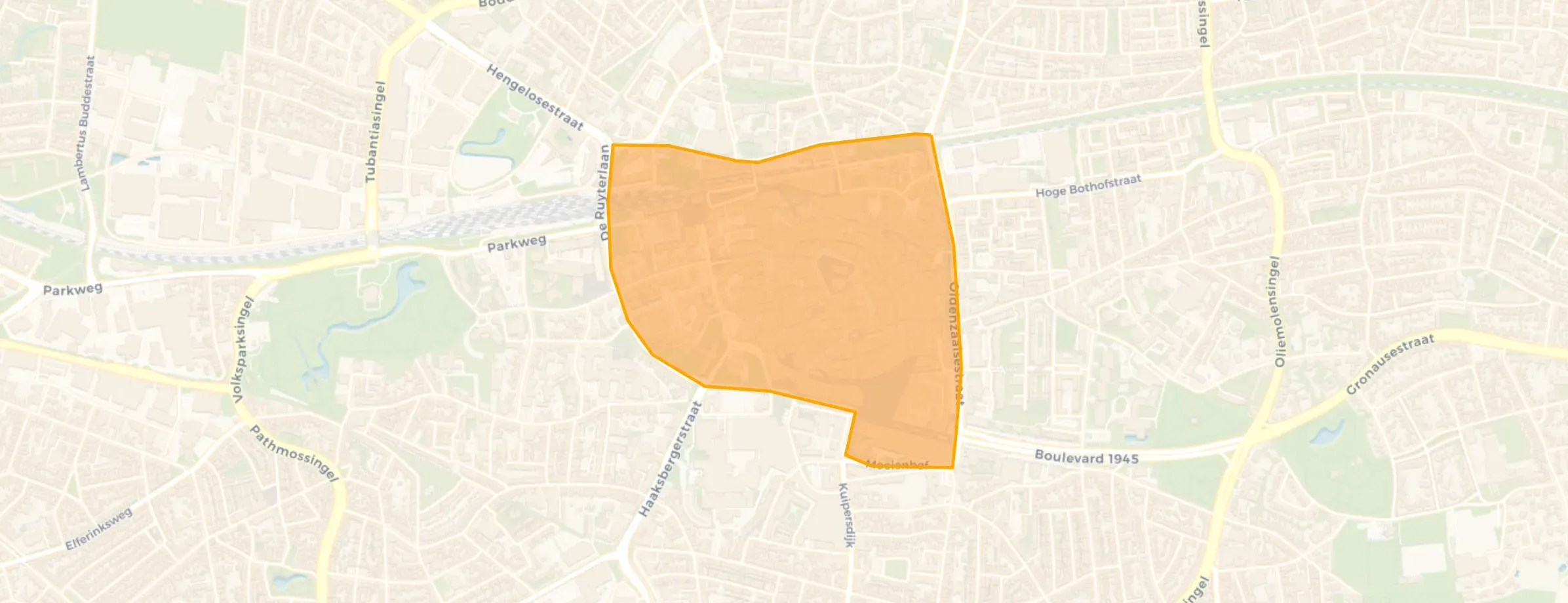
Neighbourhood in Enschede
City is located in the province of Overijssel, in the municipality of Enschede, in the district Binnensingelgebied The neighbourhood has a total area of 56 hectares, of which 56 hectares are land and 0 hectares are water. The neighbourhood is coded as BU01530000. The postcode area is 7511AA-7514EZ.
Four residents rate the neighbourhood as more than satisfactory with a score of 6.8. They describe it as 'City life', 'City with many flaws but also cosiness' and 'Living in the city centre as a student'. Residents experience big differences in this neighbourhood: amenities, safety, education receive high ratings, while greenery and cleanliness are mentioned as weak points.
City has 3.840 residents. Of these, 57,3% are men and 42,6% are women. Most residents are 25 to 45 years (39,2%). The other age groups are 30,6% for '15 to 25 years', 15,2% for '45 to 65 years', 10,9% for '65 years or older' and 4,0% for '0 to 15 years'. Of the residents, 78,6% is unmarried, 11,3% is married, 7,9% is divorced and 2,1% is widowed. 2.010 residents originate from the Netherlands, 875 come from Europe and 950 come from countries outside Europe.
There are 2.870 households in City. 77,2% of these are single-person households, 16,9% households without children and 5,9% households with children. The average household size is 1,3 persons.
In City there are 3.000 income recipients. The average income per income recipient is €27.100, which is €8.700 (24%) lower than the national average of €35.800. Per resident, the average income is €25.300, which is €3.900 (13%) lower than the national average of €29.200. Most residents of City are educated to an intermediate level. 42,2% have an intermediate education (HAVO, VWO or MBO 2-4), 39,5% have a university or higher professional education (HBO/WO) and 18,3% have a lower education (VMBO or MBO 1).
Of the 3.840 residents, around 55% are in paid employment, which amounts to 2.112 people. This is 10% lower than the national average of 65%. The majority of workers are in salaried employment (90%), while 10% are self-employed. In City, 22% of residents receive a benefit. The largest group is those receiving a state pension (AOW). 370 people receive this benefit.
In City there are 2.246 homes with an average assessed value (WOZ) of €224.000. Of these, around 90% are occupied and 10% unoccupied. Most homes are rental properties. This amounts to 93% rental homes and 7% owner-occupied homes. Of the homes, 7% privately owned, 48% owned by housing associations, 44% owned by other landlords and 1% of unknown ownership. The most common construction periods in City are 1980-1990 (26%) and 2000-2010 (12%).
There are currently 19 homes for sale in City. The most recently listed home is Mooienhof 10-106 by Prisma Era Makelaars Hengelo. Over the past year, 27 homes were sold in City. On average, a home was sold within 103 days.
The average asking price for a home for sale in City over the past year was €367.037. This is 64% higher than the average assessed value (WOZ) of €224.000. The average asking price per m² of plot is €3.496.
There are 4 homes for rent in City. The most recent home is Walstraat 16-15, offered by www.woninghuren.nl. Over the past year, 181 homes were let in City. On average, a listing was let within 19 days.
No recent rental data available for City.
In City there are 2.718 addresses with a registered energy label. The most common labels are C (25%), A (24%) and B (16%). On average, an address in City uses 1.980 kWh of electricity per year. This is 30% below the national average of 2.810 kWh. With an annual consumption of 740 m³ per address, natural gas consumption is 42% below the national average of 1.280 m³.
I've been living here for over 2 years now. Above a shop (our own shop). The neighbourhood is very friendly and tidy. Many new buildings are being built for students and first-time buyers! Everything is very close by, which is super convenient. There are many rubbish bins and also racks for deposit bottles. Great neighbourhood!!
Auto-translated to English by AIWe have a shop in the city centre... 83 years in the family. Over the years, the inner city has changed a lot! And not for the better. Demolition of beautiful buildings, many empty shop premises where unfortunately only the so-called "fortune seekers" often settle. The result is that they are empty again after a while! It is often made difficult for shopkeepers because of all the rules from the municipality. Rules thought up by gentlemen somewhere in a warm office who don't even seem to know the whole situation in the city themselves. Streets are closed, the car park in our neighbourhood closed, and that, as they say, for a higher purpose! No, it is certainly not a pleasure to be a small independent business in a city like Enschede where there is only room for large worthless chains like Primark, Sissy Boy XL and Action. No more appreciation for a decent butcher, fish or fruit shop. Very unfortunate but that is the reality in Enschede.
Auto-translated to English by AIEnschede is not really my place to live. There are a lot of junkies, people really live for themselves and there is no social cohesion. The house is easily accessible by public transport, as it is a 7-minute walk from the station. However, if you drive into the city centre by car, you can only do so between 7 and 11 o'clock. If you have your own car, you can't park it anywhere; it can be a 20-minute walk. School is very close, you have the UT, ROC van Twente and Saxion. Living in the city centre is convenient because everything is close by in terms of shops. There is also a lot of crime in the neighbourhood, young people walking around with weapons (apparently) and many junkies arguing over money and drugs. The houses in the centre are old and poorly insulated; you pay an arm and a leg for rent and gas, water, electricity. There is little greenery, although there is the city park.
Auto-translated to English by AIThe neighbourhood is cosy. Enschede is a beautiful city and I live right in the centre. The station is nearby and there is also a lovely city park a 10-minute walk from my home. A downside is that in summer the city can smell quite unpleasant, and therefore my home too. If you open the windows, it stinks quite a bit. Furthermore, you also have to deal with the noise of the nightlife from Friday to Sunday.
Auto-translated to English by AI
The housing stock is mainly post-war — 55% was built between 1945 and 1990. In addition, the most common type is flats (94%).
Over the past year a home for sale in City was listed for an average of €311,222 (€3,253 per m²). Last quarter prices fell by 30%.
A rental home in City cost an average of €1,514 per month (€17 per m²).
Residents give City a 6.8 out of 10 based on 4 reviews. Amenities stands out with a 9.3; cleanliness lags behind with a 5.3.
Buurt City has 3,840 residents. The largest age group is 25 to 45 years (39%). Notably, 77% of the households are single-person households.
From City you can on average reach a supermarket at 0.2 km, a GP at 0.6 km, a railway station at 0.8 km, a primary school at 0.7 km (as the crow flies, source: CBS).
Right now you will find 20 homes for sale and 26 homes for rent in City. A home for sale here is listed for an average of 76 days — relatively long for the current market.

Buurtje.nl uses cookies to make the site work and to improve it. In doing so, we process data such as your IP address and the pages you visit.
We use this data for three purposes: running the website (functional), measuring visits so we can improve Buurtje.nl (analytics), and — if you allow it — tailoring ads to your interests (marketing).
How we handle your data is described in our privacy policy. You can change your preferences at any time via 'Cookie preferences' at the bottom of every page.
Choose per category which cookies we may place. Read more in our privacy policy.