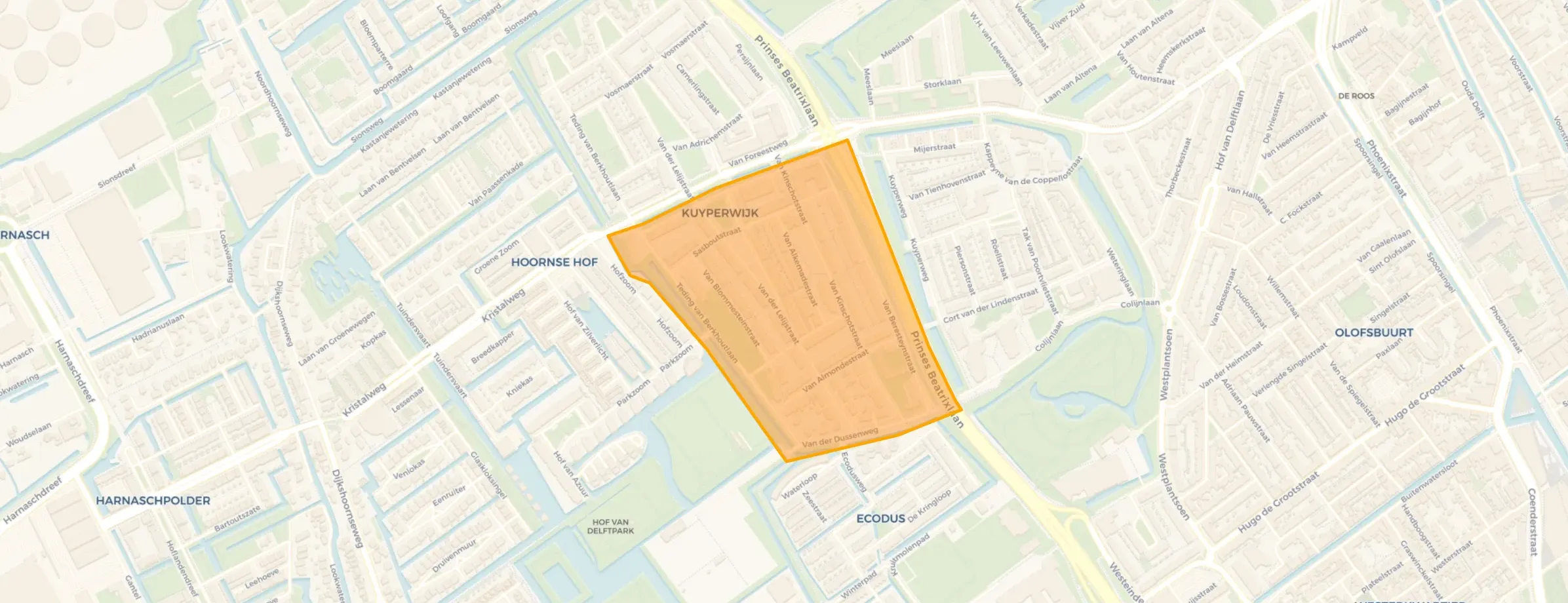
Neighbourhood in Delft
Kuyperwijk-Zuid is located in the province of Zuid-Holland, in the municipality of Delft, in the district Voordijkshoorn The neighbourhood has a total area of 17 hectares, of which 17 hectares are land and 0 hectares are water. The neighbourhood is coded as BU05031401. The postcode area is 2614BA-2614XR.
One resident rates the neighbourhood as good with a score of 7.1. The resident describes this neighbourhood as 'The neighbourhood is deteriorating terribly'. Based on a limited number of reviews, no clear trends are visible yet in this neighbourhood.
Kuyperwijk-Zuid has 1.750 residents. Of these, 47,7% are men and 52,3% are women. Most residents are 25 to 45 years (34,0%). The other age groups are 21,7% for '45 to 65 years', 15,7% for '0 to 15 years', 14,6% for '15 to 25 years' and 14,0% for '65 years or older'. Of the residents, 62,9% is unmarried, 21,1% is married, 12,9% is divorced and 3,4% is widowed. 1.030 residents originate from the Netherlands, 185 come from Europe and 535 come from countries outside Europe.
There are 1.010 households in Kuyperwijk-Zuid. 55,4% of these are single-person households, 18,3% households without children and 26,2% households with children. The average household size is 1,7 persons.
In Kuyperwijk-Zuid there are 1.400 income recipients. The average income per income recipient is €30.700, which is €5.100 (14%) lower than the national average of €35.800. Per resident, the average income is €25.200, which is €4.000 (14%) lower than the national average of €29.200. Most residents of Kuyperwijk-Zuid are educated to an intermediate level. 41,5% have an intermediate education (HAVO, VWO or MBO 2-4), 33,8% have a university or higher professional education (HBO/WO) and 24,6% have a lower education (VMBO or MBO 1).
Of the 1.750 residents, around 61% are in paid employment, which amounts to 1.068 people. This is 4% lower than the national average of 65%. The majority of workers are in salaried employment (87%), while 13% are self-employed. In Kuyperwijk-Zuid, 24% of residents receive a benefit. The largest group is those receiving a state pension (AOW). 210 people receive this benefit.
In Kuyperwijk-Zuid there are 944 homes with an average assessed value (WOZ) of €276.000. Of these, around 96% are occupied and 4% unoccupied. Most homes are rental properties. This amounts to 81% rental homes and 19% owner-occupied homes. Of the homes, 19% privately owned, 58% owned by housing associations and 23% owned by other landlords. The most common construction periods in Kuyperwijk-Zuid are 1950-1970 (79%) and 2020 and later (12%).
There are currently no homes for sale in Kuyperwijk-Zuid. The most recently listed home is Van Almondestraat 54I by Agterberg Makelaardij. No homes were sold in Kuyperwijk-Zuid over the past year.
There are currently no homes for rent in Kuyperwijk-Zuid. The most recent home is Van Kinschotstraat 166, offered by www.woonnet-haaglanden.nl. No homes were let in Kuyperwijk-Zuid over the past year.
No recent rental data available for Kuyperwijk-Zuid.
In Kuyperwijk-Zuid there are 990 addresses with a registered energy label. The most common labels are A (33%), E (20%) and B (14%). On average, an address in Kuyperwijk-Zuid uses 1.880 kWh of electricity per year. This is 33% below the national average of 2.810 kWh. With an annual consumption of 680 m³ per address, natural gas consumption is 47% below the national average of 1.280 m³.
The neighbourhood is deteriorating very quickly unfortunately. Rubbish is increasingly being dumped next to containers, more drug-using residents and their associated dealers. Hardly any parking spaces left for visitors, the surrounding neighbourhoods come here to park to avoid paid parking in their own area, the church musicians park the area full of expensive cars on Wednesday evenings. The general condition of older homes is poor despite renovation. Cracks in balconies and ceilings are hidden under coating, insulation or paint. The new-build owner-occupied homes have brought a lot of antisocial people (not from Delft) with them, making the playground less fun for the children who grew up here and leaving a lot of rubbish behind. Cars are parked on street corners, making it impossible to see as a road user. Cars are parked on passing and refuge areas, on Van Kinschotstraat, cars are half in the middle of the road up to beyond the designated parking spaces at the bus crossing. In short, the neighbourhood is increasingly busy and increasingly antisocial. Not to mention the perspective houses in between that cause nuisance. Old residents who have lived here for years and are moving because of nuisance-causing new neighbours, it's all just possible nowadays. Don't forget the housing associations, taking responsibility for overdue maintenance, serious defects and living nuisance, Stedelink and Woonbron also don't. The low flats near the bicycle tunnel are completely disfiguring the neighbourhood, people dump everything by the container or on the street there. That landlord also doesn't show himself. Enforcement is never there either and I haven't seen the neighbourhood police officer in 28 years.
Auto-translated to English by AI
The housing stock is mainly post-war — 51% was built between 1945 and 1990. In addition, the most common type is flats (91%).
Over the past year a home for sale in Kuyperwijk-Zuid was listed for an average of €534,846 (€5,304 per m²).
A rental home in Kuyperwijk-Zuid cost an average of €2,380 per month (€20 per m²).
Buurt Kuyperwijk-Zuid has 1,750 residents. The largest age group is 25 to 45 years (34%). Notably, 55% of the households are single-person households.
The housing supply in Kuyperwijk-Zuid is remarkably efficient: 59% has an A, A+ or B label. The average natural gas consumption per household is 680 m³ per year.
From Kuyperwijk-Zuid you can on average reach a supermarket at 0.5 km, a GP at 0.2 km, a railway station at 2.1 km, a primary school at 0.6 km (as the crow flies, source: CBS).

Buurtje.nl uses cookies to make the site work and to improve it. In doing so, we process data such as your IP address and the pages you visit.
We use this data for three purposes: running the website (functional), measuring visits so we can improve Buurtje.nl (analytics), and — if you allow it — tailoring ads to your interests (marketing).
How we handle your data is described in our privacy policy. You can change your preferences at any time via 'Cookie preferences' at the bottom of every page.
Choose per category which cookies we may place. Read more in our privacy policy.