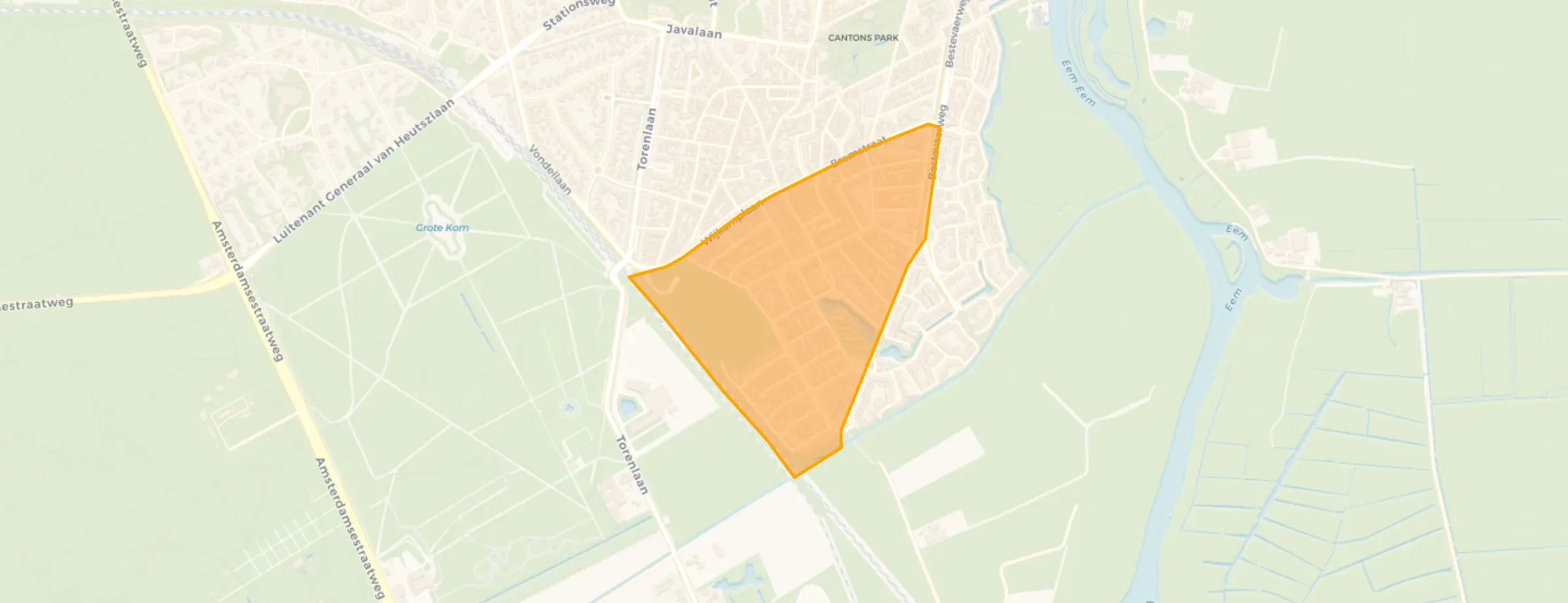
Neighbourhood in Baarn
Nieuwe-Oosterhei is located in the province of Utrecht, in the municipality of Baarn, in the district Baarn The neighbourhood has a total area of 38 hectares, of which 38 hectares are land and 0 hectares are water. The neighbourhood is coded as BU03080005. The postcode area is 3742EE-3742XX.
Two residents rate the neighbourhood as mediocre with a score of 4.9. They describe it as 'Lost piece of heath populated by junkies, criminals, antisocials, scum, trash from elsewhere or there' and 'Healthy, cultural and seniors all come together. Together with churches and schools there is always some movement in this neighbourhood'. Based on a limited number of reviews, no clear trends are visible yet in this neighbourhood.
Nieuwe-Oosterhei has 2.585 residents. Of these, 46,4% are men and 53,4% are women. Most residents are 45 to 65 years (27,1%). The other age groups are 26,7% for '25 to 45 years', 19,5% for '65 years or older', 16,4% for '0 to 15 years' and 10,3% for '15 to 25 years'. Of the residents, 48,9% is unmarried, 33,5% is married, 12,8% is divorced and 4,4% is widowed. 1.880 residents originate from the Netherlands, 135 come from Europe and 570 come from countries outside Europe.
There are 1.210 households in Nieuwe-Oosterhei. 39,3% of these are single-person households, 25,6% households without children and 35,1% households with children. The average household size is 2,1 persons.
In Nieuwe-Oosterhei there are 2.000 income recipients. The average income per income recipient is €30.200, which is €5.600 (16%) lower than the national average of €35.800. Per resident, the average income is €25.800, which is €3.400 (12%) lower than the national average of €29.200. Most residents of Nieuwe-Oosterhei are educated to an intermediate level. 45,7% have an intermediate education (HAVO, VWO or MBO 2-4), 29,3% have a lower education (VMBO or MBO 1) and 25,0% have a university or higher professional education (HBO/WO).
Of the 2.585 residents, around 63% are in paid employment, which amounts to 1.629 people. This is 2% lower than the national average of 65%. The majority of workers are in salaried employment (85%), while 15% are self-employed. In Nieuwe-Oosterhei, 27% of residents receive a benefit. The largest group is those receiving a state pension (AOW). 440 people receive this benefit.
In Nieuwe-Oosterhei there are 1.201 homes with an average assessed value (WOZ) of €335.000. Of these, around 98% are occupied and 2% unoccupied. Most homes are rental properties. This amounts to 58% rental homes and 42% owner-occupied homes. Of the homes, 42% privately owned, 56% owned by housing associations and 2% owned by other landlords. The most common construction periods in Nieuwe-Oosterhei are 1950-1970 (56%) and 1980-1990 (12%).
There are currently no homes for sale in Nieuwe-Oosterhei. The most recently listed home is Wijkamplaan 59 by Bos Makelaardij o.g.. No homes were sold in Nieuwe-Oosterhei over the past year.
There are currently no homes for rent in Nieuwe-Oosterhei. The most recent home is Dotterbloemlaan 18, offered by Huispedia. No homes were let in Nieuwe-Oosterhei over the past year.
No recent rental data available for Nieuwe-Oosterhei.
In Nieuwe-Oosterhei there are 1.243 addresses with a registered energy label. The most common labels are C (28%), A (20%) and B (15%). On average, an address in Nieuwe-Oosterhei uses 2.200 kWh of electricity per year. This is 22% below the national average of 2.810 kWh. With an annual consumption of 900 m³ per address, natural gas consumption is 30% below the national average of 1.280 m³.
Better stay away, then you don't have to witness or experience the dull misery. Nobody misses anything!
Auto-translated to English by AIBorn and raised in this neighbourhood where many cultural people and churches come together. Schools and childcare also a large playground.. for children. Community centre and associations also present. Supermarket within walking distance. Also a nice park that is closed at night. And yes also a cemetery and a funeral home in the neighbourhood. Medical centre also there with pharmacy, physio and dentist and GPs. Accessible for everyone. From young to old lives here. People know each other, or not, but that is usually what the person wants themselves. Parking is a bit of an issue, but there is usually a spot. Most houses were built just after the war. Grew quickly until 1980. After that time buildings were replaced or renovated. 3 emergency homes for refugees since this year. This neighbourhood is absolutely not boring or quiet... 24 hours there is movement... I wouldn't want to leave here soon. Public transport unfortunately gone, but maybe that will come back a bit. All in all you can be born here and die. Only downside is that there are hardly any things for young people aged 14 to 21. They then look further than the neighbourhood. But complain about this neighbourhood no I cannot do that. A few more bins and a better mentality in cleaning up could sometimes use a lesson here, but that is more for the municipality.... Also the preservation and protection of greenery could be better from the municipality.
Auto-translated to English by AIThe most common type is terraced houses (52%).
Over the past year a home for sale in Nieuwe-Oosterhei was listed for an average of €708,676 (€5,401 per m²).
A rental home in Nieuwe-Oosterhei cost an average of €1,834 per month (€18 per m²).
Buurt Nieuwe-Oosterhei has 2,585 residents. Many families: 35% of the households have children.
A considerable share of the supply in Nieuwe-Oosterhei is less efficient: 29% has an E, F or G label. The average natural gas consumption per household is 900 m³ per year.
From Nieuwe-Oosterhei you can on average reach a supermarket at 0.3 km, a GP at 0.8 km, a railway station at 1.6 km, a primary school at 0.5 km (as the crow flies, source: CBS).