Homes for sale in D-buurt, Amsterdam
Discover available homes for sale in D-buurt and compare prices, neighbourhood scores, and resident reviews. View the current listings directly on this page.


House prices and market figures for D-buurt, Amsterdam
D-buurt is primarily a rental neighbourhood. As many as 99% of the 1,681 homes are rental properties, the majority of which are owned by other landlords (75%) and a quarter by a housing association. Owner-occupied homes are rare here: only 1% of the stock is owner-occupied. This makes supply scarce and the market dynamics interesting to understand well.
The average WOZ value in D-buurt is €58,000, which differs significantly from the district average in Amsterdamse Poort en omgeving (€226,000) and is well below the Amsterdam average of €517,000. This low WOZ value reflects the composition of the housing stock: it largely concerns social rental homes, not owner-occupied homes at market prices.
Nevertheless, three homes were sold in D-buurt in the past twelve months, with an average purchase price of €423,333. The range ran from €350,000 to €525,000, with an average living area of 63 m². That works out to approximately €6,720 per square metre, which is not exceptional for Amsterdam. For current asking prices and availability of owner-occupied homes in D-buurt, you can consult the overview at the top of this page. Would you like to compare with the broader supply? Then also check out the owner-occupied homes in Amsterdamse Poort en omgeving.
Living in D-buurt, Amsterdam
D-buurt is located in the southeast of Amsterdam, in the district of Amsterdamse Poort en omgeving. It is a compact, urban neighbourhood with a distinct character: young, busy and functional. The population largely consists of young people between 15 and 25 years old, which determines the atmosphere on the street. Students and young adults dominate the streetscape, with many single-person households and few families. Only 5% of residents are married, giving the neighbourhood a temporary and transient character.
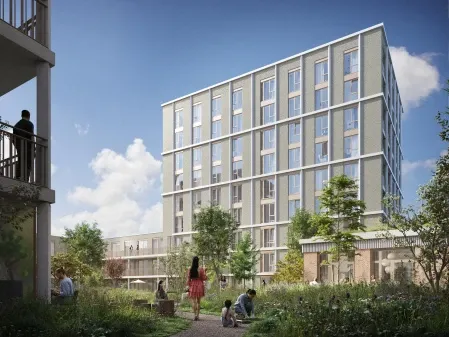
In terms of buildings, it mainly involves apartment blocks from the 1970s and 1980s, characteristic of the large-scale expansion districts that Amsterdam built during that period. The architecture is functional and sober, not particularly iconic. Resident Gabriel describes the neighbourhood as "very cosy and lots of nature", indicating that the green space in and around the neighbourhood offers more than the facades suggest. Sub-scores from residents confirm this: greenery scores a 7.5, which is relatively high.
In terms of amenities, the neighbourhood scores well. In the immediate vicinity you will find Amsterdamse Poort shopping centre, one of the largest shopping centres in Amsterdam, with supermarkets, shops, a library and catering establishments. This explains the high amenities score of 8.0. For education, the neighbourhood scores a 7.5, indicating a reasonable supply of schools in the area. The municipality of Amsterdam offers an overview of schools, healthcare facilities and neighbourhood activities in this part of the city at amsterdam.nl.
Accessibility is a clear plus point, with a score of 8.0. Ganzenhoef metro station and Duivendrecht station are a short distance away, allowing you to quickly reach the city centre or Schiphol. The A10 ring road is also easily accessible, and several bus routes run through the neighbourhood. Resident JRP describes it as "easy accessibility to the rest of the country", and that is correct: the southeast of Amsterdam is a logical base for those who commute or travel.
The overall resident rating stands at 7.2 out of 10, based on reviews via the neighbourhood main page of D-buurt. The lowest sub-score is beauty (6.0), which aligns with the image of a functional flat neighbourhood without much architectural charm. Safety scores a 7.0, which is acceptable for an urban neighbourhood but not exceptional.
Compared to neighbouring communities such as F-buurt and Nelson Mandelapark, D-buurt has a similar character: predominantly rental homes, a young population and good public transport connections. Those looking for more greenery and a quieter atmosphere can also look at Vogeltjeswei, which is slightly on the edge of the district.
Who is an owner-occupied home in D-buurt interesting for?
Given the demographics and the scarcity of owner-occupied homes, D-buurt is not an obvious choice for families or seniors. It is more a neighbourhood for starters or young buyers who consciously choose a central location in the southeast of Amsterdam, with good public transport connections and short travel times. Supply is limited: on average, only a handful of homes are sold per year, so those who want to buy must be patient and able to act quickly. Buying a home in D-buurt requires realistic expectations: the homes are compact (average 63 m²) and prices are around €423,000. Those who want to be more flexible can also check out the rental homes in D-buurt as an alternative.
What residents say about D-buurt
The neighbourhood receives an average rating of 7.2 out of 10, based on resident experiences. Accessibility (8.0) and amenities (8.0) are the strongest points. Beauty (6.0) and housing (6.5) score the lowest. JRP writes about a "safe atmosphere with sufficient facilities", while Gabriel calls the neighbourhood "unexpectedly good". That word "unexpectedly" is telling: D-buurt may not make a special impression at first glance, but those who live there appreciate the practical qualities. All reviews and sub-scores can be found on the information page of D-buurt.
Compare owner-occupied homes in and around D-buurt
Buurtje.nl bundles housing supply from more than 1,500 sources and combines that with resident reviews and neighbourhood data, so you not only search for a home but also understand whether the neighbourhood suits you. Would you like to compare more broadly? Then check out the supply in Amsterdamse Poort or explore owner-occupied homes in Amsterdam as a whole. Those considering a completely different type of neighbourhood can also look at Jordaan or Haarlemmerbuurt for a comparison of atmosphere and price.
Frequently asked questions
What is the cost of a home in D-buurt?
The average purchase price in D-buurt over the past year was €423,333, with a range of €350,000 to €525,000. The average living area was 63 m², which works out to about €6,720 per square metre. Supply is scarce: only a few homes are sold in this neighbourhood each year.
What is the WOZ value in D-buurt?
The average WOZ value in D-buurt is €58,000. That is significantly lower than the district average of Amsterdamse Poort and surroundings (€226,000) and well below the Amsterdam average of €517,000. The low WOZ value reflects the fact that the neighbourhood consists almost entirely of rental properties, including many social housing units.
What is it like to live in D-buurt?
D-buurt is a young, urban neighbourhood in the southeast of Amsterdam with a functional character. The area attracts many students and young adults and has good accessibility and a wide range of amenities. Residents give the neighbourhood an average score of 7.2 out of 10. Accessibility and amenities score highest; beauty and housing score lowest.
Is D-buurt suitable for first-time buyers?
D-buurt can be interesting for first-time buyers who consciously choose the southeast of Amsterdam, with good public transport connections and centrally located shops. However, the supply of owner-occupied homes is very limited: only 1% of the housing stock is owner-occupied. First-time buyers should expect an average purchase price of over €420,000 and a compact living area averaging 63 m².
How is the accessibility of D-buurt?
The accessibility of D-buurt is good and receives a score of 8.0 out of 10 from residents. Ganzenhoef metro station and Duivendrecht station are a short distance away, with direct connections to Amsterdam city centre and Schiphol. The A10 ring road is quickly accessible for motorists. Several bus routes run through the neighbourhood, which also facilitates daily commuting.
What type of homes are for sale in D-buurt?
The housing stock in D-buurt mainly consists of flats from the 1970s and 1980s. Owner-occupied homes are rare in this neighbourhood: only 1% of the housing stock is owner-occupied. The homes that are sold are relatively compact with an average area of 63 m². Buying an apartment in D-buurt is therefore the most common type of transaction.
Is D-buurt safe?
Residents rate safety in D-buurt at 7.0 out of 10. That is an average score for an urban neighbourhood in Amsterdam. Resident JRP describes the atmosphere as "safe" and mentions sufficient facilities in the area. Those who want to know more about safety and liveability can consult the resident reviews on the D-buurt neighbourhood homepage.
Lively atmosphere with sufficient facilities and easy accessibility to the rest of the country.
Auto-translated to English by AIVery cosy and lots of nature
Auto-translated to English by AI