Neighbourhood in Tiel
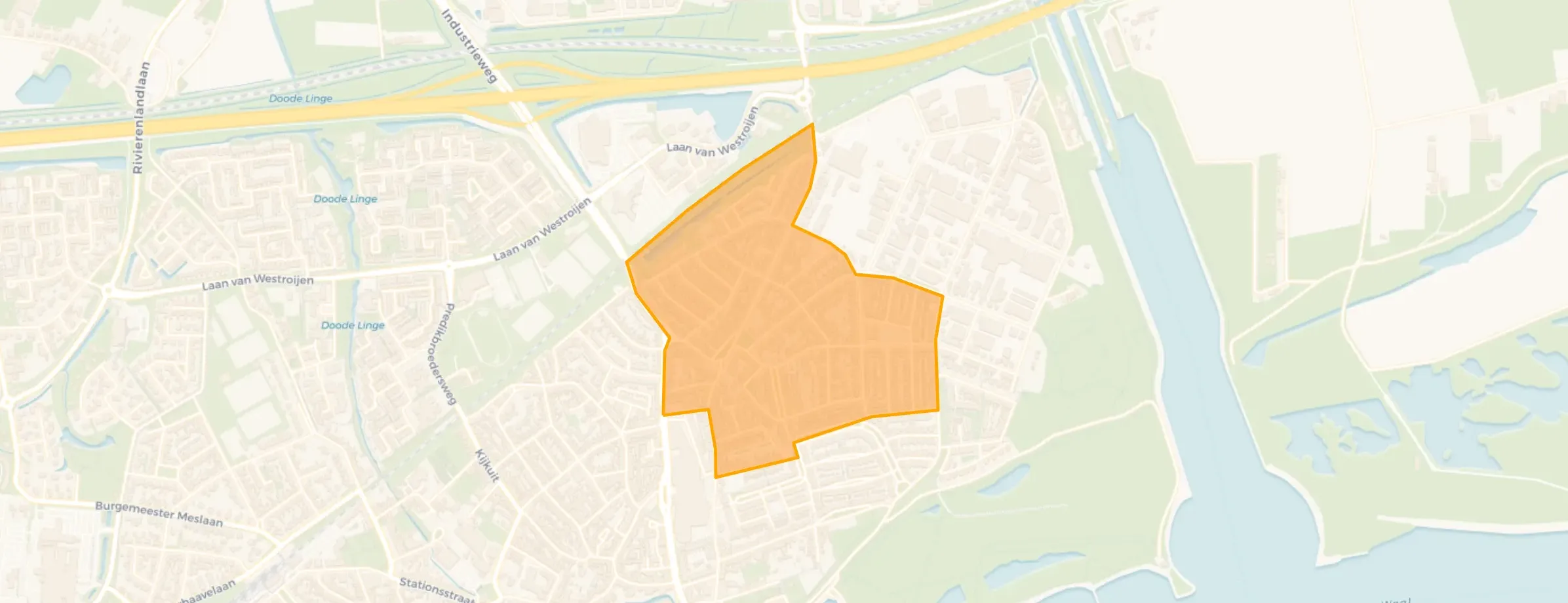
Het Ooij is located in the province of Gelderland, in the municipality of Tiel, in the district Tiel kern The neighbourhood has a total area of 42 hectares, of which 42 hectares are land and 0 hectares are water. The neighbourhood is coded as BU02810007. The postcode area is 4005AB-4005VZ.
Two residents rate the neighbourhood as good with a score of 7.8. They describe it as 'It's a nice neighbourhood but not much happens' and 'You can always count on each other'. Based on a limited number of reviews, no clear trends are visible yet in this neighbourhood.
Het Ooij has 3.110 residents. Of these, 48,9% are men and 51,3% are women. Most residents are 45 to 65 years (28,5%). The other age groups are 28,3% for '25 to 45 years', 18,0% for '0 to 15 years', 14,0% for '65 years or older' and 11,4% for '15 to 25 years'. Of the residents, 50,2% is unmarried, 36,5% is married, 9,5% is divorced and 3,9% is widowed. 1.935 residents originate from the Netherlands, 295 come from Europe and 885 come from countries outside Europe.
There are 1.365 households in Het Ooij. 34,8% of these are single-person households, 24,9% households without children and 40,3% households with children. The average household size is 2,3 persons.
In Het Ooij there are 2.400 income recipients. The average income per income recipient is €27.200, which is €8.600 (24%) lower than the national average of €35.800. Per resident, the average income is €22.900, which is €6.300 (22%) lower than the national average of €29.200. Most residents of Het Ooij are educated to a lower level. 46,0% have a lower education (VMBO or MBO 1), 41,8% have an intermediate education (HAVO, VWO or MBO 2-4) and 12,2% have a university or higher professional education (HBO/WO).
Of the 3.110 residents, around 61% are in paid employment, which amounts to 1.897 people. This is 4% lower than the national average of 65%. The majority of workers are in salaried employment (89%), while 11% are self-employed. In Het Ooij, 24% of residents receive a benefit. The largest group is those receiving a state pension (AOW). 370 people receive this benefit.
In Het Ooij there are 1.294 homes with an average assessed value (WOZ) of €264.000. Of these, around 99% are occupied and 1% unoccupied. Most homes are rental properties. This amounts to 59% rental homes and 41% owner-occupied homes. Of the homes, 41% privately owned, 55% owned by housing associations and 4% owned by other landlords. The most common construction periods in Het Ooij are 1950-1970 (48%) and 1990-2000 (10%).
There are currently 5 homes for sale in Het Ooij. The most recently listed home is Wielewaallaan 31 by Dolron Rivierenland Makelaars. Over the past year, 34 homes were sold in Het Ooij. On average, a home was sold within 38 days.
The average asking price for a home for sale in Het Ooij over the past year was €412.015. This is 56% higher than the average assessed value (WOZ) of €264.000. The average asking price per m² of plot is €3.679.
There are currently no homes for rent in Het Ooij. No homes were let in Het Ooij over the past year.
No recent rental data available for Het Ooij.
In Het Ooij there are 1.298 addresses with a registered energy label. The most common labels are C (23%), B (20%) and D (18%). On average, an address in Het Ooij uses 2.640 kWh of electricity per year. This is 6% below the national average of 2.810 kWh. With an annual consumption of 1.010 m³ per address, natural gas consumption is 21% below the national average of 1.280 m³.
I get along well with all my neighbours and I also like that there are several schools in the area
Auto-translated to English by AISafe neighbourhood, lovely people, very hospitable and above all very cosy. They were always there for us. To help us. Everything is quickly accessible and a nice path has been laid with planters in between to reduce speed. The baker, butcher, chip shops, supermarkets and the shopping centre are nearby.
Auto-translated to English by AIThe most common type is terraced houses (58%).
Over the past year a home for sale in Het Ooij was listed for an average of €391,874 (€3,924 per m²).
A rental home in Het Ooij cost an average of €1,260 per month (€17 per m²).
Buurt Het Ooij has 3,110 residents. Many families: 40% of the households have children.
A considerable share of the supply in Het Ooij is less efficient: 29% has an E, F or G label. The average natural gas consumption per household is 1,010 m³ per year.
From Het Ooij you can on average reach a supermarket at 1.0 km, a GP at 2.0 km, a railway station at 2.2 km, a primary school at 0.3 km (as the crow flies, source: CBS).