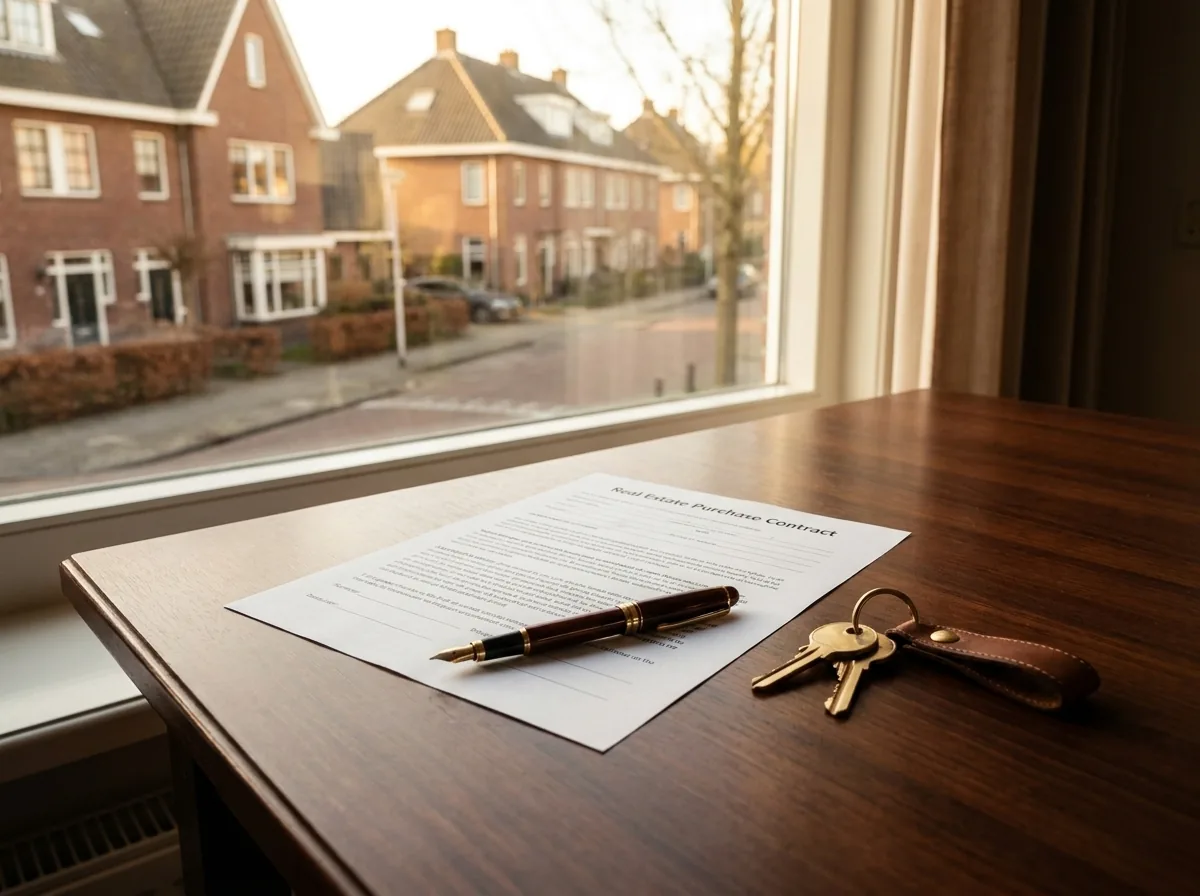
Your offer has been accepted. It feels like the finish line, but legally it is only the start. Within a few days the koopakte (purchase agreement) is ready for you, often called the voorlopig koopcontract or preliminary purchase agreement. What it says determines whether you can walk away unharmed if your mortgage falls through, and what it costs if you do so too late. This is what you need to know before you sign.
A verbal agreement is not yet a sale
When a private individual buys a home in the Netherlands, the sale must be put in writing. A verbal agreement with the estate agent is therefore not yet binding for you as the buyer: only the signed purchase agreement counts. That is also when all arrangements about price, transfer date, movable items and conditions become final. So check that everything you agreed is actually in it.
The statutory cooling-off period
After signing, you as the buyer have a three-day cooling-off period. It starts on the day after you receive a copy of the signed agreement. If it ends on a weekend or public holiday, it runs until the next working day. Within that time you can withdraw from the purchase without giving a reason and at no cost. Do so in writing, so there can be no dispute. The seller does not have a cooling-off period.
Three days is short. Do not use them to reconsider whether you want the house at all, but to check things you were not yet sure about, such as a final conversation with your mortgage adviser.
Deposit or bank guarantee
Almost every purchase agreement states that you must provide security within a few weeks, usually 10 percent of the purchase price. That can be a deposit paid into the notary's account, or a bank guarantee arranged through your bank. A bank guarantee costs a small one-off fee, but you do not have to put the money down yourself. At the transfer, the deposit is offset against the purchase price.
Conditions precedent: your emergency exit
With an ontbindende voorwaarde (a condition allowing cancellation), you can cancel the purchase at no cost if something falls through. The most important ones:
- Financing condition: if you cannot get the mortgage, you can cancel. Check the amount stated (it must match what you actually need) and the deadline. You can only cancel until that date, with a written rejection from at least one lender.
- NHG condition: if you want a mortgage with the National Mortgage Guarantee, include it explicitly.
- Building inspection: if you have not had the home inspected yet, you can cancel if serious defects above an agreed amount come to light. More on this in our blog on the building inspection.
- Sale of your current home: less common, and sellers rarely agree to it in a tight market, but it is possible.
In a market where many buyers bid over asking, you see buyers dropping conditions to make their offer more attractive. That is a risk you should take consciously. Read our blog on overbidding before you do.
What if you pull out too late?
Once the cooling-off period has passed and you cannot invoke a condition, you are bound to the purchase. If you fail to meet your obligations, the seller can claim a penalty. It is set out in the agreement and is usually 10 percent of the purchase price. On a €450,000 home that is €45,000. That is why the deadline of your financing condition matters so much: put it in your calendar and agree with your adviser when you need a binding offer at the latest.
Have the agreement registered
The notary can register the purchase agreement in the public registers of the Kadaster (Land Registry). That protects you between signing and transfer, for example if the seller goes bankrupt or the property is seized. It costs a few hundred euros and is certainly worth it when there is a long period until the transfer.
Always check these points
- The list of items: what stays and what the seller takes, from curtains to the kitchen.
- Age and asbestos clauses: in older homes, these limit the seller's liability for defects.
- The transfer date: does it fit with giving notice on your rental or selling your current home?
- For an apartment: the statements about the VvE, and for erfpacht the details of ground rent and period.
If you are unsure about a clause, ask your buying agent or the notary to explain it before you sign, not after. Then come the mortgage, the notary and finally the key handover.